• Tentang UGM
  • Portal Akademik
  • Pusat TI
  • Perpustakaan
  • Penelitian
Universitas Gadjah Mada
  • About Us
    • About CRCS
    • Vision & Mission
    • People
      • Faculty Members and Lecturers
      • Staff Members
      • Students
      • Alumni
    • Facilities
    • Library
  • Master’s Program
    • Overview
    • Curriculum
    • Courses
    • Schedule
    • Admission
    • Scholarship
    • Accreditation and Certification
    • Academic Collaborations
      • Crossculture Religious Studies Summer School
      • Florida International University
    • Academic Documents
    • Student Satisfaction Survey
  • Article
    • Perspective
    • Book Review
    • Event Report
    • Class Journal
    • Interview
    • Wed Forum Report
    • Thesis Review
    • News
  • Publication
    • Reports
    • Books
    • Newsletter
    • Monthly Update
    • Infographic
  • Research
    • CRCS Researchs
    • Resource Center
  • Community Engagement
    • Film
      • Indonesian Pluralities
      • Our Land is the Sea
    • Wednesday Forum
    • ICIR
    • Amerta Movement
  • Beranda
  • Wednesday Forum News
  • page. 22
Arsip:

Wednesday Forum News

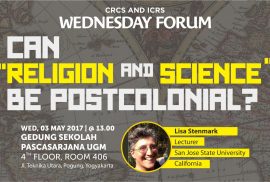
Can “Religion and Science” Be Postcolonial?

HeadlineNewsWednesday Forum News Wednesday, 26 April 2017


Abstract
In the late-15th to mid-16th century, Europe experienced three revolutions: a geographical revolution (“voyages of discovery” and colonial expansion); a religious revolution (the Protestant Reformation) and a Scientific Revolution. Within the religion and science discourse, the relationship between two of these revolutions—the Protestant Reformation and the Scientific Revolution—has been much studied, while the third revolution has been ignored. As a result, the ghosts of colonialism still haunt us. This presentation will explore the ways considerations of the third revolution—and postcolonial perspectives—broaden out understanding and expand the discourse, with special attention to the contributions of postcolonial Science Fictions.
Speaker
Lisa Stenmark is author of Religion, Science and Democracy: A Disputational Friendship, and co-editor (with Whitney Bauman) of Religion, Science and Queer Theory, part of a series Religion and Science as a Critical Discourse. She teaches at San Jose University and, in her spare time, she practices Aikido (in which she has a Black Belt) and other martial arts, trains triathlons and is an avid Science Fiction fan.
Look at the full poster of the event here.
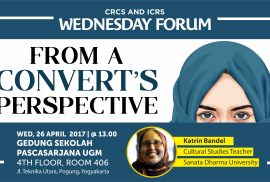
From a Convert's Perspective

HeadlineNewsWednesday Forum News Thursday, 20 April 2017


Abstract
Positionality is an important issue in the humanities and social sciences today. What is the relationship of the researcher to the topic she/he is discussing? From what position does she/he speak? To me personally as European living and working in Indonesia, this has always been challenging question. It has become even more complex and challenging since I converted to Islam. Only one essay in my newest book (2016) is explicitly about this, but basically the book is written from the perspective of someone in the process of crossing over (converting) and reflects on the ambivalence of this process.
Speaker
Katrin Bandel was born in 1972 in Wuppertal, Germany. She has been living in Yogyakarta since 2002, where she teaches at the Master Program for Religious and Cultural Studies at the Sanata Dharma University. She has published three books, the newest of which is Kajian Gender dalam Konteks Pascakolonial (2016).
Look at the full poster of the event here.

Perceiving Islam and Muslims in Poland in the context of the European refugee crisis

HeadlineNewsWednesday Forum News Wednesday, 12 April 2017


Abstract
The EU countries have been inefficiently managing the latest European migrant crisis, among them Poland was particularly unsuccessful. Contemporary discourse on refugees from the Middle East in Poland revolves around the following issues: the danger of altering Polish culture, the increase of the likelihood of terrorism, and the postulate of empathy towards people threatened by war. The religious factor plays a significant role in this discourse, since refugees who come from predominantly Muslim countries from a group of special interest in this Catholic-majority state. Halina Grzymała-Moszczyńska, Adam Anczyk, and Anna M. Maćkowiak have examined, qualitatively, how Poles perceive Islam, and how this image may be associated with attitudes towards refugees. The aim of this study was to analyze narratives about Islam and the religious Other, emerging from partially structured interviews. The questionnaire, containing citations from the Bible, the Quran, and the Bhagavad Gita served as the trigger for interviews conducted after filling it out.
Speaker
Anna M. Maćkowiak is a doctoral student at the Department of Phenomenology and Anthropology of Religion, Institute for the Study of Religions, Jagiellonian University, Krakow. Currently she is beginning to realization of her individual research grant (Preludium) concerning constructing meanings of selected Indonesian religious rituals by hosts, tourists, and travellers. Her academic interests and activities pertain also to inter-religious relations, religious syncretism, and the influence of religions on daily life of Indonesian and Poles.
Look at the full poster of the event here.

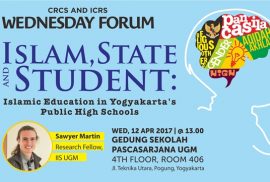
Islam, State and Student: Islamic Education in Yogyakarta’s Public High Schools

HeadlineNewsWednesday Forum News Friday, 7 April 2017


Abstract
One of the most significant ways the Indonesian state plays an active role in the country’s religious life is through education: Muslim students at all levels are required to take Islamic education classes, for which the government writes curricula and employs teachers. Therefore, the state—from the center at the Ministry of Religious Affairs to the periphery at individual teacher at public schools—has considerable power to shape religious perspectives of each new generation. His ongoing research is an ethnographic study of Islamic education in public high schools (Sekolah Menengah Atas Negeri) in the province of Yogyakarta, carried out through classroom observation, teacher interviews, and student focus groups. He will present the characteristics and effects of Islamic education in three fields: (a) perspective of religious diversity within Islam; (b) the valorization of the democratic nation-state as Islamic; and (c) the gender ideologies promoted as normatively Islamic. It is also noted how these phenomena vary in and among schools, noting the influence of socio-economic class, education, gender and religious background.
Speaker
Sawyer Martin French is research fellow at the Institute for International Studies at the Faculty of Social and Political Sciences at Universitas Gadjah Mada. He is currently conducting a yearlong research project on Islamic education in public high schools in Yogyakarta with the support of a grant in socio-cultural anthropology from the National Science Foundation.
Look at the full poster of the event here.
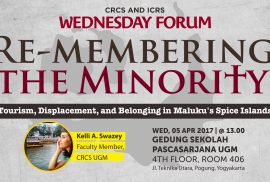
Re-membering the minority: tourism, displacement, and belonging in Maluku's Spice Islands

HeadlineNewsWednesday Forum News Monday, 3 April 2017


Abstract
In post-conflict Maluku, there has been renewed interest in redeveloping the Banda Islands as a major tourist attraction for the region, and as a world heritage site. As practices of tourism represent culture for diverse audiences, they also inform how local inhabitants conceptualize their identities, as well as influence the processes of collective memory. The Indonesian concepts of culture draw on relationships to land, community and cosmology referred to as adat that have a dynamic and complex relationship to people’s religious identifications. In this talk, I’ll explore how Christians displaced from the Banda islands during the conflict are being “re-membered” as outsiders in the process of reconstructing culture for the consumption of tourists, and consider how representations of culture for the tourism industry can potentially strengthen exclusive versions of local identity.
Speaker
Kelli Alicia Swazey is a faculty member at the Center for Religious and Cross-Cultural Studies at the Graduate School of Universitas Gadjah Mada. She holds a PhD in Cultural Anthropology from the University of Hawai’i Manoa. Her research focuses on identity in the public sphere, representation and the media, minority religions in Indonesia, and religion and tourism. She has designed several programs on diversity in Southeast Asia, and has been a featured TED speaker and a fellow of the INK (Innovation and Knowledge) program. 
Look at the full poster of the event here.

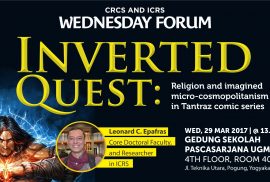
Inverted Quest: Religion and imagined micro-cosmopolitanism in Tantraz comic series

HeadlineNewsWednesday Forum News Thursday, 23 March 2017


Abstract
As suggested by Ben Anderson, media is a powerful means in creating imagined community and accordingly in establishing a sense of cosmopolitanism. Taking this insight, the presentation will explore the rethoric represented in the series of comic under the title Baladeva, published by Tantraz Comiks (/Comics) Bali, Denpasar. The comic will be framed within the notion of micro-cosmopolitanism—a cosmopolitanism from below (Cronin, 2006)—through which the pressing questions of imagination of nationalism and cosmopolitanism, counter-transnational religious discourse, and religious minority are played out. Contemplating the present day contestation between nationalism and transnationalism discourse, understanding contemporary comics to a degree might illuminate the shift in the present Indonesia, notably from the perspective of popular culture.
Speaker
Leonard Chrysostomos Epafras is a core doctoral faculty and researcher at the Indonesian Consortium for Religious Studies, at the Graduate School of UGM. His research projects include Jewish Studies, Digital Humanities, and Pop-Culture Studies.
Look at the full poster here.

1…2021222324…61

Instagram

Much has been said about faith and ecology—but one Much has been said about faith and ecology—but one question often slips through the cracks: who is actually paying for it?
Behind every conservation effort, there are financial choices, priorities, and actors shaping what is possible. This talk with dives  into the often-overlooked terrain of sustainable financing in the intersection of religion, ecology, and conservation in Indonesia. 
Come and join in a thought-provoking discussion with @sofjandicky at UGM Graduate School building, 3rd floor. We provide snacks and drinks, don't forget to bring your tumbler. This event is free and open to public.
Kuliah itu SCAM? Apa sih bedanya SCAM versi anak Kuliah itu SCAM?

Apa sih bedanya SCAM versi anak CRCS UGM?
 #skill #connection #attitude #mindset #fyp
B A T A S Ada momen ketika agama hadir sebagai ba B A T A S 
Ada momen ketika agama hadir sebagai bahasa terakhir untuk bertahan. Seperti perempuan-perempuan di Sudan yang mempertanyakan apakah bunuh diri bisa menjadi jalan pulang yang lebih manusiawi daripada hidup dalam kekerasan. Ini merupakan situasi ekstrem ketika dosa dan keselamatan tidak lagi nyata dalam keseharian sementara dunia memilih diam. Pada titik itu, mereka memilih untuk berbicara "langsung" kepada Tuhan melalui jalan yang kelam.

Simak refleksi @safinatul_aula tentang bunuh diri dan agensi "kesalehan" di situs web crcs
A N G K E R Makam menjadi ruang pisah antara yang A N G K E R
Makam menjadi ruang pisah antara yang hidup dan mati. Mereka yang masih bernyawa melanjutkan cerita, mereka yang mati bersemayam di makam. Pada titik ini, makam memisahkan antara yang sakral dan profan, yang adi kodrati dan yang sehari-hari. Namun, makam juga menjadi ruang jumpa antarkeduanya. Yang hidup menceritakan ulang kisah yang meninggal sehingga mendiang terus mengada. Selama kisah diceritakan dan nama terus diumbulkan ke langit, selama itu pula mereka mengabadi. Karenanya, makam itu angker, sebuah jangkar yang menakutkan dan menautkan sekaligus. 

Simak catatan lapangan @yohanes_leo27 terkait makam di situs web crcs.
Follow on Instagram

Twitter

Tweets by crcsugm

Universitas Gadjah Mada

Gedung Sekolah Pascasarjana UGM, 3rd Floor
Jl. Teknika Utara, Pogung, Yogyakarta, 55284
Email address: crcs@ugm.ac.id


© CRCS - Universitas Gadjah Mada

KEBIJAKAN PRIVASI/PRIVACY POLICY