Abstract
Starting with a discussion of goddesses presenting “her stories” of water and land, my presentation delves more deeply into ideas of natural femininity that often lost in present ways of writing “his-story. It is devoted to showing how can turn distant knowledge of a faraway past into touching individual memories for us who hear the spirits speaking through our bodies, our sexualities, trees, plants, animals, land, and water—this is in stark contrast to the homogenizing and brutal knowledge that sees nature as a mere ‘natural resources’ and the threat of ‘natural disaster’. My description of oikophilia will connect our reckless pursuit of individual gratification that jeopardizes our mother Earth and aid in un-learning oppressive myths toward women’s roles in natural preservation, and thus exposing the fundamental problem that all people need a philosophy of conservation.
Wednesday Forum News
=&0=&
The relation between people’s perceptions of pollution (of Upper Citarum river) and purification (in Islamic teaching and local narratives) and their practices of water use.
Growing population and excessive urbanization in West Java has led to an increased demand for water and space, bringing with it significant problems related to water in and around the Upper Citarum River basin. The environmental burden is making the Citarum one of the most polluted rivers in the world. More effective water management and attention to public health has been perceived as the best way to overcome the problem, but that approach puts aside local views on the sacred nature of the river’s water. Hence it is is necessary to focus on the nexus between development and religion as concerns water. This presentation will search for the answer in how Muslims in the Upper Citarum Basin perceive the river as (un)clean and how their behavior is influenced by their understandings of pollution and purification.
Speaker
Haryani Saptaningtyas is a researcher and member of the advocacy staff of Percik Institute, Salatiga. She completed her master degree in Social and Cultural Anthropology, Vrije Universiteit, Amsterdam, The Netherlands. Since 1997, she has been actively involved in social and enviromental research. Currently she is a Ph.D. candidate in the Faculty of Philosophy, Theology and Religious Studies at Radboud University Nijmegen, where she is working on an interdisciplinary research project entitled “Water, Health and Development at Upper Citarum River Basin.”

Abstract
The return of capital invites the return of marxism. As a set of epistemological and theoretical tools for understanding capitalism and changing it, Marxism suffers from lack of adequate presentation amid the Indonesian academia and is often discredited as obstinately “ideological”, “dogmatic” or simply “utopian”. On the other hand, suspicion over Marxism and its emancipatory practice is widespread among religious discourses. Indeed, Marxism is often understood as the antithesis of religion. Should Islam renounce Marxism and embrace the “truth” of Capital while letting itself be corrupted by Capital? Could Marxism be a viable way of restoring the liberating messages of Islam?

Abstract
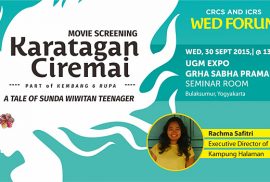
Sunda Wiwitan is an indigenous religion of that is practiced by some Sundanese people in Cigugur, Kuningan, West Java. Although the state recognizes this spiritual practice as an aliran kepercayaan, or a recognized belief organization, this community still faces discrimination for practicing their ancestral religion both from the state and from members of the religious majority in their surrounding social environment.
This fifteen-minute documentary tells the story of Anih, a 14 year old Sunda Wiwitan girl, and how she faces the challenges of the societal reactions to being part of a family of Sunda Wiwitan followers.
Karatagan Ciremai is of one of six documentaries of the Kembang 6 Rupa series, a collaborative documentary project voicing girls’ points of view from six areas in Indonesia: Kuningan, Indramayu, Sleman, Sumedang, Sumbawa and Wamena.