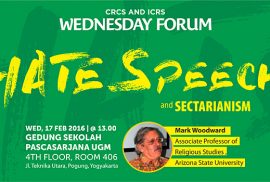
 Two of the most challenging questions faced by those promoting freedom of speech is to what extent speech is free and whether there are kinds of speech which should be restricted. Very often this brings about a dilemma, since restriction can be seen as the opposite of freedom. This is partly because there are people who can utilize the freedom of speech to spread hatred or incite harm to other people or to the well-being of society in general. The question: Is there room for hate speech within free speech? How should hate speech be defined? On February 15, 2016, CRCS student Azis Anwar Fachrudin interviewed Mark Woodward on the question of religious hate speech. Woodward is Associate Professor of Religious Studies at Arizona State University (ASU) and is also affiliated with the Center for the Study of Religion and Conflict there. He was a Visiting Professor, teaching at the Center for Religious and Cross-cultural Studies (CRCS), Gadjah Mada University, for several years. He has written books related to Islam in Java and Indonesian Islam in general, as well as more than fifty scholarly journal articles, including “Hate Speech and the Indonesian Islamic Defenders Front” co-authored with several others including CRCS alumnus Ali Amin and ICRS alumna Inayah Rohmaniyah and published by the ASU Center for Strategic Communication in 2012. On February 17, 2016, he presented in the CRCS/ICRS Wednesday Forum, on the subject of “Hate Speech and Sectarianism.”
***
Hate speech is quite complex to define, but if someone asks you about it, how would you first define and explain it?
There is no any academic or political consensus on what is and what is not hate speech. It varies considerably from one country to the next when we’re thinking about it in political or legal ways. I think though that we can say that hate speech does two things. It treats or defines people as being less human and in higher level involves demonization. And that’s sometimes quite literal. One of the reasons why I use FPI [Islamic Defenders Front; in Indonesian, Front Pembela Islam, abbreviated as FPI] as an example is that it is so clear when they say, for example, Azyumardi is iblis [the devil]…
Or Ahok is kafir [an infidel] … this counts as hate speech?
Yes, calling people iblis is one level up. At its highest level, hate speech is defining people as archetype of evil. Once you define people in these ways, then you’re just defied, at least in your mind, in calling for the organization to be outlawed. Sometimes, [you’re called] to kill them. We’ve seen that.
So, there are scales of hate speech…
Ya, scales. Lower level of hate speech would be simply saying that a group or an individual is sesat or deviant, and it moves up from there… at the highest level it calls “kill them!” Literally calling for violence. In almost any level it can be used to justify violence; it can be used for purposes of political mobilization. That’s particularly powerful when it’s used by either large NGOs or by governments.
Your paper is opened by a quite provocative statement. It says, “FPI is a domestic Indonesian terrorist organization.” How can you say that it’s terrorist?
It is a terrorist organization; it deliberately seeks to terrorize people. Terror is a state of mind; it is a psychological and sociological term. It is spreading extreme fear in people. This is what FPI does…
But they would certainly reject to be called terrorist…
Most certainly they reject it, so does Jamaah Islamiyah; they would respond that they weren’t terrorist; they were mujahidin. No one, or very few people, will say “I am a terrorist.” But look at what they do, though. They threaten people; they terrify, beat and sometimes kill them. I have no problem calling them terrorist at all.
So you’re prepared to take the risk of saying that.
I’m perfectly prepared to call them terrorists. This is an academic judgment. I know that there are people who for political reason would restrict the use of terrorism, to think like suicide bombing. But that’s a political judgment, not an academic judgment.
To support your thesis, you’re collecting data from what FPI has done to particularly Ahmadis and those who are considered to be deviant…
Anyone they consider to be deviant… and people who don’t fast during Ramadan, or gay and lesbian people, and increasingly Shia…
But I think there’s one thing quite important from [FPI founder] Habib Rizieq as he was once giving a sermon, I watched it on Youtube, in which he’s making three categories of Shiites (Ghulat, Rafidah, Mu’tadilah). Have you made a note about this?
I have not seen that. I very much like to. Habib Rizieq has been somewhat more reluctant to be critical of Shia than he has of Ahmadiyah and liberals. Most of the examples that we use in that paper are about liberals. It has been successful to the extent that people are now very reluctant to call themselves liberals. If you’re calling yourself a liberal, you’re putting yourself at risk.
Actually the attackers of Shiites in Sampang were not FPI, right? And this is particularly because FPI has a view on Shia that is different from theirs.
There are a lot of different organizations that are behind anti-Shia, as well as anti-Ahmadiyah. One of the alarming features of this is that hatred toward Shia has brought people who normally would not be on the same side. Very good example of that is, if you look at Forum Umat Islam and their publication called Suara Islam, then you look at the editorial board… you have Habib Rizieq, and you have [Jamaah Ansharut Tauhid’s leader] Abu Bakar Baasyir. And Baasyir is Salafi-Wahabi.
Salafi-Wahabi?
It’s clear from what he has written; it’s clear from the people he denounces. He speaks frequently and forcefully about concepts like bid’ah, khurafat, syirik, denouncing ziarah kubur, and things like that. And Habib Rizieq is… habib… (who likes to gather people to do) salawat…
Closer to NU in terms of rituals…
Closer to NU, and to other habibs [a title typically referring to Prophet Muhammad’s descendants]. I’ve been to events at the masjid and bazaar near FPI and you have salawat, you have maulid, all the things… If you went to see Habib Luthfi, you would see the same sort of ritual. So this is a new development in political Islam in Indonesia. You would find those groups on the same side; it is really only hatred of someone else that brings them together.
A common enemy creates a new alliance…
That’s right. “The enemy of my enemy is my friend.”
One of your main theses in that paper is that the government cannot stop FPI violence because it fears appearing non-Islamic. Does that imply that what FPI has done is actually in accordance with the common will of the people they’re trying or pretending to defend?
That’s a very difficult question. It does seem to be clear that at least at the beginning—maybe no longer true—FPI was linked to elements within the police and military. I don’t think that the majority of Indonesians support the sweepings. We haven’t seen these recently as much as we had; they were for a while. But there are many people who are afraid to oppose them publicly because there are threats.
Because of threats or because what FPI is doing is Islamic?
Well, there are people who would agree with what they say, but not agree with their methods. There are people who would be very strong political opponent of Shia and Ahmadiyah on religious ground, but they would not consider violence to be justified. We need to be very clear on those differences. The issue is not whether or not you agree with someone’s religion. I may not agree with Salafi-Wahabi teachings, but I’m not going to go and say that they should be killed. It’s criminality, not theology. It’s actions that are important… or inciting violence. That’s very complicated and you’ll question. There is a paradox, between controlling hate speech and defending free speech. This is a paradox that has no clear resolution; no easy answer.
I think one of the political strategies to minimize or to stop FPI violence is to cut the ties between FPI and the police.
Well, that’s definitely one thing that needs to be done. I don’t even know whether this still operates. Certainly the police are not willing to clamp down on them very hard. There are some people who think that if they did, it would only get worse. There are other people who think they don’t have the power to do that. But I don’t believe that. Because the Indonesian security forces have proven themselves to be extremely effective in cracking down groups like Jamaah Islamiyah. If they wanted… if they decided to shutdown FPI, they could. I don’t have any doubt about that. FPI does have a much broader basis of support than Jemaah Islamiyah. Because they are not talking about things like establishing a caliphate…
They are talking more about amar ma’ruf nahy munkar [Quranic injunction to “enjoin what is right and forbid what is wrong”]…
Yeah, and they are talking about aliran sesat [heretical movements].
And basically it doesn’t have a problem with Pancasila, right?
No, it doesn’t have a problem with Pancasila. Honestly, groups like FPI and partly MMI are more difficult to deal with than Jamaah Islamiyah…
Because they can operate within the government…
Because they can operate within the government… and they can operate basically within the framework of things that are considered to be religiously acceptable. Being habib has a great deal of prestige.
Rizieq’s “habib-ness” makes a great deal…
His habib-ness is part of what gives him religious authority for many people. This is certainly true of many of his followers…. preman [gangsters], and some mantan preman.
Coming back to the topic of hate speech. Do you think Indonesia should have a law banning hate speech, such as calling others as kafir or…?
There are some regulations that were issued by the national police; no one pays any attention to them. But I think this is a political choice that only the people of Indonesia can make. No matter what choice they make, there will be people who will be critical. And again, if you look at this in a world wide way, in functioning democracies, you’ll find, for example, in the United States you can say the most terrible thing you want. But in Germany, if you say anything good about Nazis or if you display Nazi symbols, you get arrested. There is a wide range of strategies.
Yeah, limits on free speech create new dilemmas…
Right, that’s absolutely right. A strong government would not tolerate hate speech. On the other hand, maybe there are other people who would say this is a price we have to pay for democracy. This is where the paradox comes. Democracy is always messy and noisy.
Would you prefer to say that, for example, [rising FPI leader] Sobri Lubis who was saying that it is lawful to shed the blood of Ahmadis should not be punished?
He probably crosses the line, because he very clearly says kill the people and directly incites a crime. I don’t think it causes problem with free speech to prosecute people who encourage others to kill people. This is probably the line. Actively encouraging violence is probably the line.
So, one line that, I think, can be agreed on by all people is inciting physical violence, right?
I think so. I think you could have a broad consensus of opinion that says that this (encouraging violence) is too much.
One last question. Since you’re mostly dealing with FPI, would you further your research to reach other cases such as, the most recent, Gafatar in Kalimantan Barat and Ahmadiyah in Bangka? They are not done by FPI, but people around them.
Yes. An important question here is, what are the social processes at work? In the last ten years, there has been a climate that promotes or indirectly promotes this kind of thing; that it becomes socially acceptable in ways that it probably would not have been before. Ahmadis have been in Indonesia peacefully for more than a hundred years. Both Muhammadiyah and NU have issued fatwa that said this is sesat. Nobody did encourage any kind of violence. Shia? No one cared at all, because the Shia didn’t bother any body. All these have been an invented crisis in the last ten years. Who is kambing hitam here? Belum jelas.
Do you think that it has something to do with, like some would say, Wahhabism?
Well, partly. It’s definitely a global phenomenon. The paper that we’re talking about is part of a global research project. And we have seen the same thing in Nigeria, which is a country where there are no Ahmadis and Shia. People there are going around, talking about the danger of the Shia… even though there are no Shias! It is in one way a global phenomenon.
Ok, Pak Mark. That’s all. Thank you so much.
Azis Anwar Fachrudin | CRCS | Interviews