• Tentang UGM
  • Portal Akademik
  • Pusat TI
  • Perpustakaan
  • Penelitian
Universitas Gadjah Mada
  • About Us
    • About CRCS
    • Vision & Mission
    • People
      • Faculty Members and Lecturers
      • Staff Members
      • Students
      • Alumni
    • Facilities
    • Library
  • Master’s Program
    • Overview
    • Curriculum
    • Courses
    • Schedule
    • Admission
    • Scholarship
    • Accreditation and Certification
    • Academic Collaborations
      • Crossculture Religious Studies Summer School
      • Florida International University
    • Academic Documents
    • Student Satisfaction Survey
  • Article
    • Perspective
    • Book Review
    • Event Report
    • Class Journal
    • Interview
    • Wed Forum Report
    • Thesis Review
    • News
  • Publication
    • Reports
    • Books
    • Newsletter
    • Monthly Update
    • Infographic
  • Research
    • CRCS Researchs
    • Resource Center
  • Community Engagement
    • Film
      • Indonesian Pluralities
      • Our Land is the Sea
    • Wednesday Forum
    • ICIR
    • Amerta Movement
  • Beranda
  • Wednesday Forum News
  • Interfaith Dialogue and the Pandemic

Interfaith Dialogue and the Pandemic

  • Wednesday Forum News
  • 19 May 2020, 21.19
  • Oleh: CRCS UGM
  • 0

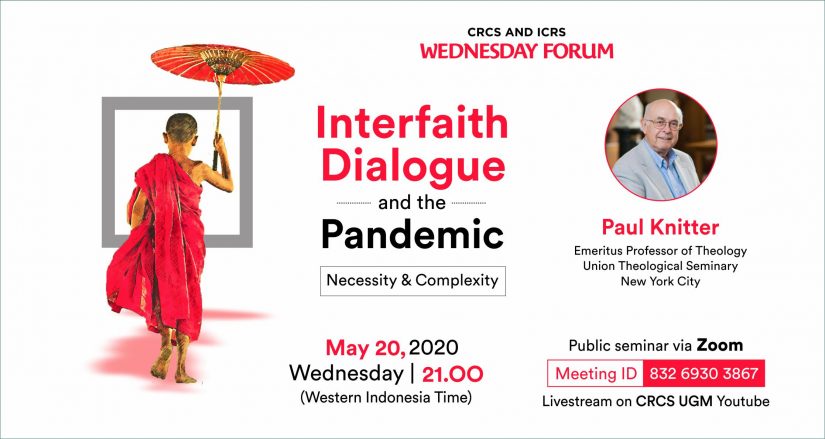
Interfaith Dialogue and the Pandemic: Necessity and Complexity

Wednesday Forum – May 20, 2020

Paul Knitter is an old friend of CRCS, having taught courses here between 2004 and 2006.  To open our conversation with him, he will review some of the main concerns of his long career as a Christian dialogical theologian: 

  • The need that Christianity and all religions have of developing a “theology of religions.” Such a theology is necessary in order to confront the reality that all (or most) religions contain within their teachings and beliefs obstacles to their commitment to interreligious dialogue.
  • The necessity, and the opportunity, of basing interreligious dialogue on the shared commitment of all religions to promoting human and environmental justice and well-being. (especially at this time of the pandemic). Interreligious conversation should be based on interreligious action and cooperation. 
  • What he has learned from his long dialogue with Buddhism (summarized in his book Without Buddha I Could Not Be a Christian), especially what social activists can learn from Buddhism concerning the “primacy” of compassion over justice, and of contemplation over action.
  • His recent research and publications about the generally unrecognized links between racial (or ethnic or national) supremacy and religious supremacy.

He will then take up questions about “Religions and the Pandemic” – what religious faith and interreligious dialogue can contribute to confronting the suffering and confusion that the pandemic has caused for so many people. 

Paul Knitter is the Paul Tillich Emeritus Professor of Theology and Religions at Union Theological Seminary in New York City. He earned a Licentiate in Theology at the Catholic Pontifical Gregorian University in Rome Italy (1966) before going on to earn his Doctorate in Theology from the Protestant University of Marburg in Germany (1972). 

Look at the full poster of this event here.

Paul Knitter taught at CRCS in 2003

Instagram

Whose gaze am I carrying in my body? Over time, we Whose gaze am I carrying in my body?
Over time, we learn to watch ourselves through the eyes of others. What does it take for a body to loosen itself from these gazes? Perhaps it begins with simply staying present. Breathing. Not disappearing. Quietly refusing.
Join this thought provoking discussion at #wednesdayforum with @anquaerere
We provide snacks and drinks, don't forget to bring your tumbler. This event is free and open to public.
Family law is never just about the family. It’s al Family law is never just about the family. It’s also about who gets to shape the state.

Join this thought provoking discussion at #wednesdayforum. We provide snacks and drinks, don't forget to bring your tumbler. This event is free and open to public.
What does it mean for humans and societies to trul What does it mean for humans and societies to truly flourish?
Michael Champion from Australian Catholic University explores the growing field of flourishing across the humanities and social sciences—from philosophy and development economics to positive psychology and the Global Flourishing Study.
The discussion will ask what Religious Studies can contribute to as well as critically question in contemporary ideas of flourishing, while opening possibilities for new research in interreligious and intercultural studies between Indonesia and Australia. Join this thought provoking discussion at #wednesdayforum. We provide snacks and drinks, don't forget to bring your tumbler. This event is free and open to public.
Ke Salzburg mengenal diri. Ikrana dan perjalanan S Ke Salzburg mengenal diri.
Ikrana dan perjalanan Study Exchange selama di Kota Mozart.

#Studyexchange #salzburg #crcsugm #sekolahpascasarjanaugm #religiousstudies
Follow on Instagram

Twitter

Tweets by crcsugm

Universitas Gadjah Mada

Gedung Sekolah Pascasarjana UGM, 3rd Floor
Jl. Teknika Utara, Pogung, Yogyakarta, 55284
Email address: crcs@ugm.ac.id


© CRCS - Universitas Gadjah Mada

KEBIJAKAN PRIVASI/PRIVACY POLICY