Meta Ose Ginting | CRCS | WedForum Report

Going to the cinema is a new social practice in modern society. To some extent it can also be perceived as a spiritual practice. Dr Nacim Pak-Shiraz, the Head of Persian Studies and a Senior Lecturer in Persian and Film Studies at the University of Edinburgh and guest speaker at the Wednesday Forum on February 9th, studies this paradox in the dynamics of Iranian cinema. She began by noting that there has been only a little academic attention to the movies based on Quranic epics, in contrast to what has happened with Biblical epics from Hollywood.
For a long time, the study of the Quran has been focused on the text and its interpretation. Pak-Shiraz explained that movies lead us to cultural contexts and deeper understanding of Islamic arts. Therefore, more attention should be given to the dynamics of Quran and its representation in the creative industry.
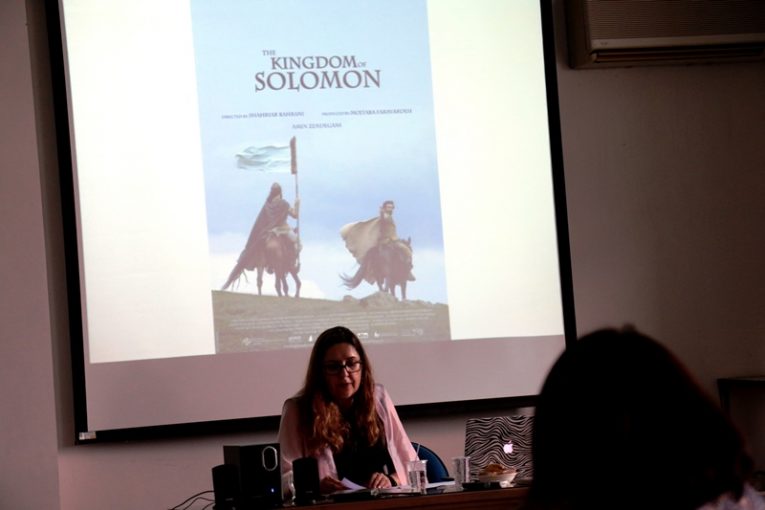
 Pak-Shiraz focused on the 2010 movie The Kingdom of Solomon (Mulk-i Sulayman-i Nabi) directed by Shahriar Bahrani, as her object of study. As the pioneer in its genre, this movie brought up many reactions at various levels. There are many challenges in the making of Quranic epic movies. Although it is slowly becoming a genre in Iranian cinematography, the problem of visual creativity versus Quranic interpretation cannot be ignored.
For the authorities, this kind of movies could be banned in the sense of protecting religious authenticity. The idea of Quranic cinema was opposed by many groups as anti-religious. The production of movies from this genre is subject to the strict rule of the Culture Ministry and so the development for Quranic epic movies in the Iranian cinema has taken a long time.
In her research, Pak-Shiraz shows a process of how the movie’s makers try to keep the balance—and fill the gap—between religious authenticity and dramatic effectivity. They use the “vocabularies” and methods from Hollywood cinematography to create a bridge to connect the Quran to the logic of the audience, including appealing to their enjoyment through special effects and CGI. For Pak-Shiraz, it is important to make sure that in the process of production, the movie maker emphasizes that the Quran is the main source, often elaborated on a companion website. The struggle is related to the sensitivity of the subject.
During the Q and A session, interesting questions came from the audience that was familiar with other styles of Iranian movies as well as some of the Islamic films by Bahrani and other directors. One of the questions asked about how the audience perceived this genre. Pak-Shiraz explained that as this genre try to synthesize Quran and moviegoing, people considered it as a part of religious practice.
*Meta Ose Ginting is CRCS student of the 2015 batch