
• Tentang UGM
  • Portal Akademik
  • Pusat TI
  • Perpustakaan
  • Penelitian
Universitas Gadjah Mada
  • About Us
    • About CRCS
    • Vision & Mission
    • People
      • Faculty Members and Lecturers
      • Staff Members
      • Students
      • Alumni
    • Facilities
    • Library
  • Master’s Program
    • Overview
    • Curriculum
    • Courses
    • Schedule
    • Admission
    • Scholarship
    • Accreditation and Certification
    • Academic Collaborations
      • Crossculture Religious Studies Summer School
      • Florida International University
    • Academic Documents
    • Student Satisfaction Survey
  • Article
    • Perspective
    • Book Review
    • Event Report
    • Class Journal
    • Interview
    • Wed Forum Report
    • Thesis Review
    • News
  • Publication
    • Reports
    • Books
    • Newsletter
    • Monthly Update
    • Infographic
  • Research
    • CRCS Researchs
    • Resource Center
  • Community Engagement
    • Film
      • Indonesian Pluralities
      • Our Land is the Sea
    • Wednesday Forum
    • ICIR
    • Amerta Movement
  • Beranda
  • Headline
  • Showing off piety: between wefies and riya’

Showing off piety: between wefies and riya’

  • Headline, News, Wednesday Forum Report
  • 6 April 2017, 11.11
  • Oleh: ardhy_setyo
  • 0

Anang G Alfian | CRCS | Wednesday Forum Report

As a product of the globalized world, social media have created a virtual space of communication and interaction. Many people use it with enthusiasm as it helps humans build communication and connectivity much faster than ever before. On the other hand, many consider this phenomenon a challenge for living ethically and productively.

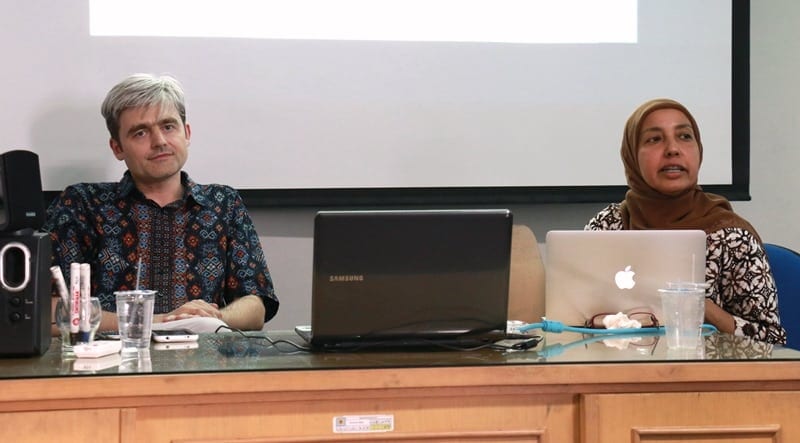
Dealing with this topic, Wednesday Forum on February 9th 2017 held a discussion on “wefies” (group self-portraits posted on social media) in relation to the Islamic concept of riya’ (showing off piety). The two speakers, Fatimah Husein, currently teaching at CRCS/ICRS as well as UIN Sunan Kalijaga, and Martin Slama of the Institute for Social Anthropology at the Austrian Academy of Sciences, presented the emerging phenomenon of online piety in Indonesia, especially on how Muslims rethink riya’ in today’s popular “wefie” culture. The presentation was based on Husein’s article titled “The Revival of Riya’: Displaying Muslim Piety Online in Indonesia” which has been submitted for a virtual issue of American Ethnologist and Slama’s research project on “Islamic (Inter)Faces of the Internet: Emerging Socialities and Forms of Piety in Indonesia” funded by the Austrian Science Fund.

Fatimah Husein and Martin Slama observed that media are central to the articulation of Indonesian Muslims’ pious life. They further gave examples of online communities such as ODOJ (One Day One Juz) and wefies practices among Muslims during religious rituals, traveling, or pengajian (religious gathering). This phenomenon, they argued, requires Muslims to deal with the riya’ question, because during the last two decades showing off one’s Islamic piety mediated by smartphones and the Internet has become widespread.
In cases such as the ODOJ community and wefies practices, there is an ambiguity of perception of piety as it is displayed on social media. While this technology can advantageously facilitate piety, it also may potentially lead to riya’, which Muslims must avoid. The question asked then is whether or not these practices, such as reporting that one has read a juz of the Qur’an, constitutes an act of riya’ and, if so, what strategy Muslims should use to avoid it.

Explaining one of the definitions of riya’, Fatimah Husein quoted Quraish Shihab stating that riya’ is commonly defined as “the act of showing off our ‘ibadah (worship) with the hope to be praised by others before, during, or after conducting that activity”. The sufi al-Muhasibi, Husein continued, said that riya’ is “a barrier to Allah’s receipt to human prayer” and, according to al-Ghazali, “is unlawful, and even constitutes a form of polytheism: worshipping the self in addition to Allah.”
In the Q&A session after the presentation, a participant delivered her view that “wefies” can be a kind of da’wah and technology has made her more knowledgeable of Islamic teachings. She further argued that riya’ can only be known inwardly, by looking at someone’s intention. Responding to this, Husein said that the concern of riya’ actually came from her respondents, which points to a widespread worry of committing riya’. She gave an example of one of her respondents who consulted her ustadz and received the answer that riya’ goes back to one’s deep intention. If the act is accompanied by good intention, the ustadz argued, it is no problem. According to Husein, worries concerning riya’ were also expressed by an ODOJ member who consulted her religious teacher. Her teacher then, as she explained, distinguished the good from the bad riya’, a distinction which is, again, based on intention.

The presentation by Fatimah Husein and Martin Slama referred  not only to the theological debate about riya’ but also emphasized riya’ as social phenomenon using an anthropological perspective. Because of the widespread concern with regard to riya’ and because there is no single answer to the issue, they suggested that by recognizing the spectrum of how people cope with the problem of riya’ , we can understand how and why this issue is currently re-emerging.

*Anang G Alfian is CRCS student of the 2016 batch

Tags: fatimah husein Indonesia martin slama one day one juz online piety riya' Wednesday Forum wefie

Leave A Comment Cancel reply

Your email address will not be published. Required fields are marked *

*

Instagram

Clicks are shaping conflicts. In Indonesia’s digit Clicks are shaping conflicts.
In Indonesia’s digital sphere, algorithms now fuel intolerance, speed up radical shifts, and collapse the distance between online anger and real-world violence. “From Clicks to Conflict” reframes radicalism and extremism through Indonesia’s own data, cases, and digital behavior. Understanding how hate evolves online isn’t optional anymore. It’s the frontline of preventing the next wave of violence. 

Come and join  #wednesdayforum discussion at UGM Graduate School building, 3rd floor.  We provide snacks and drinks, don't forget to bring your tumbler. This event is free and open to public.
H I L A N G Dalam sejarah perjuangan peradaban, pe H I L A N G
Dalam sejarah perjuangan peradaban, perempuan kerap ditulis sebagai jeda, bukan kalimat utama. Ia seolah hilang tak terdengar meski perannya selalu bingar. Seperti yang ditunjukkan oleh keempat pembicara ini, perempuan kerap menjadi dasar atas sebuah pergerakan, selalu menemukan celah dan mengubahnya menjadi kehidupan. Dari keempatnya kita belajar bahwa perempuan punya hak dan kemampuan untuk menafsir ulang hidup tanpa harus menunggu restu siapa pun.

Simak kembali percakapan di sesi ini dan menapaktilasi ragam perjuangan perempuan seluas mungkin di YouTube CRCS UGM.
L A M P I O N Memori laiknya lampion. Terkadang ia L A M P I O N
Memori laiknya lampion. Terkadang ia redup dan rawan, tetapi terus menggantung di langit halaman. Arsip ialah bahan bakar yang terus menghidupi ingatan. Ia menjadi sumbu bagi suluh yang berpijar. Pun dengan arsip-arsip budaya dan agama Tionghoa di Indonesia. Keberadaannya menjadi pembuka jalan untuk menata kembali peta bangsa dari serpihan gelap yang sengaja dilupakan. 

Simak kembali perbincangan bernas peluang dan tantangan digitalisasi arsip-arsip budaya dan agama Tionghoa di Indonesia hanya di YouTube CRCS UGM
Faith could be cruel. It can be used to wound thos Faith could be cruel. It can be used to wound those we might consider "the other". Yet, rather than abandoning their belief, young queer Indonesians choose to heal by re-imagining it. The Rainbow Pilgrimage is a journey through pain and prayer, where love becomes resistance and spirituality turns into shelter. Amidst the violence, they walk not away from faith, but towards a kinder, more human divine. 

Come and join #wednesdayforum discussion at UGM Graduate School building, 3rd floor. We provide snacks and drinks, don't forget to bring your tumbler. This event is free and open to public.
Follow on Instagram

Twitter

Tweets by crcsugm

Universitas Gadjah Mada

Gedung Sekolah Pascasarjana UGM, 3rd Floor
Jl. Teknika Utara, Pogung, Yogyakarta, 55284
Email address: crcs@ugm.ac.id


© CRCS - Universitas Gadjah Mada

KEBIJAKAN PRIVASI/PRIVACY POLICY