
• Tentang UGM
  • Portal Akademik
  • Pusat TI
  • Perpustakaan
  • Penelitian
Universitas Gadjah Mada
  • About Us
    • About CRCS
    • Vision & Mission
    • People
      • Faculty Members and Lecturers
      • Staff Members
      • Students
      • Alumni
    • Facilities
    • Library
  • Master’s Program
    • Overview
    • Curriculum
    • Courses
    • Schedule
    • Admission
    • Scholarship
    • Accreditation and Certification
    • Academic Collaborations
      • Crossculture Religious Studies Summer School
      • Florida International University
    • Academic Documents
    • Student Satisfaction Survey
  • Article
    • Perspective
    • Book Review
    • Event Report
    • Class Journal
    • Interview
    • Wed Forum Report
    • Thesis Review
    • News
  • Publication
    • Reports
    • Books
    • Newsletter
    • Monthly Update
    • Infographic
  • Research
    • CRCS Researchs
    • Resource Center
  • Community Engagement
    • Film
      • Indonesian Pluralities
      • Our Land is the Sea
    • Wednesday Forum
    • ICIR
    • Amerta Movement
  • Beranda
  • Headline
  • Emplacement and displacement in the Banda Islands

Emplacement and displacement in the Banda Islands

  • Headline, News, Wednesday Forum Report
  • 12 April 2017, 12.08
  • Oleh: ardhy_setyo
  • 0

Anthon Jason | CRCS | Wednesday Forum Report

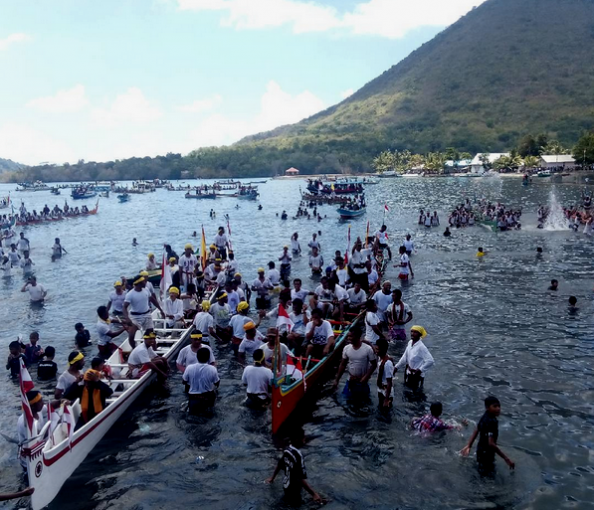
The Kora-Kora race in Banda Neira. Photo by Kelli Swazey

In Indonesia, people can be called by their homeland’s name, such as orang Batak, orang Sunda, orang Manado and so on. The Indonesian concepts that are tied tightly to ideas of land, community, and cosmology referred to as adat have a dynamic and complex relationship to people’s religious identification and how they understand their identities. People can be emplaced or displaced in regard to how their religious identity relates to their cultural identification with particular places. While emplacement is the process by which people identify themselves with a place, displacement is a dislocation, removal, expropriation, takeover, or ideological process to refute claims of rights over land, the use of cultural symbols, or the ability of people and groups to self-identify.

Dealing with this topic in her presentation at the CRCS-ICRS Wednesday Forum on April 5th, 2017, Dr Kelli Swazey talked about how that issue of emplacement and displacement has affected people, particularly the Christian population of the Banda Islands in Maluku. She revealed how the tourism industry, as the third largest industry in Banda, has influenced the way people think about Christians as the minority religion, but not the cultured minority, and how tourism has the potential to distance displaced Christians from the practices that identify them as Bandanese.

Dr. Swazey began her presentation with a historical reference to the Banda islands from a Chinese text in 1304, and later archaeological evidence of non-Islamic communities in the region until the early 16th century. In addition, she discussed a massive transformation in society in Banda islands: the massacre of the majority of the population of Banda people by Dutch forces, and the repopulation of the island with slaves brought from many other regions to work as laborers for the cultivation of spices. In short, Dr. Swazey wanted to address the question of who the Bandanese or Orang Banda asli are.

From historical and archaeological evidences, it is apparent that answering that question is no easy, particularly if the paradigm employed is the notion on keaslian, or some sort of racial purity. History has suggested that Bandanese were never really ethnically pure. Bandanese Christians were not a minority in culture because they shared in the cosmological and local belief systems of the island. However, after a conflict drove most of the Christian population from the islands, they began to lose access to land rights in the islands. This could be constitutive of a starting point of ethnogenesis based on religion. Ethnogenesis, as commonly understood, is the formation and development process of an ethnic group. This process emerges because of self-identification or, in the case of Bandanese Christians, the result of outsiders’ identification.

In challenging the notion of Christians being minority of Banda, Dr. Swazey suggested the definition by Eriksen (2010): minority is not only about the population but also the condition where one group is subordinate to another more dominant group that coexists but is either culturally, ethnically, socially or religiously distinct. Based on this framework, minority can happen at any time to any group. Through this, Dr. Swazey theorized that the tourism industry is contributing to a process of minoritization for displaced Bandanese Christians.
Dr. Swazey suggested that we should be concerned about the influences of the tourism industry, as the process of reconstruction and representation employed in the industry is tied intimately with identity and to native concepts of authenticity, belonging, as well as national frameworks of recognition and representation. One of the policy trends of Indonesian tourism industry is to represent religious tourism for the convenience of certain tourists or to attract particular segments of tourists, like sharia tourism or halal tourism. This phenomenon can be both positive and negative.

In the process of reconstruction, tourism not only helps people understand who they ethnically or culturally are, but also helps embody what tourists want or they think what tourists want. It is a dialogical process. It has just much potential to inclusion as it does for exclusion. The mutually constitutive definitions of adat and agama play a role in defining who can claim ties to place and therefore claim recognition and authority.

*The writer Anthon Jason is CRCS student of the 2016 batch.

Tags: banda islands christian-muslim relation Ethnicity kelli swazey pribumi racial purity

Leave A Comment Cancel reply

Your email address will not be published. Required fields are marked *

*

Instagram

crcs_ugm

Sedang tidak baik-baik saja, kamu biasanya mencari Sedang tidak baik-baik saja, kamu biasanya mencari apa di internet?

Banyak anak muda hari ini menemukan ketenangan, nasihat, bahkan jawaban atas kegelisahan melalui media sosial, konten keagamaan, akun kesehatan mental, hingga AI chatbot. Namun, bagaimana sebenarnya pengalaman itu terjadi?
Kami sedang melakukan penelitian untuk memahami bagaimana generasi muda usia 10–24 tahun mencari informasi keagamaan maupun kesehatan mental saat menghadapi masa-masa sulit.
Jika kamu merasa topik ini dekat dengan pengalamanmu, kami mengundangmu menjadi responden.
Partisipasi bersifat sukarela dan seluruh jawaban dijaga kerahasiaannya.
Kamu bisa langsung kirim DM jawabanmu atau mau tanya-tanya dulu juga boleh.

Kami tunggu ya.
Katanja koeliah S2 itoe mahal? Eitss , djangan s Katanja  koeliah S2 itoe mahal? 
Eitss , djangan salah
Bersama keempat mahasiswa angkatan 2025, kita akan ngobrolin djoeroes-djoeroes djitoe mendapatkan beasiswa di CRCS UGM

Begitoe?
Before petroleum fueled the world, it fractured th Before petroleum fueled the world, it fractured the archipelago

The raise of the colonial petroleum industry in the Dutch East Indies was also the emergence of new spatial inequalities. Outer Java was not merely discovered as a resource zone. It was politically produced as an extractive territory through imperial concessions, colonial state-building, and global struggles over resource control.

Join us in this presentation on capitalism, oil, and the colonial fractures that continue to haunt the geography of modern Indonesia. We provide snacks and drinks, don't forget to bring your tumbler. This event is free and open to public.
M B G Satu kotak makan berisi nasi putih pulen seb M B G
Satu kotak makan berisi nasi putih pulen sebagai sumber karbohidrat utama, dimasak dari beras medium pilihan, air, sedikit garam, dan beberapa tetes minyak agar tidak cepat basi. Di sampingnya terdapat ayam semur kecap, dibuat dari potongan daging ayam, bawang merah, bawang putih, kecap manis, daun salam, lengkuas, garam, dan sedikit gula sehingga memberi asupan protein hewani yang cukup untuk pertumbuhan. Sebagai pendamping lauk utama, disediakan tempe orek manis gurih dari tempe iris tipis, bawang merah, bawang putih, cabai, kecap, dan gula merah. Tempe ini berfungsi menambah protein nabati sekaligus membuat kotak makan tampak lebih penuh, sebab protein memang sering lebih meyakinkan bila hadir rangkap dua. Untuk unsur sayuran, ada tumis wortel dan buncis yang dimasak dari wortel segar, buncis, sedikit kol, bawang putih, garam, merica, dan minyak sayur. Warna oranye-hijau pada sayur ini penting: bukan hanya untuk vitamin A dan serat, tetapi juga agar foto dokumentasi tidak terlihat terlalu pucat.Sebagai pelengkap vitamin alami, satu buah pisang atau sepotong pepaya matang diletakkan di sudut kotak. Buah dipilih yang murah, tahan banting, tidak gampang memar, dan cukup fotogenik ketika dibagikan massal. Terakhir, ditambahkan susu UHT kotak kecil berbahan susu sapi, gula, dan fortifikasi vitamin, atau kadang telur rebus utuh sebagai penutup protein tambahan.

Berbuih-buih seperti pelaksanaannya ...
Follow on Instagram

Twitter

Tweets by crcsugm

Universitas Gadjah Mada

Gedung Sekolah Pascasarjana UGM, 3rd Floor
Jl. Teknika Utara, Pogung, Yogyakarta, 55284
Email address: crcs@ugm.ac.id


© CRCS - Universitas Gadjah Mada

KEBIJAKAN PRIVASI/PRIVACY POLICY