Terrorism from the perspective of identity politics
Imanuel Geovasky – 18 May 2018
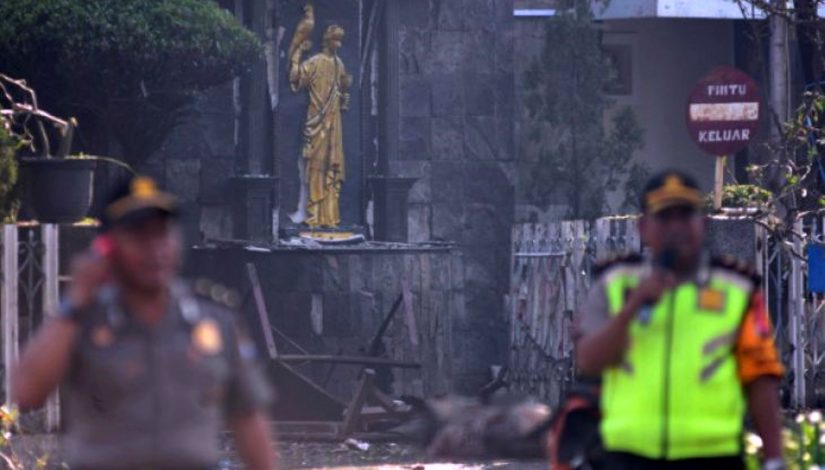
The attention of Indonesian society, as well as the whole world, has been drawn into the series of terror attacks that hit major cities in Java over the last week, from the killing of five police personnel at the National Police’s Mobile Brigade headquarters detention center in Depok on May 9 to the suicide bombings of three churches in Surabaya on May 13 by six members of one family to the premature explosion of another bomb that evening at an apartment in Wonocolo, Sidoarjo, killing another family apparently planning an attack, to suicide bombings of the Surabaya Police headquarters the following day, May 14, again by one family. Two days later, on May 16, terror attacks took place at the Riau Police headquarters. Detachment 88 (Densus 88) is currently seeking to hunt down and arrest suspected terrorists and some having already been shot by this special police unit on terrorism.
Over the last week, experts have offered analyses of this series of events from various perspectives, including security studies, politics, political psychology, religious and conflict studies, and so on, trying to understand why these terror attacks happened and to develop concrete strategies for both the police and the public so as to prevent them from happening again. In this essay, I want to take up the causes and mechanisms of terrorism from the perspective of identity politics.
The mechanisms of identity politics
There is no single agreed-upon definition of identity politics. But many scholars agree that identity politics is fundamentally a political endeavor that bases a way of thinking and actings on the identities of the group with the aim of fighting for the group’s interests (Castells, 2010; Buchari, 2014; Lawler, 2014). Identity politics do not emerge from a vacuum, but rather within particular contexts or conditions.
External factors such as discrimination or marginalization that curtail a group within society’s access to economic, social, educational, medical, and political resources contribute to the emergence of identity politics. Moreover, there are internal factors such as primordialism and ethnocentrism, which lead to the perception that one’s group is the best and truest and hence superior to any other group, can also strengthen identity politics based on such identities as religion, ethnicity, language, territory, sect, ideology, and the like. (Buchari, 2014).
Identity politics emerges through several stages: (1) A group in society feels that it has continuously suffered as the victim of injustice, experiencing, for example, repression from the powers-that-be or domination by other social groups; (2) these experiences of injustice threaten the group’s identity because they show that the group’s very existence is under threat of gradual elimination; (3) the group gathers all available resources as well as economic and social capital for the purpose of resistance; (4) which is done for the sake of the group’s survival and as part of its mechanisms of resilience (Buchari, 2014, Lawler, 2014).
Groups in society usually want to be acknowledged in public (recognition) and to enjoy fair and equal access to every part of society as other groups (redistribution).
Stages towards acts of terror
Now let’s look at the recent terror attacks which, according to National Police Chief Gen. Tito Karnavian, were committed by members of the Indonesian ISIS-linked group Jamaah Ansharut Daulah (JAD). In Iraq and Syria, ISIS has sought to establish a caliphate. But this effort has not come to pass as military forces of Western and Middle Eastern countries have demolished their bases and resources, resulting in a drastic decline of military power and territories under their control. This situation made ISIS and its affiliates feel a tremendous sense of marginalization.
Indonesians who joined ISIS have experienced the same marginalization. When they returned home to Indonesia, they have been stigmatized by their communities and their presence is under heavy surveillance by the police.
The narrative that the ISIS supporters and sympathizers have been treated unfairly in the global political system and are victims of the ISIS’s defeat in Iraq and Syria has continuously been echoed by ISIS followers, including members of the JAD network,. Sharing the same narrative, they feel the need to fight for their existence, their interests, and their identity. Therefore, they feel they must engage in resistance to maintain their existence and gain the public’s attention (as a strategy for recognition).
UIN Sunan Kalijaga lecturer and researcher on terrorism Noorhaidi Hasan has argued that “terrorism is born out of an identity crisis as a result of a complex situation that has made the terrorists unable to behave like normal people. They live in a political system they consider to have colonized them, resulting in feelings of frustration. They blame the state as the controller of this system they hate, itself the puppet of the capitalist system, the infidels (kuffar), and so on.” The terrorists hold the view that their acts of terror are a means of rebuilding their uprooted identity.
“They (the terrorists) believe that their acts of terror are a way to help get them out of this chaotic and miserable life; sometimes with an altruistic reasoning as they believe that their ‘sacrifice’ may make some other people’s lives better. They believe that it is better to die as a martyr than to succumb to depression,” argues Hasan.
Based on this view, it is clear that the actions perpetrated by the terrorists can be understood in terms of identity politics. But it should be emphasized here that their identity politics are identity politics in a very negative and bad sense.
Towards a society without terror
Now what? Of course this analysis not only seeks to show that those terror acts can be understood as an identity politics, but also to enable our joint efforts as civil society to prevent such acts of terrorism from happening again.
Seen from the mechanisms of identity politics outlined above, there are several actions that need to be done by the community. These include re-thinking how to be more sensitive to situations in which there is discrimination and marginalization, especially towards groups in society that appear to be withdrawing themselves from normal social interactions.
If a group in society commits self-alienation and is stigmatized and shunned by society, members of this group will increasingly isolate themselves from social interaction outside their own group. It will be highly likely that their radical ideology is strengthened by the so-called “echo chamber effect” and they will be exposed only to radical narratives, as was apparently experienced by the wives and children of the terrorist families in Surabaya.
If it is true that acts of terrorism are related to crises of identity, it is necessary for all of us to reflect on the meanings of our religious identities in the public sphere. Religious identities and practices that support or even enable narratives of hatred and violence must be stopped!
The emergence of violent actions always passes through noticeable stages: from hate speech against certain groups to the dissemination of the view that those groups are “less than human” when compared with others. This dehumanization is what fuels acts of terror and make them so cruel and atrocious.
_______________
This piece is a translation by Azis Anwar (edited by Greg Vandebilt) from its original version in Indonesian: Terorisme dalam Sudut Pandang Politik Identitas
Header image: The Catholic church of Santa Maria Tak Bercela, Surabaya, after the bombings. Courtesy: ANTARA FOTO/M Risyal Hidayat.