• Tentang UGM
  • Portal Akademik
  • Pusat TI
  • Perpustakaan
  • Penelitian
Universitas Gadjah Mada
  • About Us
    • About CRCS
    • Vision & Mission
    • People
      • Faculty Members and Lecturers
      • Staff Members
      • Students
      • Alumni
    • Facilities
    • Library
  • Master’s Program
    • Overview
    • Curriculum
    • Courses
    • Schedule
    • Admission
    • Scholarship
    • Accreditation and Certification
    • Academic Collaborations
      • Crossculture Religious Studies Summer School
      • Florida International University
    • Academic Documents
    • Student Satisfaction Survey
  • Article
    • Perspective
    • Book Review
    • Event Report
    • Class Journal
    • Interview
    • Wed Forum Report
    • Thesis Review
    • News
  • Publication
    • Reports
    • Books
    • Newsletter
    • Monthly Update
    • Infographic
  • Research
    • CRCS Researchs
    • Resource Center
  • Community Engagement
    • Film
      • Indonesian Pluralities
      • Our Land is the Sea
    • Wednesday Forum
    • ICIR
    • Amerta Movement
  • Beranda
  • Wednesday Forum News
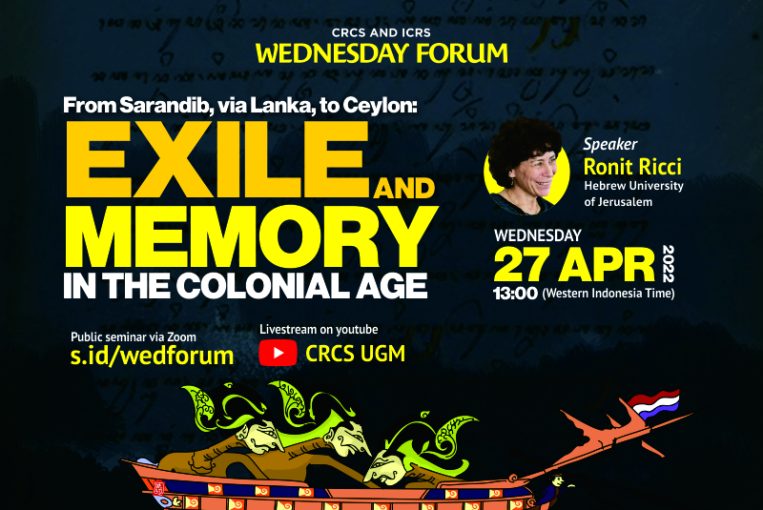
  • From Srandib, via Lanka, to Ceylon: Exile and Memory in the Colonial Age

From Srandib, via Lanka, to Ceylon: Exile and Memory in the Colonial Age

  • Wednesday Forum News
  • 11 May 2022, 20.16
  • Oleh: crcs ugm
  • 0

From Srandib, via Lanka, to Ceylon: Exile and Memory in the Colonial Age

Wednesday Forum – 27 April 2022

The small, Indian Ocean island known as Sarandib, Lanka, and Ceylon was a site of banishment throughout the 18th century for members of royal families, convicts, servants and others sent there from across the Indonesian archipelago. Descendants of these exiles who remained on the island continued to speak and write in Malay, the archipelago’s lingua franca, and to adhere to a collective Muslim identity for several centuries and into the present. The talk considers if and how earlier religious and literary traditions of banishment tied to the island – those of Adam’s fall from paradise to Sarandib and Sinta’s abduction to Lanka – played a role in the lives of the early exiles and their descendants.

Professor Ronit Ricci teaches in the departments of Asian Studies and Comparative Religion at the Hebrew University of Jerusalem. Since 2013 she has been developing Indonesian Studies at the Hebrew University, the only Israeli university to offer this field of study. Her research interests include Javanese and Malay manuscript cultures, Translation Studies, and Islamic literatures of South and Southeast Asia. She is the Principal Investigator for the ERC-funded project “Textual Microcosms” (2021-2026) which will explore the phenomenon of interlinear translation across the Indonesian-Malay world.

The full poster of this event is available here.
Leave A Comment Cancel reply

Your email address will not be published. Required fields are marked *

*

Instagram

To understand Iran, geopolitics alone is not enoug To understand Iran, geopolitics alone is not enough.
Behind every headline about war or sanctions lies a deeper landscape of history, memory, and moral imagination. In this conversation, Dicky Sofjan shows that contemporary conflicts involving Iran cannot be read only through the language of strategy and power. They must also be understood through the histories and symbols that continue to mobilize political and social meaning today.

Click the link in our bio to read the full interview.
Some changes in family life arrive quietly. In Yog Some changes in family life arrive quietly. In Yogyakarta and Ponorogo, more husbands cook, clean, and care for children, while still remaining the imam in the household. What shifts is not only labor but the meaning of leadership, belief, and marriage itself. A small domestic change opens a larger question about gender, religion, and the stories families tell about themselves.

Join the conversation at the #wednesdayforum with Alimatul Qibtiyah, March 11 at UGM or via livestream. We're offering a free iftar, so get there early! This event is free and open to the public.
What is well-being? Indonesia today: land taken, f What is well-being?
Indonesia today: land taken, forests cleared, plantations marching under the banner of food security. Officials call it progress, yet Indigenous ground tells another story. Baduy farmers keep ngahuma alive: rice, ritual, survival, all tied together. Wellbeing here isn’t profit. It’s balance when human and earth still holding on.

Join us for the next  #wednesdayforum discussion at the 3rd floor of the UGM Graduate School building. We're offering a free iftar, so please register. This event is free and open to the public.
yuk, pendaftaran sudah dibuka ... cek syarat-syara yuk, pendaftaran sudah dibuka ...
cek syarat-syaratnya ...
jika ada yang mau tanya-tanya,
langsung meluncur ke kolom komentar ya ...
Follow on Instagram

Twitter

Tweets by crcsugm

Universitas Gadjah Mada

Gedung Sekolah Pascasarjana UGM, 3rd Floor
Jl. Teknika Utara, Pogung, Yogyakarta, 55284
Email address: crcs@ugm.ac.id


© CRCS - Universitas Gadjah Mada

KEBIJAKAN PRIVASI/PRIVACY POLICY