• Tentang UGM
  • Portal Akademik
  • Pusat TI
  • Perpustakaan
  • Penelitian
Universitas Gadjah Mada
  • About Us
    • About CRCS
    • Vision & Mission
    • People
      • Faculty Members and Lecturers
      • Staff Members
      • Students
      • Alumni
    • Facilities
    • Library
  • Master’s Program
    • Overview
    • Curriculum
    • Courses
    • Schedule
    • Admission
    • Scholarship
    • Accreditation and Certification
    • Academic Collaborations
      • Crossculture Religious Studies Summer School
      • Florida International University
    • Academic Documents
    • Student Satisfaction Survey
  • Article
    • Perspective
    • Book Review
    • Event Report
    • Class Journal
    • Interview
    • Wed Forum Report
    • Thesis Review
    • News
  • Publication
    • Reports
    • Books
    • Newsletter
    • Monthly Update
    • Infographic
  • Research
    • CRCS Researchs
    • Resource Center
  • Community Engagement
    • Film
      • Indonesian Pluralities
      • Our Land is the Sea
    • Wednesday Forum
    • ICIR
    • Amerta Movement
  • Beranda
  • Wednesday Forum News
  • Understanding the Political Strategy of Hizbut Tahrir Indonesia

Understanding the Political Strategy of Hizbut Tahrir Indonesia

  • Wednesday Forum News
  • 1 December 2011, 00.00
  • Oleh:
  • 0

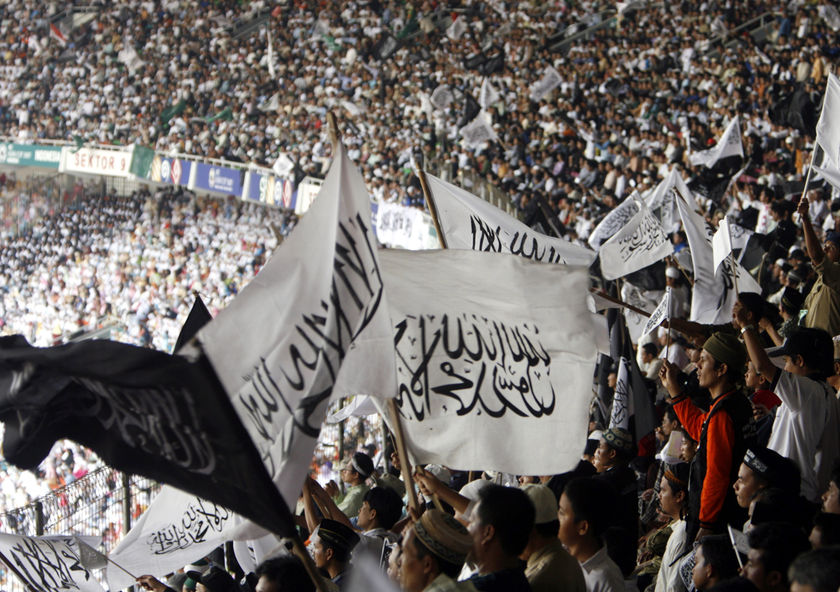
Democracy provides both opportunities and challenges for Islamist movements Indonesia. On the one side, it grants movements with political freedom that allows mobilization. Such a freedom is a privilege for Indonesian Islamists compared to political restriction in many other Muslim countries. On the other side, democracy presents political opportunities for accommodation of Islamic political interest. The majority Muslim population gives potential constituent for the accommodation of Islamic values and laws. This democratic advantage however poses a challenge for Islamist movement advocating a fundamental change in the political system. The presence of Muslims in the system counters anti-systemic opposition. The impact of this challenge is evident in the political behavior of Hizbut Tahrir Indonesia (HTI). Started with a revolutionary goal of replacing democracy with an Islamic political system of khilafah, the movement now has to adjust with political reality. While persistently continuing its rhetorical opposition to democracy, HTI is becoming more tolerant of participation in the democratic system.


This view was delivered by M. Iqbal Ahnaf, Ph.D. in his WedForum presentation (30/11/11) entitled “From Revolution to Refolution: The Evolution of The Political Strategy of Hizbut Tahrir Indonesia”.


As a part of the conclusion of his dissertation at the School of Government at Victoria University of Wellington, Iqbal argues that HTI’s change is apparent in its inconsistent opposition to the key elements of democracy. Normatively HTI sees democracy as un-Islamic, but in reality it demonstrates an interest in positive engaging with democratic institutions such as government, and the House of Representation. The most interesting illustration of HTI’s adjustment with the democratic circumstance, according to Iqbal, is its changing attitude toward elections. Despite the fact that election is a key element of democracy, HTI’s attitude toward elections is ambiguous. Undoubtedly, HTI is often critical of election. But, as a matter of fact, the organization is becoming less oppositional to election to the extent of seeing it as a political opportunity to advance political mobilization. The leaders of the organization have repeatedly stated intention to become a formal political party. However, Iqbal said, as at present HTI does not have sufficient resources for such a risky transformation, at an interim it embraces a limited or indirect participation HTI by attempting to broker coalition among Islamic parties in the House and endorsing supports for pro-shari’ah candidates in elections.


These changes, according to Iqbal, should be seen a part of the process of strategic thinking or ‘ijtihad” among HTI’s leaders in Indonesia to translate its ideology in the Indonesian context. Based on his analysis of the discourse and activities of HTI from 2000-2009, Iqbal found evidence that HTI envisions an alternative path to revolution and reform that resembles a political strategy called “refolution,” i.e. a hybrid combination of revolution and reform. HTI maintains the revolutionary goal of replacing the existing political system (democracy) with an Islamic system. The strategy however is not total opposition or non-participation as taught by the founder of HT (al-Nabhani), but by seeking entry into the system to gain vocal points for political campaign and mobilization among key actors within the system. At the most optimistic speaking, Iqbal said, the success of this endeavor will resemble the shape of extreme-right or anti-system parties in Europe that that are small, but are significant because of their consistent position on key issues.


Above all, HTI’s leaders, according to Iqbal, are rational people. It should also be noted that HTI is a political, not religious, movement. The organization is therefore open for changes of political strategy to adjust with political circumstances. The fact that since its founding in 1953 HT around the world has not fund an ideal model of success story will make strategic discussion an open topic among the leaders of the organization. For Iqbal, what is clear so far is that maintaining political freedom is more important for HTI than strict ideological stubbornness that could risk its current progress in social mobilization. (IQB)


Photo: Blogspot
Leave A Comment Cancel reply

Your email address will not be published. Required fields are marked *

*

Instagram

crcs_ugm

Sedang tidak baik-baik saja, kamu biasanya mencari Sedang tidak baik-baik saja, kamu biasanya mencari apa di internet?

Banyak anak muda hari ini menemukan ketenangan, nasihat, bahkan jawaban atas kegelisahan melalui media sosial, konten keagamaan, akun kesehatan mental, hingga AI chatbot. Namun, bagaimana sebenarnya pengalaman itu terjadi?
Kami sedang melakukan penelitian untuk memahami bagaimana generasi muda usia 10–24 tahun mencari informasi keagamaan maupun kesehatan mental saat menghadapi masa-masa sulit.
Jika kamu merasa topik ini dekat dengan pengalamanmu, kami mengundangmu menjadi responden.
Partisipasi bersifat sukarela dan seluruh jawaban dijaga kerahasiaannya.
Kamu bisa langsung kirim DM jawabanmu atau mau tanya-tanya dulu juga boleh.

Kami tunggu ya.
Katanja koeliah S2 itoe mahal? Eitss , djangan s Katanja  koeliah S2 itoe mahal? 
Eitss , djangan salah
Bersama keempat mahasiswa angkatan 2025, kita akan ngobrolin djoeroes-djoeroes djitoe mendapatkan beasiswa di CRCS UGM

Begitoe?
Before petroleum fueled the world, it fractured th Before petroleum fueled the world, it fractured the archipelago

The raise of the colonial petroleum industry in the Dutch East Indies was also the emergence of new spatial inequalities. Outer Java was not merely discovered as a resource zone. It was politically produced as an extractive territory through imperial concessions, colonial state-building, and global struggles over resource control.

Join us in this presentation on capitalism, oil, and the colonial fractures that continue to haunt the geography of modern Indonesia. We provide snacks and drinks, don't forget to bring your tumbler. This event is free and open to public.
M B G Satu kotak makan berisi nasi putih pulen seb M B G
Satu kotak makan berisi nasi putih pulen sebagai sumber karbohidrat utama, dimasak dari beras medium pilihan, air, sedikit garam, dan beberapa tetes minyak agar tidak cepat basi. Di sampingnya terdapat ayam semur kecap, dibuat dari potongan daging ayam, bawang merah, bawang putih, kecap manis, daun salam, lengkuas, garam, dan sedikit gula sehingga memberi asupan protein hewani yang cukup untuk pertumbuhan. Sebagai pendamping lauk utama, disediakan tempe orek manis gurih dari tempe iris tipis, bawang merah, bawang putih, cabai, kecap, dan gula merah. Tempe ini berfungsi menambah protein nabati sekaligus membuat kotak makan tampak lebih penuh, sebab protein memang sering lebih meyakinkan bila hadir rangkap dua. Untuk unsur sayuran, ada tumis wortel dan buncis yang dimasak dari wortel segar, buncis, sedikit kol, bawang putih, garam, merica, dan minyak sayur. Warna oranye-hijau pada sayur ini penting: bukan hanya untuk vitamin A dan serat, tetapi juga agar foto dokumentasi tidak terlihat terlalu pucat.Sebagai pelengkap vitamin alami, satu buah pisang atau sepotong pepaya matang diletakkan di sudut kotak. Buah dipilih yang murah, tahan banting, tidak gampang memar, dan cukup fotogenik ketika dibagikan massal. Terakhir, ditambahkan susu UHT kotak kecil berbahan susu sapi, gula, dan fortifikasi vitamin, atau kadang telur rebus utuh sebagai penutup protein tambahan.

Berbuih-buih seperti pelaksanaannya ...
Follow on Instagram

Twitter

Tweets by crcsugm

Universitas Gadjah Mada

Gedung Sekolah Pascasarjana UGM, 3rd Floor
Jl. Teknika Utara, Pogung, Yogyakarta, 55284
Email address: crcs@ugm.ac.id


© CRCS - Universitas Gadjah Mada

KEBIJAKAN PRIVASI/PRIVACY POLICY