
• Tentang UGM
  • Portal Akademik
  • Pusat TI
  • Perpustakaan
  • Penelitian
Universitas Gadjah Mada
  • About Us
    • About CRCS
    • Vision & Mission
    • People
      • Faculty Members and Lecturers
      • Staff Members
      • Students
      • Alumni
    • Facilities
    • Library
  • Master’s Program
    • Overview
    • Curriculum
    • Courses
    • Schedule
    • Admission
    • Scholarship
    • Accreditation and Certification
    • Academic Collaborations
      • Crossculture Religious Studies Summer School
      • Florida International University
    • Academic Documents
    • Student Satisfaction Survey
  • Article
    • Perspective
    • Book Review
    • Event Report
    • Class Journal
    • Interview
    • Wed Forum Report
    • Thesis Review
    • News
  • Publication
    • Reports
    • Books
    • Newsletter
    • Monthly Update
    • Infographic
  • Research
    • CRCS Researchs
    • Resource Center
  • Community Engagement
    • Film
      • Indonesian Pluralities
      • Our Land is the Sea
    • Wednesday Forum
    • ICIR
    • Amerta Movement
  • Beranda
  • Wednesday Forum News
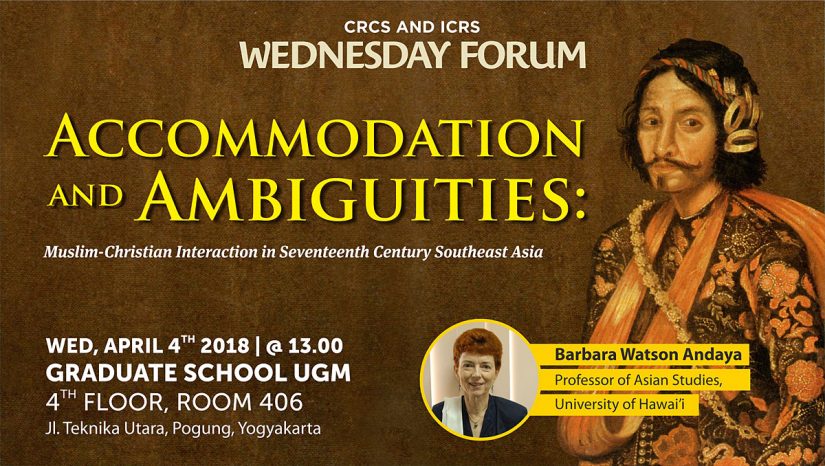
  • Accommodation and Ambiguities: Muslim-Christian Interaction in Seventeenth Century Southeast Asia

Accommodation and Ambiguities: Muslim-Christian Interaction in Seventeenth Century Southeast Asia

  • Wednesday Forum News
  • 27 March 2018, 12.46
  • Oleh: ardhy_setyo
  • 0

The memories of seventeenth-century ambivalences and the resulting tensions in the religious landscape of island Southeast Asia  have cast a long shadow which we can see played out in socio-political interactions and the ambiguous nature of Christian-Muslim interaction down to contemporary times.  As Islam spread through the Malay-Indonesian archipelago and economic rivalries between the Portuguese and Dutch heightened tensions between Catholics and Protestants, accommodation and interfaith interaction were always possible, but it is equally evident that religious boundaries were hardening as the economic and political weight of the European presence increased. Yet tolerance and receptiveness to the outside world remained, as always, hallmarks of Southeast Asian cultures. 

Barbara Watson Andaya is professor of Asian Studies at the University of Hawai‘i. Her recent publications include The Flaming Womb: Repositioning Women in Early Modern Southeast Asia (2006) and, with Leonard Y. Andaya, A History of Early Modern Southeast Asia (2015). She is working on a book on gender and sexuality in Southeast Asia.

Look at the full poster of this event here.

Download the outline of this presentation below:
[wpdm_package id=’12567′]

Tags: barbara andaya muslim christian relation Wednesday Forum

Leave A Comment Cancel reply

Your email address will not be published. Required fields are marked *

*

Instagram

What is well-being? Indonesia today: land taken, f What is well-being?
Indonesia today: land taken, forests cleared, plantations marching under the banner of food security. Officials call it progress, yet Indigenous ground tells another story. Baduy farmers keep ngahuma alive: rice, ritual, survival, all tied together. Wellbeing here isn’t profit. It’s balance when human and earth still holding on.

Join us for the next  #wednesdayforum discussion at the 3rd floor of the UGM Graduate School building. We're offering a free iftar, so please register. This event is free and open to the public.
yuk, pendaftaran sudah dibuka ... cek syarat-syara yuk, pendaftaran sudah dibuka ...
cek syarat-syaratnya ...
jika ada yang mau tanya-tanya,
langsung meluncur ke kolom komentar ya ...
K U D A A P I Kehidupan kadang hadir seperti kuda K U D A  A P I
Kehidupan kadang hadir seperti kuda, ia tak benar-benar bisa ditambatkan. Hidup terus bergerak bukan karena sebuah kepastian, melainkan untuk menolak padam meskipun tak tahu ke mana yang akan dituju. Ke mana pun tujuanmu di tahun ini,  semoga barakah selalu menyala dalam bara.

xin nian kuaile, gongxi facai
Why has democracy declined in Tunisia and Turkey, Why has democracy declined in Tunisia and Turkey, yet remained resilient in Indonesia?
Do Muslim mass organizations, elite consensus, and the negotiated relationship between religion and citizenship hold the key? Or are there deeper structural forces at play?
Join us and be part of the conversation. Let’s rethink what sustains (or undermines?) democracy in muslim-majority societies.

Come and join new round of  #wednesdayforum 2026 discussion at UGM Graduate School building, 3rd floor.  We provide snacks and drinks, don't forget to bring your tumbler. This event is free and open to public.
Follow on Instagram

Twitter

Tweets by crcsugm

Universitas Gadjah Mada

Gedung Sekolah Pascasarjana UGM, 3rd Floor
Jl. Teknika Utara, Pogung, Yogyakarta, 55284
Email address: crcs@ugm.ac.id


© CRCS - Universitas Gadjah Mada

KEBIJAKAN PRIVASI/PRIVACY POLICY