• Tentang UGM
  • Portal Akademik
  • Pusat TI
  • Perpustakaan
  • Penelitian
Universitas Gadjah Mada
  • About Us
    • About CRCS
    • Vision & Mission
    • People
      • Faculty Members and Lecturers
      • Staff Members
      • Students
      • Alumni
    • Facilities
    • Library
  • Master’s Program
    • Overview
    • Curriculum
    • Courses
    • Schedule
    • Admission
    • Scholarship
    • Accreditation and Certification
    • Academic Collaborations
      • Crossculture Religious Studies Summer School
      • Florida International University
    • Academic Documents
    • Student Satisfaction Survey
  • Article
    • Perspective
    • Book Review
    • Event Report
    • Class Journal
    • Interview
    • Wed Forum Report
    • Thesis Review
    • News
  • Publication
    • Reports
    • Books
    • Newsletter
    • Monthly Update
    • Infographic
  • Research
    • CRCS Researchs
    • Resource Center
  • Community Engagement
    • Film
      • Indonesian Pluralities
      • Our Land is the Sea
    • Wednesday Forum
    • ICIR
    • Amerta Movement
  • Beranda
  • Pos oleh
  • page. 51
Pos oleh :

Admission: Center for Religious and Cross-cultural Studies

News Saturday, 6 June 2015

Admission 2015

Applications for admission to the Center for Religious and Cross-cultural Studies (CRCS) for the 2015/2016 academic year are now being accepted.
Application Period I : January 2 – March 31, 2015.
Application Period II : April 1 Mei 31, 2015
REQUIREMENTS

  1. Undergraduate (BA) degree from an accredited undergraduate program in an Indonesian or foreign university
  2. GPA minimum:

– 2,5 (4-point scale) from an A accredited undergraduate program.
– 2,75 (4-point scale) from a B accredited undergraduate program.
– 3,0 (4-point scale) from a C accredited undergraduate program.

  1. TOEFL score minimum 475.
  2. TPA score minimum 500.

The Application Procedure and Scholarship Information can be accessed in this link https://crcs.ugm.ac.id/admission
 

Selamat! Pengumuman Lomba Esai Guru 2015

HeadlineNews Friday, 5 June 2015

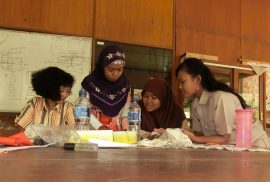
Terima kasih kepada aplikan yang telah mengirim esai kepada panitia Lomba Esai untuk SMA/K – MA/K yang diselenggarakan oleh Program Studi Agama dan Lintas Budaya (Center for Religious and Cross-cultural Studies/CRCS) Sekolah Pasca Sarjana UGM. Kami telah menerima esai dengan berbagai tema tentang opini maupun pengalaman pengelolaan keragaman di sekolah. Esai-esai tersebut telah direview oleh juri dengan mempertimbangkan tema, kedalaman isu, perspektif dan praktik dalam esai yang telah dikirim.

Kami ucapkan selamat bagi peserta yang lolos untuk mengikuti kegiatan workshop. Bagi yang belum lolos kami juga mengucapkan terima kasih atas waktu yang Anda curahkan untuk menulis dan mengirim esai. Masih ada kesempatan di program maupun agenda CRCS lainnya, Anda bisa mengunjungi website kami di https://crcs.ugm.ac.id/.

LOMBA ESAI UNTUK GURU SMA/K – MA di DIY dan Magelang

News Wednesday, 13 May 2015

Download formulir pendaftaran dibawah ini:

FORMULIR PENDAFTARAN LOMBA ESAI

2015 International Summer School on Pluralism, Development and Social Change

HeadlineNews Wednesday, 13 May 2015

summer school

Application Form

2015 International Summer School on Pluralism, Development and Social Change


The Kosmopolis Platform of the University of Humanistic Studies (the Netherlands), in cooperation with HIVOS (Humanist Institute for Cooperation with Developing Countries), the Center for the Study of Religion & Democracy (PUSAD – Pusat Studi Agama & Demokrasi), ParamadinaFoundation, and the Center for Religious and Cross-Cultural Studies of Gadjah Mada University (Indonesia), the Institute for Reconciliation and Social Justice of the University of the Free State (South Africa) and a to be confirmed university in India, welcomes applicants for the 2015 International Summer School on Pluralism, Development and Social Change.

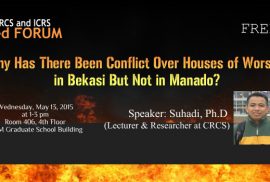
WED FORUM: Why Has There Been Conflict Over Houses of Worship?

Wednesday Forum News Tuesday, 12 May 2015

zhgf2du
Abstract:
The kind of conflict that has kept one HKBP Church community in Bekasi (Greater Jakarta) from having its own house of worship is almost unknown over the building of mosques in the Christian-majority city of Manado in northern Sulawesi. Why? This question about religion, politics, and society in contemporary Indonesia was triggered by the presenter’s research on houses of worship in four parts of Indonesia: Bekasi, Manado, Pontianak (West Kalimantan), and Bali. To answer this question, my Wednesday Forum presentation will discuss two questions: (a) what is the public perception of houses of worship in these two areas, including those of other religions? (b) How does social change (mainly caused by migration) affect interfaith relations and the recognition and protection of houses of worship in the local areas? I usequantitative and qualitative analysis to answer the research questions. I interviewed more than fifty local religious leaders in the aforementioned areas gathered more than 660 questionnaires in order to give a deeper and more satisfying explanation for conflict over houses of worship in Indonesia than has beendone before. My hope is that greater analysis of regional differences will lead to breakthroughs in peacebuilding in Indonesian society.
Speaker:
hJusDQGSuhadi earned his Ph.D. from the Department of Philosophy, Theology, and Religious Studies, Radboud University Nijmegen. He is a lecturer at Center for Religious and Cross-cultural Studies, Graduate School, Universitas Gadjah Mada.
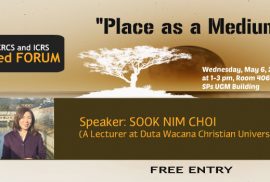
WED FORUM: Place as a Medium

HeadlineWednesday Forum News Saturday, 2 May 2015

EPNdPT2
Abstract
During the Jacob’s early journey, when he had reached certain place, he stopped for the night to rest. He took one of stones to rest his head down to sleep. He had a dream which he had an encounter with God and received blessings from him. Next morning he was afraid and said, “How awesome is this place! This is none other than the house of God; this is the gate of heaven.” Then he poured oil on top of the stone that he had used as pillow. He called that place Bethel.
Do we need a physical place to express our belief or to have a relationship with God or gods? For a long history of humanity has been having a special ‘site’ to gather to worship and share their faith with one another or a secret personal place to adore a higher being. During the Forum, I will use a variety example of places globally visiting temples and sites in Indonesia, korea, Germany, and Tunisia, during the 9th century to compare each other cultures and belief. And temples and ‘site’s that they built will be analyzed to understand their differences and their communalities relation to their belief at that time. The research for their relationship between faith and their special ‘site’ can also leads to ask another questions like do we also need a physical place in the same manner as before? Is there any change in our concept in desire for the worship fashion? If there is any change, what or where is the new place can be substituted the old sites?
Speaker:
ElyXBCXSOOK NIM CHOI. Born in Seoul Korea, in her teen years her family emigrated to São Paulo, Brasil. Studied at Instituto de Matematica e Estatistica da Universidade de São Paulo. After marriage she went to the USA and earned a Bachelor of Fine Arts, at the San Francisco Art Institute, CA, and a Master of Fine Arts, concentration in Painting, at the University of California, Berkeley, where she taught Painting and Installation class for undergraduates. She also assisted all levels of teaching as the director of art in Palo Alto Art Studio. She has been an artist and still very actively exhibiting. She is a successful entrepreneur of ‘Pepe Francois’ a fashion design jewelry business in San Francisco and ‘Palo Alto Art Studio’ an art portfolio creating business in Silicon Valley for many years.

Now she is residing in Yogyakarta and works as a lecturer in the Faculty of Architecture dan Design Product in Duta Wacana Christian University. Email: sooknimchoi@gmail.com

1…4950515253…190

Instagram

crcs_ugm

Sedang tidak baik-baik saja, kamu biasanya mencari Sedang tidak baik-baik saja, kamu biasanya mencari apa di internet?

Banyak anak muda hari ini menemukan ketenangan, nasihat, bahkan jawaban atas kegelisahan melalui media sosial, konten keagamaan, akun kesehatan mental, hingga AI chatbot. Namun, bagaimana sebenarnya pengalaman itu terjadi?
Kami sedang melakukan penelitian untuk memahami bagaimana generasi muda usia 10–24 tahun mencari informasi keagamaan maupun kesehatan mental saat menghadapi masa-masa sulit.
Jika kamu merasa topik ini dekat dengan pengalamanmu, kami mengundangmu menjadi responden.
Partisipasi bersifat sukarela dan seluruh jawaban dijaga kerahasiaannya.
Kamu bisa langsung kirim DM jawabanmu atau mau tanya-tanya dulu juga boleh.

Kami tunggu ya.
Katanja koeliah S2 itoe mahal? Eitss , djangan s Katanja  koeliah S2 itoe mahal? 
Eitss , djangan salah
Bersama keempat mahasiswa angkatan 2025, kita akan ngobrolin djoeroes-djoeroes djitoe mendapatkan beasiswa di CRCS UGM

Begitoe?
Before petroleum fueled the world, it fractured th Before petroleum fueled the world, it fractured the archipelago

The raise of the colonial petroleum industry in the Dutch East Indies was also the emergence of new spatial inequalities. Outer Java was not merely discovered as a resource zone. It was politically produced as an extractive territory through imperial concessions, colonial state-building, and global struggles over resource control.

Join us in this presentation on capitalism, oil, and the colonial fractures that continue to haunt the geography of modern Indonesia. We provide snacks and drinks, don't forget to bring your tumbler. This event is free and open to public.
M B G Satu kotak makan berisi nasi putih pulen seb M B G
Satu kotak makan berisi nasi putih pulen sebagai sumber karbohidrat utama, dimasak dari beras medium pilihan, air, sedikit garam, dan beberapa tetes minyak agar tidak cepat basi. Di sampingnya terdapat ayam semur kecap, dibuat dari potongan daging ayam, bawang merah, bawang putih, kecap manis, daun salam, lengkuas, garam, dan sedikit gula sehingga memberi asupan protein hewani yang cukup untuk pertumbuhan. Sebagai pendamping lauk utama, disediakan tempe orek manis gurih dari tempe iris tipis, bawang merah, bawang putih, cabai, kecap, dan gula merah. Tempe ini berfungsi menambah protein nabati sekaligus membuat kotak makan tampak lebih penuh, sebab protein memang sering lebih meyakinkan bila hadir rangkap dua. Untuk unsur sayuran, ada tumis wortel dan buncis yang dimasak dari wortel segar, buncis, sedikit kol, bawang putih, garam, merica, dan minyak sayur. Warna oranye-hijau pada sayur ini penting: bukan hanya untuk vitamin A dan serat, tetapi juga agar foto dokumentasi tidak terlihat terlalu pucat.Sebagai pelengkap vitamin alami, satu buah pisang atau sepotong pepaya matang diletakkan di sudut kotak. Buah dipilih yang murah, tahan banting, tidak gampang memar, dan cukup fotogenik ketika dibagikan massal. Terakhir, ditambahkan susu UHT kotak kecil berbahan susu sapi, gula, dan fortifikasi vitamin, atau kadang telur rebus utuh sebagai penutup protein tambahan.

Berbuih-buih seperti pelaksanaannya ...
Follow on Instagram

Twitter

Tweets by crcsugm

Universitas Gadjah Mada

Gedung Sekolah Pascasarjana UGM, 3rd Floor
Jl. Teknika Utara, Pogung, Yogyakarta, 55284
Email address: crcs@ugm.ac.id


© CRCS - Universitas Gadjah Mada

KEBIJAKAN PRIVASI/PRIVACY POLICY