• Tentang UGM
  • Portal Akademik
  • Pusat TI
  • Perpustakaan
  • Penelitian
Universitas Gadjah Mada
  • About Us
    • About CRCS
    • Vision & Mission
    • People
      • Faculty Members and Lecturers
      • Staff Members
      • Students
      • Alumni
    • Facilities
    • Library
  • Master’s Program
    • Overview
    • Curriculum
    • Courses
    • Schedule
    • Admission
    • Scholarship
    • Accreditation and Certification
    • Academic Collaborations
      • Crossculture Religious Studies Summer School
      • Florida International University
    • Academic Documents
    • Student Satisfaction Survey
  • Article
    • Perspective
    • Book Review
    • Event Report
    • Class Journal
    • Interview
    • Wed Forum Report
    • Thesis Review
    • News
  • Publication
    • Reports
    • Books
    • Newsletter
    • Monthly Update
    • Infographic
  • Research
    • CRCS Researchs
    • Resource Center
  • Community Engagement
    • Film
      • Indonesian Pluralities
      • Our Land is the Sea
    • Wednesday Forum
    • ICIR
    • Amerta Movement
  • Beranda
  • Berita
  • page. 7
Arsip:

Berita

Dari Diskusi di Kemenag: Memadukan Kebijakan dengan Riset

BeritaHeadlineNews Thursday, 9 March 2017

Subandri Simbolon | CRCS | Berita

Agar tak salah arah, kebijakan seharusnya berdasar pada riset. Kesenjangan antara kebijakan dengan pengetahuan acapkali berujung pada kebijakan yang tak menyelesaikan masalah. Termasuk di sini kebijakan yang berkenaan dengan umat beragama.
Untuk menjembatani pemerintah dengan akademisi, pada 14 Februari 2017 Balitbang Kementerian Agama bekerja sama dengan Pusat Studi Agama dan Demokrasi (PUSAD) Paramadina mengadakan diskusi dengan topik mengenai definisi agama dan penodaan agama sebagai rangkaian dari serial diskusi “Analisis Kebijakan: Riset dan Kebijakan Terkait Kehidupan Beragama di Indonesia”. Serial diskusi ini direncanakan akan menghasilkan buku terkait tema-tema seperti intoleransi, konflik agama, kebebasan beragama dan berkeyakinan, dan kerukunan antarumat beragama. Forum diskusi itu dihadiri berbagai kalangan dari pihak Kemenag, termasuk Menteri Agama Lukman H. Saifuddin, para akademisi dan aktivis. Dua dosen Program Studi Agama dan Lintas Budaya (CRCS), Dr Samsul Maarif dan Dr Zainal Abidin Bagir, menjadi pembicara dalam forum itu.
Definisi Agama
Samsul Maarif memaparkan ulasannya dengan tajuk “Meninjau Ulang Definisi Agama, Agama Dunia, dan Agama Leluhur”. Ia menyampaikan bahwa definisi agama saat ini cenderung diskriminatif karena menggunakan paradigma “agama dunia” (world religion) untuk menilai agama lokal. Paradigma ini dalam diskursus klasik Barat prototipenya adalah Kristen sedangkan dalam konteks Indonesia adalah Islam. Agama-agama lokal, dalam paradigma ini, cenderung menempati posisi yang lebih rendah. Penggunaan paradigma agama dunia itu bukan saja menyusup ke dalam cara pengambilan kebijakan oleh pemerintah, melainkan juga telah menghantui dunia akademik di Indonesia.
Berdasar pada kritik itu, Samsul menyampaikan bahwa pemahaman mengenai agama yang cenderung esensialis harus dihindari, karena agama mesti dipahami secara diskursif berdasarkan konteks waktu, tempat, dan sejarahnya. Yang sebenarnya lebih diperlukan adalah mempertimbangkan definisi dari segi efektifitasnya dalam memecahkan masalah. Dalam hal ini, definisi yang dibuat seharusnya dapat membebaskan kelompok-kelompok tertentu, utamanya kalangan penganut agama leluhur, dari perlakukan diskriminatif.
Di samping itu, Samsul menegaskan bahwa kebijakan dan studi terhadap para penganut agama leluhur mesti dilakukan dalam konteks keragaman agama, yakni bahwa para penganut agama leluhur mendapat kebebasan untuk mendefenisikan agama mereka sendiri. Pemerintah diharapkan dapat memfasilitiasi self-determinism warganya dan melihat mereka sebagai warga negara yang setara. Definisi yang baik adalah definisi yang mampu memberikan hak-hak yang setara pada semua penganut agama, baik agama-agama dunia maupun agama-agama leluhur dan kepercayaan, di Indonesia.
Kebebasan Beragama dan Berkeyakinan
Dalam forum yang sama, Dr Zainal Abidin Bagir berbicara untuk tema “Kajian tentang Kebebasan Beragama dan Berkeyakinan di Indonesia dan Implikasinya untuk Kebijakan”.
Zainal memaparkan diskusi mutakhir tentang Kebebasan Beragama dan Berkeyakinan (KBB) baik di tingkat internasional maupun nasional serta tema-tema yang menonjol. Ia menegaskan bahwa dalam diskursus di tingkat internasional KBB bukanlah konsep yang sudah fixed dan statis, namun mengalami perkembangan hingga saat ini. Di antara masalah yang masih kerap muncul hingga kini dalam diskusi KBB adalah pertentangan antara mereka yang mengklaim universalitas KBB, sebagai bagian dari Deklarasi Universal Hak Asasi Manusia (DUHAM), dan negara-negara yang menggunakan sudut pandang partikularistik, yang merelatifkan KBB. 
Terlepas dari itu, perkembangan yang menarik adalah regionalisasi HAM, yaitu diadopsinya HAM oleh beberapa regional, termasuk Uni Eropa, ASEAN, dan Organisasi Kerja Sama Islam (OKI). Lebih jauh, meskipun ada kecenderungan partikularistik itu, dalam perkembangannya HAM ASEAN dan OKI cenderung mengalami konvergensi ke HAM internasional.
Di Indonesia sendiri, Zainal melihat beberapa perkembangan penting HAM setelah 1998, termasuk ratifikasi beberapa kovenan, dan masuknya klausul khusus mengenai HAM dalam amandemen Undang-Undang Dasar. Selanjutnya, terjadi pengarusutamaan KBB dalam berbagai UU. Perkembangan ini menurut Zainal menjadi sebuah nilai plus bagi Indonesia jika dibandingkan dengan perkembangan regional, khususnya jika dibandingkan dengan banyak negara ASEAN dan OKI. Di Indonesia pun, partikularisasi KBB terjadi, yakni dalam menghadapkan HAM dengan apa yang dianggap sebagai kultur Indonesia dan aspirasi keagamaan sebagian kelompok beragama, khususnya muslim. Salah satu bentuk partikularitas itu diekspresikan dalam konsep “kerukunan”, yang hingga tingkat tertentu menjadi pembatas kebebasan.
Di bagian akhir paparannya, Zainal mengajukan beberapa rekomendasi untuk pengembangan kajian dan perumusan kebijakan terkait KBB. Pertama, “membumikan” KBB dalam tradisi kultural atau keagaman untuk memperluas tingkat penerimaan publik. Kedua, perlunya ada kajian komparatif dengan praktik-praktik kebijakan KBB di negara-negara lain untuk memperkaya perspektif dalam mengidentifikasi faktor-faktor yang menyumbang atau menghambat keberhasilan perumusan maupun implementasi kebijakan. Ketiga, perlunya ada perhatian pada best practices dari praktik-praktik yang sudah terjadi agar kajian kebijakan tak hanya melihat aspek legal secara abstrak namun juga situasi dan kondisi yang memungkinkan keberhasilan perumusan dan penerapan kebijakan.
Batas minimal? 
Dalam sesi tanya jawab, Menteri Agama Lukman Hakim Saifuddin mengajukan satu pertanyaan tentang batas minimal yang harus dilakukan negara dalam Perlindungan Umat Beragama (PUB). Andreas Harsono, dari Human Rights Watch, menjawab bahwa batas minimal adalah tidak terjadinya kekerasan kepada kelompok keagamaan manapun. Zainal melanjutkan dengan menyampaikan bahwa hak-hak administrasi kependudukan, kebebasan beribadah harus dipenuhi bagi semua pemeluk agama, terlepas dari bagaimana agama didefinisikan.
Kasus-kasus yang acapkali terjadi adalah sulitnya sebagian kalangan untuk mendapatkan hal-hak konstitusionalnya. Di beberapa daerah, hak-hak dasar pemeluk agama leluhur belum terlayani secara penuh. Misalnya, seorang anak tidak bisa dimasukkan dalam Kartu Keluarga orang tuanya hanya karena perkawinan mereka berdasarkan agama leluhur dan tak dapat dicatat dalam pencatatan sipil. Hal ini para gilirannya berakibat pada hilang atau berkurangnya akses-akses dalam bidang lain seperti pendidikan, kesehatan dan hak politik.
Di akhir diskusi, Menteri Agama menyampaikan bahwa Kementerian Agama terbuka untuk menerima masukan dari semua pihak, khususnya dalam upaya merumuskan RUU Perlindungan Umat Beragama yang sedang diproses.

Voice vs Noise: Technology-Mediated Sound in Interfaith Dialogue

BeritaHeadlineNewsWednesday Forum News Monday, 20 February 2017


Abstract:
Urban people are always exposed to soundscape, to sounds and noises in their everyday life. With the aid of technology, the soundscape of Yogyakarta has dramatically changed in the last 30-40 years. The sounds which once gave certain characteristics to the city have changed both quantitatively and qualitatively. For most people it does not bother them if they do not pay attention to them. However, people accept certain sounds as acceptable sounds while some other may reject them as disturbing noises. The result of such perceptions create spsychologically different responses, either positively or negatively. Therefore, exploring how people in the City of Tolerance responding to the religious soundscape of the place where they live is an effort to see an interfaith relationship from a different perspective, the auditory angle.
Speaker:
Jeanny Dhewayani, Ph.D. is the Associate Director of Indonesian Consortium for Religious Studies (ICRS) Yogyakarta.She got her Master degree from University of New Mexico and Ph.D. from Australian National University, both in Anthropology. Now, She is also a professor of anthropology at Duta Wacana Christian University.
 

Sounds of the Indigenous

BeritaHeadlineNews Tuesday, 14 February 2017

Anang G Alfian | CRCS | Event

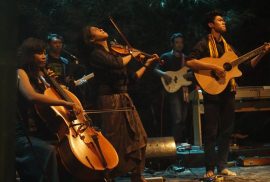
Issues of environmental damage are becoming more pervasive recently. It was just a few months ago we hear the voices of Samin community, indigenous people in the slopes of Mount Kendheng advocating environmental justice against industrialization attack surrounding the mountain, the issue of which inspired Dian Adi M.R., one of CRCS students, to compose instrumental music and conceptualize arts performance at the event called “Sounds of The Indigenous”.
Through his experience in music performance, Dian initiated the event and collaborated with various musicians, environmental activists, and academia of religious and cultural studies. This innovative way of giving collaborative performance is purposively to raise an awareness among various professions to work together on preserving nature.
Held at Taman Budaya Yogyakarta, many visitors crowded the event on the eve of January 25th 2017 to see the performance, which was started by a documentary film about the semen factory against Samin people and other environmental issues happening recently. Some commentaries from local peoples, scholars, and villagers were narrating a number of environmental problems especially in dealing with actors of interests and exploitation of nature. There is a need of consolidation and urgent answer to avoid further consequence of human misconducts toward nature.
As the introduction to the theme was read, a theatrical performance began to tell narratives and stories, and the instrumental music slowly echoed and filled the air of the room. Visitors seemed to enjoy the mystical yet artistic nuances coming out of the cello playing. Throughout the performance, music and theatrical arts were integrated and made a harmonious blend.
Some instruments were used to represent different and rich sounds from different cultures and origins. Besides guitar, violin, and other common instruments, there were also Gambus, a Middle Eastern music instrument played in the end of the session with Arabic vocal. A Dayak instrument called Sape was also used to sing with a children song. It produced a nostalgic scene of happy life when children can play with nature before industrialization has polluted environment and water.
A theatrical narrative called “Hunger” was also enacted to convey indigenous voices demanding justice and prosperity. The story was meant to see how the man’s greed is always the cause of destruction.  “Those local cultures are indeed real guardians of the nature, while ironically many intellectuals go with the interests of those people to build their projects ignoring the locals and the environment,” said Dian commenting on the theme of the performance.
Music can be a means to harmonize the relation between human and nature and awaken the awareness of the shared duty to preserve nature. Justitias Jellita, the Cello player, reflected on music as being in a harmony as she said, “The harmony is not only for musical tunes, but also for the self and the universe. Without harmony, journey of life will lose its meaning, and those who can return to his home is the ones that know where they come from. This Sounds of the Indigenous event is a valuable message and important warning that human will return to his home “Earth” anyway. Therefore, while alive, we’re responsible for our home.”
Indigenous people of Dayak tribe have their own cosmology on their music as what Anang, the Sape player, said, “For Dayak people, they believe an old saying, ‘Sapeh Benutah tulaang to’awah,’ meaning Sape can crush the bones of evil ghosts.”
This event has given us a lesson on how to maintain the relation between man and nature as important elements in the harmony of life. And music is one of the languages the indigenous speak with. Now it is our turn whoever we might be; artists, scholars, or environmental practitioners; to know where we stand on and where we are going to return.
*Anang G Alfian is CRCS student of the 2016 batch

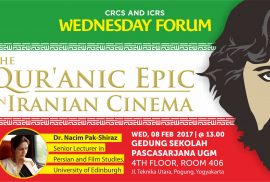
The Qur'anic Epic in Iranian Cinema

BeritaHeadlineNewsWednesday Forum News Friday, 3 February 2017

WED FORUM-02-08-BANNER
Abstract
Iranian cinema is one of the very few in the Muslim world to have employed this new medium in imagining and narrating stories of religious figures. The representation of religious figures in Islam has become particularly controversial in recent years. Therefore, it turned into a highly sensitive undertaking. In this talk I examine the complex socio-political context of Iran to study late emergence of the epic genre in Iranian cinema. In doing so I study the recent creation and development of ‘Qur’anic Films’ within Iranian cinema with specific reference to Kingdom of Solomon (Mulk-i Sulayman-i Nabi, Shahriar Bahrani, 2010), which I argue is the first Qur’anic epic in Iranian cinema if not in the Muslim world.
Speaker
Dr Nacim Pak-Shiraz is the Head of Persian Studies and Senior Lecturer in Persian and Film Studies at the University of Edinburgh. She is the author of Shi’i Islam in Iranian Cinema: Religion and Spirituality in Film (London, 2011) and a number of articles and chapters in the field of Iranian Film Studies. Dr. Pak-Shiraz also regularly collaborates with a number of film festivals, including the Edinburgh International Film Festival and The Edinburgh Iranian Festival.

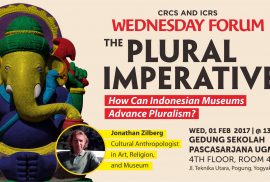
The Plural Imperative: How Can Indonesian Museums Advance Pluralism?

BeritaHeadlineNewsWednesday Forum News Thursday, 26 January 2017


Abstract:
In this discussion, Jonathan Zilberg will discuss problems fracing Indonesian museum in terms of performance, accountability and transparency. He will discuss the Goverment of Indonesia’s 2010-2014 museum revitalization program, the transformations that have been taking place in Indonesia museum over the last decade and the challenges posed for the future. He will look at museums as democracy machines and as postcolonial centers for advacing the ideology of pluralism in civil society. In particular he will address the integrated importance of museums, adchives and libraris for advacing the state of education at all levels including for countinuing adult education.
Speaker:
Jonathan Zilberg is a cultural anthropologist specializing in art and religion and in museum ethnography. He has been studying Indonesian museums for a decade and is particularly interested in museums as democracy machines and as post-colonial centers for advancing the ideology of pluralism in civil society. His immediate interests focus on Hindu-Buddhist heritage including the function of archaeological sites as open air museums as well as of museum collections and government depositories in terms of being under-utilized academic resources. For comparative purposes, he has studied museums in Aceh, Jambi, Jakarta and to a lesser extent observed select museums elsewhere in Indonesia. Currently he is CRCS UGM Visiting Scholar.

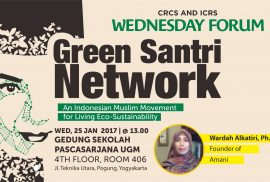
Green Santri Network: An Indonesian Muslim Movement for Living Eco-Sustainability

BeritaHeadlineNewsWednesday Forum News Thursday, 19 January 2017


Abstract:
The Green Santri Network aims to be a socio-ecological movement by Indonesian Muslim groups, using Muslims’ own sensibility and ‘thought language’ to effectively disseminate messages about Islamic ecological values for survival and sustainability and to advance the idea of relocalization, or returning to a smaller scale, as self-reliant communities with simpler ways of living and with self-local governance.  It comes out of my research into how Indonesian Muslim groups, including both the large-scale Muhammadiyah and Nahdlatul Ulama and two examples of green intentional communities, Hidayatullah and An-Nadzir, can contribute toliving knowledge transmission or murabbias a way to make sustainability education relevant in the Islamic symbolic universe in the Indonesian context,based on the understanding that more than intellectual ability is needed to comprehend this knowledge; it must be made personal by living it.
Speaker:
Wardah Alkitiri earned her Ph.D. in Sociology at the University of Canterbury, New Zealand, in 2016. Her dissertation was entitled “Muhammad’s Nation is called “The Potential for Endogenous Relocalisation in Muslim Communities in Indonesia”. She is founder of AMANI, a not-for-profit organization that aims to promote ecological sustainability through entrepreneurial creativity in Jabodetabek and Central Java.

1…56789…17

Instagram

What if "Mecca" is not always in Mecca? Across the What if "Mecca" is not always in Mecca?
Across the Indonesian archipelago, Muslims have developed ways of bringing, imagining, and reconfiguring Mecca within local landscapes. One fascinating case is Tembayat in Central Java—a pilgrimage site shaped by Islamic, Javanese, and Sufi traditions  situated in a landscape with a much older Hindu-Buddhist history.

So, is Tembayat simply a “little Mecca”?
Or something more complicated?

Come and join this thought-provoking discussion at #wednesdayforum.
We provide snacks and drinks, don't forget to bring your tumbler. This event is free and open to public.
Two origin stories. Two journeys through time. The Two origin stories. Two journeys through time.
The Minahasan story of To'ar and Lumimu'ut has travelled through generations and Genesis, too, was retold and reshaped many times before the version we now know as the “fall” became dominant. Neither story has an untouched "original". What happens when we read them side by side—not simply as stories of a fall from grace, but as stories about growing up?
Join this thought provoking discussion with @tirodaenuwysj at #wednesdayforum.
We provide snacks and drinks, don't forget to bring your tumbler. This event is free and open to public.
What does Kendeng teach us about Indonesia’s ecolo What does Kendeng teach us about Indonesia’s ecological disasters today?
Years ago in the North Kendeng Mountains, women resisted cement mining to defend karst mountains, water sources, farmland, and Ibu Bumi. Today, as Indonesia faces floods, landslides, and other ecological disasters, their struggle feels increasingly urgent. Join this thought provoking discussion on how Ibu Bumi becomes a meeting point for Muslim and Sedulur Sikep ecological ethics at #wednesdayforum.
We provide snacks and drinks, don't forget to bring your tumbler. This event is free and open to public.
Can the body be a language of faith? Explore how C Can the body be a language of faith?
Explore how Confucian values are embodied through ritual, gestures, discipline, and everyday practices.
From li and xiao to colonial Indonesia and the Covid-19 pandemic, we will discover how the body becomes a site of virtue, faith, and social harmony.

Join this discussion at #wednesdayforum with @sutrisno.evi
We provide snacks and drinks, don't forget to bring your tumbler. This event is free and open to public.
Follow on Instagram

Twitter

Tweets by crcsugm

Universitas Gadjah Mada

Gedung Sekolah Pascasarjana UGM, 3rd Floor
Jl. Teknika Utara, Pogung, Yogyakarta, 55284
Email address: crcs@ugm.ac.id


© CRCS - Universitas Gadjah Mada

KEBIJAKAN PRIVASI/PRIVACY POLICY