• Tentang UGM
  • Portal Akademik
  • Pusat TI
  • Perpustakaan
  • Penelitian
Universitas Gadjah Mada
  • About Us
    • About CRCS
    • Vision & Mission
    • People
      • Faculty Members and Lecturers
      • Staff Members
      • Students
      • Alumni
    • Facilities
    • Library
  • Master’s Program
    • Overview
    • Curriculum
    • Courses
    • Schedule
    • Admission
    • Scholarship
    • Accreditation and Certification
    • Academic Collaborations
      • Crossculture Religious Studies Summer School
      • Florida International University
    • Academic Documents
    • Student Satisfaction Survey
  • Article
    • Perspective
    • Book Review
    • Event Report
    • Class Journal
    • Interview
    • Wed Forum Report
    • Thesis Review
    • News
  • Publication
    • Reports
    • Books
    • Newsletter
    • Monthly Update
    • Infographic
  • Research
    • CRCS Researchs
    • Resource Center
  • Community Engagement
    • Film
      • Indonesian Pluralities
      • Our Land is the Sea
    • Wednesday Forum
    • ICIR
    • Amerta Movement
  • Beranda
  • Wednesday Forum News
  • Interfaith Dialogue and the Pandemic

Interfaith Dialogue and the Pandemic

  • Wednesday Forum News
  • 19 May 2020, 21.19
  • Oleh: CRCS UGM
  • 0

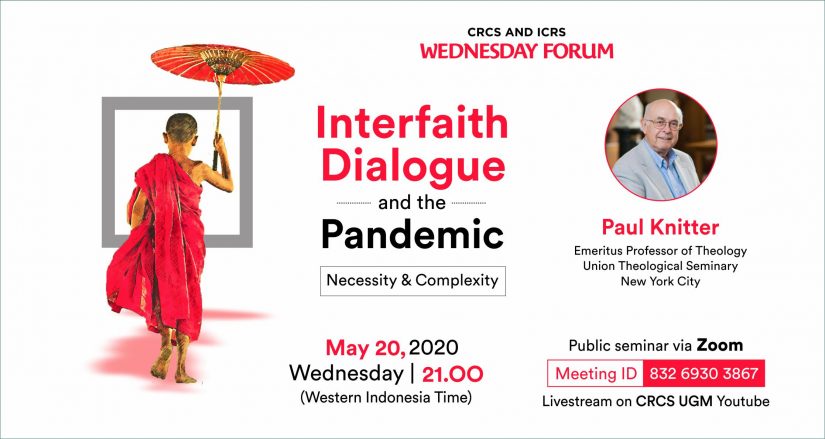
Interfaith Dialogue and the Pandemic: Necessity and Complexity

Wednesday Forum – May 20, 2020

Paul Knitter is an old friend of CRCS, having taught courses here between 2004 and 2006.  To open our conversation with him, he will review some of the main concerns of his long career as a Christian dialogical theologian: 

  • The need that Christianity and all religions have of developing a “theology of religions.” Such a theology is necessary in order to confront the reality that all (or most) religions contain within their teachings and beliefs obstacles to their commitment to interreligious dialogue.
  • The necessity, and the opportunity, of basing interreligious dialogue on the shared commitment of all religions to promoting human and environmental justice and well-being. (especially at this time of the pandemic). Interreligious conversation should be based on interreligious action and cooperation. 
  • What he has learned from his long dialogue with Buddhism (summarized in his book Without Buddha I Could Not Be a Christian), especially what social activists can learn from Buddhism concerning the “primacy” of compassion over justice, and of contemplation over action.
  • His recent research and publications about the generally unrecognized links between racial (or ethnic or national) supremacy and religious supremacy.

He will then take up questions about “Religions and the Pandemic” – what religious faith and interreligious dialogue can contribute to confronting the suffering and confusion that the pandemic has caused for so many people. 

Paul Knitter is the Paul Tillich Emeritus Professor of Theology and Religions at Union Theological Seminary in New York City. He earned a Licentiate in Theology at the Catholic Pontifical Gregorian University in Rome Italy (1966) before going on to earn his Doctorate in Theology from the Protestant University of Marburg in Germany (1972). 

Look at the full poster of this event here.

Paul Knitter taught at CRCS in 2003

Instagram

Clicks are shaping conflicts. In Indonesia’s digit Clicks are shaping conflicts.
In Indonesia’s digital sphere, algorithms now fuel intolerance, speed up radical shifts, and collapse the distance between online anger and real-world violence. “From Clicks to Conflict” reframes radicalism and extremism through Indonesia’s own data, cases, and digital behavior. Understanding how hate evolves online isn’t optional anymore. It’s the frontline of preventing the next wave of violence. 

Come and join  #wednesdayforum discussion at UGM Graduate School building, 3rd floor.  We provide snacks and drinks, don't forget to bring your tumbler. This event is free and open to public.
H I L A N G Dalam sejarah perjuangan peradaban, pe H I L A N G
Dalam sejarah perjuangan peradaban, perempuan kerap ditulis sebagai jeda, bukan kalimat utama. Ia seolah hilang tak terdengar meski perannya selalu bingar. Seperti yang ditunjukkan oleh keempat pembicara ini, perempuan kerap menjadi dasar atas sebuah pergerakan, selalu menemukan celah dan mengubahnya menjadi kehidupan. Dari keempatnya kita belajar bahwa perempuan punya hak dan kemampuan untuk menafsir ulang hidup tanpa harus menunggu restu siapa pun.

Simak kembali percakapan di sesi ini dan menapaktilasi ragam perjuangan perempuan seluas mungkin di YouTube CRCS UGM.
L A M P I O N Memori laiknya lampion. Terkadang ia L A M P I O N
Memori laiknya lampion. Terkadang ia redup dan rawan, tetapi terus menggantung di langit halaman. Arsip ialah bahan bakar yang terus menghidupi ingatan. Ia menjadi sumbu bagi suluh yang berpijar. Pun dengan arsip-arsip budaya dan agama Tionghoa di Indonesia. Keberadaannya menjadi pembuka jalan untuk menata kembali peta bangsa dari serpihan gelap yang sengaja dilupakan. 

Simak kembali perbincangan bernas peluang dan tantangan digitalisasi arsip-arsip budaya dan agama Tionghoa di Indonesia hanya di YouTube CRCS UGM
Faith could be cruel. It can be used to wound thos Faith could be cruel. It can be used to wound those we might consider "the other". Yet, rather than abandoning their belief, young queer Indonesians choose to heal by re-imagining it. The Rainbow Pilgrimage is a journey through pain and prayer, where love becomes resistance and spirituality turns into shelter. Amidst the violence, they walk not away from faith, but towards a kinder, more human divine. 

Come and join #wednesdayforum discussion at UGM Graduate School building, 3rd floor. We provide snacks and drinks, don't forget to bring your tumbler. This event is free and open to public.
Follow on Instagram

Twitter

Tweets by crcsugm

Universitas Gadjah Mada

Gedung Sekolah Pascasarjana UGM, 3rd Floor
Jl. Teknika Utara, Pogung, Yogyakarta, 55284
Email address: crcs@ugm.ac.id


© CRCS - Universitas Gadjah Mada

KEBIJAKAN PRIVASI/PRIVACY POLICY