• Tentang UGM
  • Portal Akademik
  • Pusat TI
  • Perpustakaan
  • Penelitian
Universitas Gadjah Mada
  • About Us
    • About CRCS
    • Vision & Mission
    • People
      • Faculty Members and Lecturers
      • Staff Members
      • Students
      • Alumni
    • Facilities
    • Library
  • Master’s Program
    • Overview
    • Curriculum
    • Courses
    • Schedule
    • Admission
    • Scholarship
    • Accreditation and Certification
    • Academic Collaborations
      • Crossculture Religious Studies Summer School
      • Florida International University
    • Academic Documents
    • Student Satisfaction Survey
  • Article
    • Perspective
    • Book Review
    • Event Report
    • Class Journal
    • Interview
    • Wed Forum Report
    • Thesis Review
    • News
  • Publication
    • Reports
    • Books
    • Newsletter
    • Monthly Update
    • Infographic
  • Research
    • CRCS Researchs
    • Resource Center
  • Community Engagement
    • Film
      • Indonesian Pluralities
      • Our Land is the Sea
    • Wednesday Forum
    • ICIR
    • Amerta Movement
  • Beranda
  • Wednesday Forum News
  • Protecting the future: Climate change and intergenerational justice

Protecting the future: Climate change and intergenerational justice

  • Wednesday Forum News
  • 10 October 2018, 10.29
  • Oleh: ardhy_setyo
  • 0

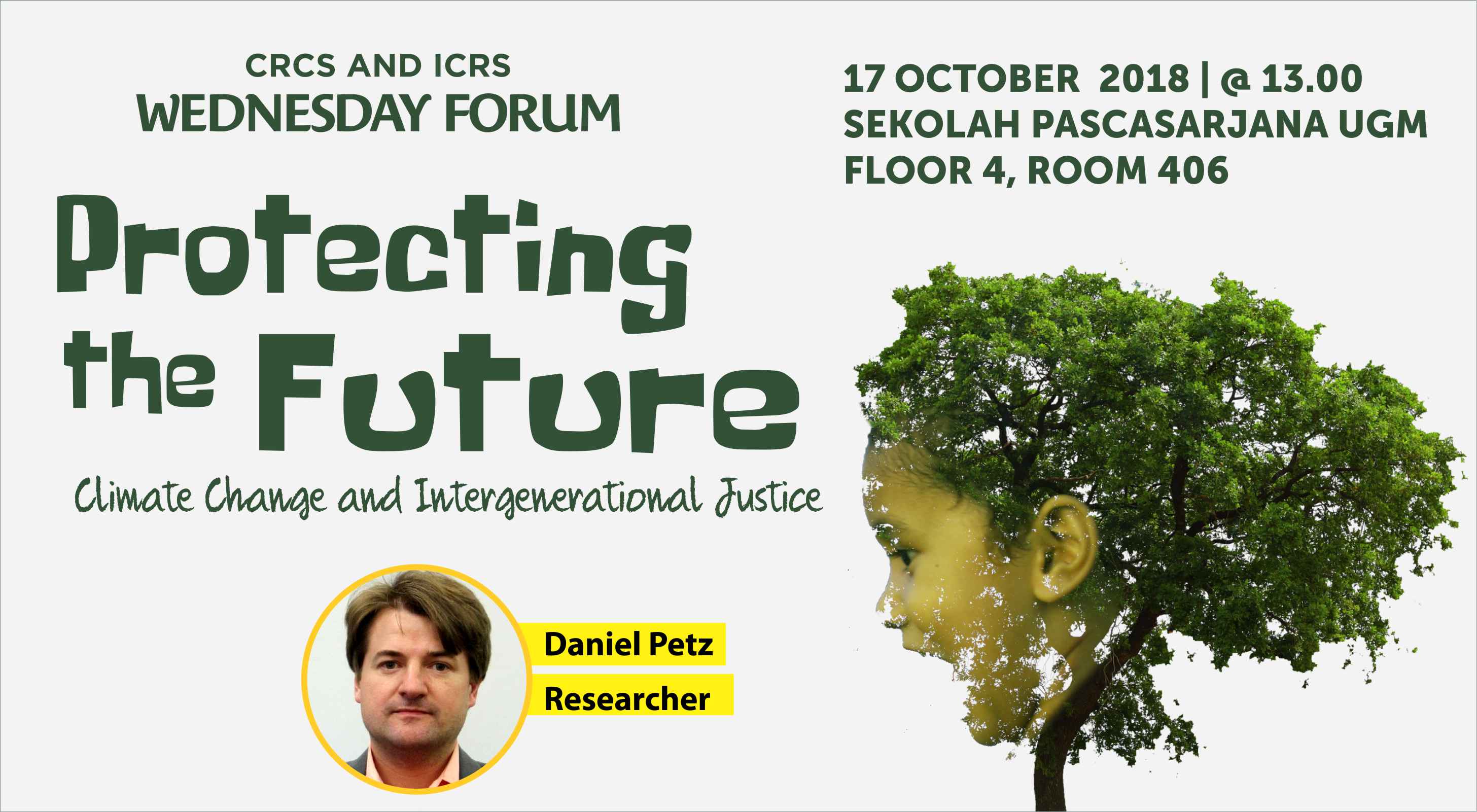
The emerging field of climate ethics is essential for the survival of life on our one earth and for imagining a more just future in the face of the reality of climate change. Not only does climate change pose a threat to current generations, but it forces us to understand our rights and duties in a multigenerational time frame and to ask how we are to weigh interests of the present against the risks of violating the rights of future generations as we formulate climate change policies. This talk employs a sufficientarian approach to distributive and intergenerational justice, using a threshold conception of harm and capabilities as the currency of justice.   

Daniel Petz finished his PhD on climate ethics at University of Graz (Austria) in 2018. He has served as a researcher on natural disaster and climate change issues with the Brookings Institution (USA) and as a guest lecturer and researcher in UGM’s Department of International Relations and Center for Security and Peace Studies.

Look at the full poster of this event here.
Tags: climate change daniel petz

Leave A Comment Cancel reply

Your email address will not be published. Required fields are marked *

*

Instagram

A S (E L A) M A T Konon, Asmat berasal dari kata " A S (E L A) M A T
Konon, Asmat berasal dari kata "As Akat" dalam bahasa setempat yang berarti 'orang yang tepat'. Entah kebetulan atau ada akar bahasa turunan, kata "ismat" (عِصْمَة) dalam bahasa Arab artinya perlindungan dan kerap merujuk pada salah satu sifat manusia terpilih. Hompimpa etimologis tersebut menyiratkan bahwa keselamatan sudah menubuh dalam masyarakat adat Asmat. Namun, keselamatan rupanya punya banyak versi dan tidak selalu bersepakat, bahkan saling meniadakan. Apa pun versinya, keselamatan tak boleh menjadi alasan untuk menghapus memori, apalagi eksistensi. Keselamatan seharusnya membuka ruang baru untuk saling memahami.

Simak ulasan @yunus_djabumona tentang Asmat dan keselamatan hanya di situs web crcs.
keluarga bukan soal kepemilikan, melainkan keberpi keluarga bukan soal kepemilikan, melainkan keberpihakan
damai bahagia untuk sesama dan semesta
I B U Mari berhenti sejenak dari perdebatan apaka I B U 
Mari berhenti sejenak dari perdebatan apakah 22 Desember lebih layak disebut Hari Ibu atau Hari Gerakan Perempuan. Keberadaannya menjadi momentum dan pengingat bahwa sejarah perlawanan dibangun dari ingatan-ingatan yang sering sengaja disisihkan.

Perempuan adalah ibu yang melahirkan sejarah.
Ketika pengalaman perempuan dihapus dari narasi resmi, yang hilang bukan hanya cerita melainkan pelajaran tentang keberanian, solidaritas, dan ketahanan sosial. 

Simak ulasan @nauliahanif di situs web crcs
Clicks are shaping conflicts. In Indonesia’s digit Clicks are shaping conflicts.
In Indonesia’s digital sphere, algorithms now fuel intolerance, speed up radical shifts, and collapse the distance between online anger and real-world violence. “From Clicks to Conflict” reframes radicalism and extremism through Indonesia’s own data, cases, and digital behavior. Understanding how hate evolves online isn’t optional anymore. It’s the frontline of preventing the next wave of violence. 

Come and join  #wednesdayforum discussion at UGM Graduate School building, 3rd floor.  We provide snacks and drinks, don't forget to bring your tumbler. This event is free and open to public.
Follow on Instagram

Twitter

Tweets by crcsugm

Universitas Gadjah Mada

Gedung Sekolah Pascasarjana UGM, 3rd Floor
Jl. Teknika Utara, Pogung, Yogyakarta, 55284
Email address: crcs@ugm.ac.id


© CRCS - Universitas Gadjah Mada

KEBIJAKAN PRIVASI/PRIVACY POLICY