Sembilan mahasiswa CRCS dari dua angkatan yang berbeda berhasil memeroleh gelar Master of Art dari Program Studi Agama dan Lintas Budaya pada prosesi wisuda Pascasarjana Universitas Gadjah Mada, Selasa, 19 April 2016. Sebagian besar dari mereka mendapatkan penghargaan sebagai wisudawati-wisudawan berprestasi dengan predikat cum laude. Tema thesis mereka pun cukup beragam mulai dari etika, budaya lokal, kesehatan, media online, humanitarian, tato, aliran kepercayaan, lingkungan hingga gerakan keagamaan. Berikut nama-nama dan karya thesis mereka:
Arsip:
CRCS

Center for Religious and Cross-cultural Studies (CRCS), Graduate School, Gadjah Mada University proudly announces the call for Thesis Award. The Award is aimed to encourage CRCS students of batch 2015 to write a high quality of master thesis and a publishable article out the thesis on “Religious Education in Higher Education.”
The requirements of the Thesis Award are:
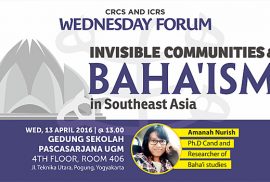

Abstract
The spread of religious millenarianism in the member states of the Association of Southeast Asian Nations (ASEAN) has raised significant questions about religious movement in those countries. The Baha’i religion provides an important case and relevant context as the Baha’i movement has been paralyzed in its country of origin, Iran, since the beginning of the movement in 1844. To avoid persecution and violence, many Baha’i adherents moved to other regions in Southeast Asia. The Baha’i religion is committed to developing educational skills, economic sustainability, gender empowerment, and social movements. Thus, ASEAN encompasses a dynamic and diverse region that aims to provide social, religious, economic, and cultural security for ASEAN citizens. Minority religions such as the Baha’i community, which at the times are victims of conflict and violence, play an important role in achieving those aims. Conversely, religious violence and conflict may be seen as part of the regional deficit in terms of religious freedom and tolerance. In this context, my study tries to examine religious millenarianism and the future evolution of the ASEAN community. The study investigates the co-existence of the Baha’i community with other religious groups such as Muslim, Christian, and Buddhist in their social, political, and cultural negotiations. As the Baha’i engage on some social and political issues in globalization and embrace liberalism and pluralism in the public space, I argue that this study contributes to scholarship in terms of understanding the fate of religious millenarianism in the future of the ASEAN community.
Speaker
Amanah Nurish Ph.D Cand Researcher of Baha’i studies. She is pursuing doctorate at ICRS UGM-Yogyakarta and working as consultant of USAID team-Washington for assessment program, “Fragility and Conflict”. She wrote book chapters, articles, and journals. Her latest publications: Sufism and Baha’ism: The Crossroads of Religious Movement in Southeast Asia (2016, Equinox publisher, London) Perjumpaan Baha’i Dan Syiah Di Asia Tenggara (2016, Maarif Jurnal, Jakarta) Welcoming Baha’i: New Official Religion In Indonesia (2014, The Jakarta Post) Social Injustice and Problem Of Human Rights In Indonesian Baha’is Community (2012, En Arche Journal, Yogyakarta) etc. She received prestigious awards for her academic works such as King Abdullah Bin Abdulazis’s interfaith center-Vienna, SEASREP-Philippine, ENITS-Thailand, Luce & Ford Foundation-USA, ARI-NUS, etc. With her teamwork, she is currently undertaking a broader anthropological research on “ Religious Millenarianism in ASEAN countries” for publication supported by Arizona State University of America.

Aziz Anwar Fachrudin | CRCS | Article
 Among the challenges Muslims face when they are engaged in the recently overwhelming debate on whether Islam is a religion of violence/peace is the fact that the Quran contains many verses which, at least when seen at a glance, promote violence. Indeed, there are verses in the Quran that even encourage fighting and killing, addressed to those considered unbelievers/infidels (kuffar) and/or polytheists (mushrikin); and when they are read and interpreted literally, they can be seen as preaching hatred toward non-Muslims. Moreover, some of those verses have been picked by the Islamic State (of Iraq and al-Sham, or ISIS) to justify its atrocities toward those having different beliefs. On the other hand, those “violent verses” are often cited by many involved in the debate, particularly by Islamophobias in the West, to discredit Islam and to show that Islam is a religion of violence, instead of peace.
This paper is going to examine those “violent verses’; not all, but some of them that have similar redaction. That is, those verses which read, more or less, “kill them wherever you find them”. There are three verses which are like that: (1) QS. al-Baqarah [2]:191; (2) QS. al-Nisa’ [4]:89; and (3) QS. al-Tawbah [9]:5. It is to examine both the classical and the modern interpretations of those three verses. By classical interpretations I mean the interpretations and commentaries of those verses as in classical books of tafsir written by medieval, pre-modern Muslim scholars of exegesis, to which very often many Muslims today still refer. By modern interpretations I mean the interpretations and commentaries that are written by modern Muslim exegetes. Along this line of elaboration, I shall compare both in order to know to what extent there has been a change in interpretations of the abovementioned verses.
This paper shall therefore be intended to convey three things. First is to show both classical and modern interpretations of those verses. Second is to point out what we will get when we compare those two types of interpretations and how the verses have been interpreted differently. Third, this paper shall be finished by some hermeneutical reflections resulting from the examination of both the classical and the modern interpretations. As for the classical interpretations, the books of tafsir that shall be mostly referred to in this paper are that of al-Tabari (839-923), Al-Razi (1149-1209), al-Qurtubi (1214-1273), and Ibn Kathir (1301-1373). While for the modern interpretations, the books of tafsir that shall be referred to are that of Rashid Rida (1865-1935), al-Sha‘rawi (1911-1998), Al-Zuhayli (1932-2015), and Quraish Shihab (1944-…). All these books of tafsir contains exegeses that are elaborated in chronological, chapter-based way, or verse by verse conforming to the way the verses are serially organized in the Quran. (This way is technically known as al-tafsir al-tajzi‘i or tafsir based on chapters or partitions of the Quran, as compared to al-tafsir al-mawdu‘i or tafsir based on themes/topics.) In this paper, when I mention a name of a mufassir (exegete) of them, it means I refer to his interpretations/commentaries that come after the verse being discussed. Read more in religio.uinsby.ac.id
*Aziz Anwar Fachrudin is CRCS Student batch 2014
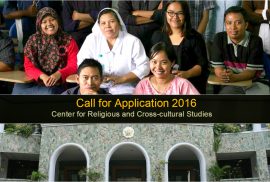
Applications for admission to the Center for Religious and Cross-cultural Studies (CRCS) for the 2016/2017 academic year are now being accepted. For more information click Admission 2016 and information on scholarship click Scholarship


Abstract
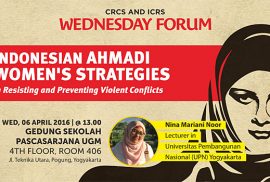
The Indonesian Ahmadiyya community has been facing violent conflicts after the Reformasi era. This dissertation focuses on the narrative of Ahmadi women about their experiences in dealing with daily conflicts they face in relation to their faith. This paper focuses on the acts of the Ahmadi women organization called Lajnah Imaillah from 2000 to early 2015 by examining their defense mechanism and exercising agency in resisting and preventing conflicts. The study was conducted in four areas in Indonesia, Kuningan in West Java, Yogyakarta, Lombok in West Nusa Tenggara and Head Office of Lajnah Imaillah in Bogor. The informants were Ahmadi women from different socio economics status and positions in the organization. Using narrative inquiry, this research found out that in responding and resisting to violent conflicts, Lajnah Imaillah has been changing its way of resistance and its forms of defense mechanism. The conflicts that Ahmadi women face have encouraged them organizationally and individually to be more actively participate in wider society and build good relationships with the religious others outside of the community. Therefore this paper argues that non-violent defense mechanism promotes better relations and mutual understanding among conflicting parties in society.
Speaker
 Nina Mariani Noor just earned her Ph.D from Inter Religious Studies, ICRS (Indonesian Consortium For Religious Studies) Universitas Gadjah Mada last January. Her concern is on conflict resolution, gender, and minority studies. Nina is Programme Executive Globethics.net Indonesia (www.globethics.net) . Globethics.net is the biggest, global online platform dedicated to promote inclusive, values-driven transformation for sustainable living, through access to knowledge, networking, collaborative research, training and events. She also teaches in Universitas Pembangunan Nasional (UPN) Yogyakarta this semester.