• Tentang UGM
  • Portal Akademik
  • Pusat TI
  • Perpustakaan
  • Penelitian
Universitas Gadjah Mada
  • About Us
    • About CRCS
    • Vision & Mission
    • People
      • Faculty Members and Lecturers
      • Staff Members
      • Students
      • Alumni
    • Facilities
    • Library
  • Master’s Program
    • Overview
    • Curriculum
    • Courses
    • Schedule
    • Admission
    • Scholarship
    • Accreditation and Certification
    • Academic Collaborations
      • Crossculture Religious Studies Summer School
      • Florida International University
    • Academic Documents
    • Student Satisfaction Survey
  • Article
    • Perspective
    • Book Review
    • Event Report
    • Class Journal
    • Interview
    • Wed Forum Report
    • Thesis Review
    • News
  • Publication
    • Reports
    • Books
    • Newsletter
    • Monthly Update
    • Infographic
  • Research
    • CRCS Researchs
    • Resource Center
  • Community Engagement
    • Film
      • Indonesian Pluralities
      • Our Land is the Sea
    • Wednesday Forum
    • ICIR
    • Amerta Movement
  • Beranda
  • fatimah husein
  • fatimah husein
Arsip:

fatimah husein

Showing off piety: between wefies and riya’

HeadlineNewsWednesday Forum Report Thursday, 6 April 2017

Anang G Alfian | CRCS | Wednesday Forum Report

As a product of the globalized world, social media have created a virtual space of communication and interaction. Many people use it with enthusiasm as it helps humans build communication and connectivity much faster than ever before. On the other hand, many consider this phenomenon a challenge for living ethically and productively.

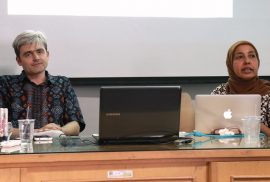
Dealing with this topic, Wednesday Forum on February 9th 2017 held a discussion on “wefies” (group self-portraits posted on social media) in relation to the Islamic concept of riya’ (showing off piety). The two speakers, Fatimah Husein, currently teaching at CRCS/ICRS as well as UIN Sunan Kalijaga, and Martin Slama of the Institute for Social Anthropology at the Austrian Academy of Sciences, presented the emerging phenomenon of online piety in Indonesia, especially on how Muslims rethink riya’ in today’s popular “wefie” culture. The presentation was based on Husein’s article titled “The Revival of Riya’: Displaying Muslim Piety Online in Indonesia” which has been submitted for a virtual issue of American Ethnologist and Slama’s research project on “Islamic (Inter)Faces of the Internet: Emerging Socialities and Forms of Piety in Indonesia” funded by the Austrian Science Fund.
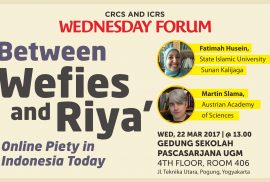
Between Wefies and Riya’: Online Piety in Indonesia Today

HeadlineNewsWednesday Forum News Thursday, 16 March 2017


Abstract
The presenters examine popular forms of online piety in Indonesia. They are particularly concerned how Indonesian Muslims try to cope with the ambivalences that their social media practices inevitably generate. These practices range from taking wefies (selfies of a group of people) at religious events that are posted on social media platforms, participating in online Quran reading groups, various form of online da’wah (proselytization) to documenting one’s pilgrimages and meetings with Islamic figures online. Given the importance of visibility that these social media practices entail, the presentation has a special focus on the concept of riya’ (showing off one’s piety) reminding Muslims to avoid that behavior. Arguing that discussions about riya’ have experienced a kind of revival in today’s social media age, the presenters attempt to point out that online piety is inherently ambiguous eliciting a dynamic of discourses and practices that considerably informs the current field of Islam in Indonesia today.
Speaker
Fatimah Husein teaches at the State Islamic University Sunan Kalijaga Yogyakarta. Her latest article entitled “The Revival of Riya’: Displaying Muslim Piety Online in Indonesia” has been submitted for a virtual issue of American Ethnologist.
Martin Slama is a researcher at the Institute for Social Anthropology, Austrian Academy of Sciences. His latest publications include “A Subtle Economy of Time: Social Media and the Transformation of Indonesia’s Islamic Preacher” Economy (Economic Anthropology 4:1, 2017). 
Look at the full poster here.

Instagram

📢 Fellowship Kebebasan Beragama atau Berkeyakinan 📢 Fellowship Kebebasan Beragama atau Berkeyakinan (KBB) 2026 – Angkatan VII

CRCS UGM bersama sejumlah lembaga mitra membuka kesempatan bagi 20–25 dosen untuk mengikuti program fellowship yang berfokus pada isu kebebasan beragama atau berkeyakinan di Indonesia.
Program ini ditujukan bagi dosen dari bidang hukum, syariah, teologi, filsafat, studi agama, serta ilmu sosial dan politik yang tertarik mengembangkan pengajaran, riset, dan diskusi akademik tentang KBB di perguruan tinggi.
Melalui fellowship ini, peserta akan mendapatkan ruang belajar, jejaring akademik, serta dukungan untuk memperkuat kajian dan pengajaran tentang kebebasan beragama di kampus.
To understand Iran, geopolitics alone is not enoug To understand Iran, geopolitics alone is not enough.
Behind every headline about war or sanctions lies a deeper landscape of history, memory, and moral imagination. In this conversation, Dicky Sofjan shows that contemporary conflicts involving Iran cannot be read only through the language of strategy and power. They must also be understood through the histories and symbols that continue to mobilize political and social meaning today.

Click the link in our bio to read the full interview.
Some changes in family life arrive quietly. In Yog Some changes in family life arrive quietly. In Yogyakarta and Ponorogo, more husbands cook, clean, and care for children, while still remaining the imam in the household. What shifts is not only labor but the meaning of leadership, belief, and marriage itself. A small domestic change opens a larger question about gender, religion, and the stories families tell about themselves.

Join the conversation at the #wednesdayforum with Alimatul Qibtiyah, March 11 at UGM or via livestream. We're offering a free iftar, so get there early! This event is free and open to the public.
What is well-being? Indonesia today: land taken, f What is well-being?
Indonesia today: land taken, forests cleared, plantations marching under the banner of food security. Officials call it progress, yet Indigenous ground tells another story. Baduy farmers keep ngahuma alive: rice, ritual, survival, all tied together. Wellbeing here isn’t profit. It’s balance when human and earth still holding on.

Join us for the next  #wednesdayforum discussion at the 3rd floor of the UGM Graduate School building. We're offering a free iftar, so please register. This event is free and open to the public.
Follow on Instagram

Twitter

Tweets by crcsugm

Universitas Gadjah Mada

Gedung Sekolah Pascasarjana UGM, 3rd Floor
Jl. Teknika Utara, Pogung, Yogyakarta, 55284
Email address: crcs@ugm.ac.id


© CRCS - Universitas Gadjah Mada

KEBIJAKAN PRIVASI/PRIVACY POLICY