• Tentang UGM
  • Portal Akademik
  • Pusat TI
  • Perpustakaan
  • Penelitian
Universitas Gadjah Mada
  • About Us
    • About CRCS
    • Vision & Mission
    • People
      • Faculty Members and Lecturers
      • Staff Members
      • Students
      • Alumni
    • Facilities
    • Library
  • Master’s Program
    • Overview
    • Curriculum
    • Courses
    • Schedule
    • Admission
    • Scholarship
    • Accreditation and Certification
    • Academic Collaborations
      • Crossculture Religious Studies Summer School
      • Florida International University
    • Academic Documents
    • Student Satisfaction Survey
  • Article
    • Perspective
    • Book Review
    • Event Report
    • Class Journal
    • Interview
    • Wed Forum Report
    • Thesis Review
    • News
  • Publication
    • Reports
    • Books
    • Newsletter
    • Monthly Update
    • Infographic
  • Research
    • CRCS Researchs
    • Resource Center
  • Community Engagement
    • Film
      • Indonesian Pluralities
      • Our Land is the Sea
    • Wednesday Forum
    • ICIR
    • Amerta Movement
  • Beranda
  • Human security
  • Human security
Arsip:

Human security

Shifting the center of security concerns to humanity

HeadlineNewsWednesday Forum Report Monday, 23 October 2017

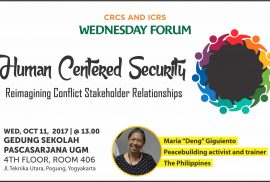
Wednesday Forum report of the presentation by Maria "Deng" Giguiento, a peacebuilding activist and trainer at Mindanao Peacebuilding Institute.

Human Centered Security: Reimagining Conflict Stakeholder Relationships

HeadlineNewsWednesday Forum News Wednesday, 4 October 2017

Wednesday Forum, Oct 11, 2017, with Maria (Deng) Gigiento from the Philippines.
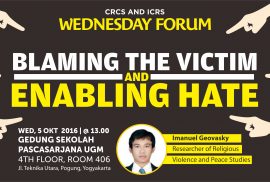
Wednesday Forum: Blaming The Victim and Enabling Hate

NewsWednesday Forum News Thursday, 29 September 2016

wed-forum-10-05banner
Abstract
Who has the authority to end the discrimination and violence religious minority groups continue to face despite protections promised in Indonesia’s constitution? This talk examines three recent cases—the Ahmadiyya in West Java, Shi’a in East Java, and two HKBP churches also in West Java—to show how the three kinds of authority (legal-rational, traditional, and charismatic) identified by Max Weber are all used to legitimate extremism and violence in the face of contradictory actions by the government, including religious leaders with institutional authority inside it. Unless the actors in the government recognize that they must use their authority responsibly, extremist religious leaders who seek to mobilize hate against others, especially minorities, will continue to be able to do so and Indonesian society will remain immature.
Speaker
Imanuel Geovasky is graduated from School of Public Policy and Social Research International Christian University, Tokyo, Japan. He got Japan ICU Foundation Scholarship (JICUF) (New York based) and United Board for Higher Education in Asia (UBCHEA) (New York and Hongkong based) Faculty Development Scholarship for Master Degree in Peace Studies at International Christian University, Tokyo, Japan, from September 2013 – July 2015. His focus research on Religious-based violence and discrimation against minorities in Indonesia society, Human security and Peace building.

Instagram

What happens when religious identities refuse to f What happens when religious identities refuse to fit neatly into sectarian labels? This forum explores how Shiʿi histories are constructed, remembered, and contested across Southeast Asia and beyond. Through fragmented evidence, shifting allegiances, and local knowledge traditions, it asks who gets to define religious belonging—and whose histories get recognized, obscured, or forgotten.

Come and join this thought-provoking discussion with @sarahmuwahidah at #wednesdayforum.
We provide snacks and drinks, don't forget to bring your tumbler. This event is free and open to public.
SADAR Salib berdiri, saf salat merapat. Sebuah po SADAR 
Salib berdiri, saf salat merapat. Sebuah potret kebersamaan yang mengingatkan bahwa perbedaan keyakinan tidak harus menjadi penghalang untuk berjalan bersama. Ketika demonstrasi usai, ujian lain pun dimulai: apakah kita tetap berdiri di sisi mereka yang tertindas, bahkan ketika mereka berbeda keyakinan?

simak tulisan @angelique_tjoa tentang #indonesiasadar hanya di situs web crcs
SABDA-ABDI Bunyinya berdekatan, tetapi jarak kuas SABDA-ABDI

Bunyinya berdekatan, tetapi jarak kuasanya bisa sejauh langit dan bumi. Sabda datang dari atas, abdi belajar mendengarkan dari bawah. Yang satu terbiasa dituruti, yang lain diharapkan berbakti. Namun, apa jadinya ketika abdi mulai bersabda? Apakah gusti masih bersedia mendengar, atau telinga istana hanya terbuka untuk pujian? Barangkali, yang perlu diuji bukan kesetiaan abdi, melainkan kebesaran seorang gusti: sanggupkah ia menerima suara yang tak lagi terdengar seperti sembah?

baca gerundelan aelengkapnya di situs web crcs
Can the body speak where words fall short? Throug Can the body speak where words fall short?

Through Amerta Movement, dialogue moves beyond words into movement, embodiment, and sensory awareness. Dance becomes a way of listening, relating, and connecting—with ourselves, others, and the world around us.

Join us in reimagining dialogue with @samsulmaarif6202 at #wednesdayforum.

We provide snacks and drinks, don't forget to bring your tumbler. This event is free and open to public.
Follow on Instagram

Twitter

Tweets by crcsugm

Universitas Gadjah Mada

Gedung Sekolah Pascasarjana UGM, 3rd Floor
Jl. Teknika Utara, Pogung, Yogyakarta, 55284
Email address: crcs@ugm.ac.id


© CRCS - Universitas Gadjah Mada

KEBIJAKAN PRIVASI/PRIVACY POLICY