Wednesday forum sebagai acara rutin CRCS/ICRS di awal tahun 2016 mengundang Risnawati Utami, seorang aktifis hak asasi untuk masyarakat difable. Bersama dengan organisasinya, OHANA (Organisasi Harapan Nusantara) dia memberikan advokasi untuk masyarakat dengan kebutuhan khusus. Advokasi ini untuk mengawal para difable agar diperlakukan setara dengan masyarakat Indonesia yang lain.
Dalam presentasinya, Risnawati mengatakan bahwa “ masyarakat difabel itu sekitar 15% dari populasi dunia, yang artinya mereka adalah minoritas dengan jumlah terbesar di negara berkembang. Kenapa seorang dengan kebutuhan khusus perlu mendapatkan perhatian, ini karena mereka masih terdiskriminasi”. Dalam model keagamaan- religious model misalnya, Utami memberikan contoh tentang bagaimana orang dengan kebutuhan khusus di Bali. Adat budaya Bali memahami orang dengan kebutuhan khusus adalah akibat karma atau sebagai balasan perbuatan jahat yang dilakukan orang tua mereka. Ketika mereka punya anak dengan kebutuhan khusus, mereka akan menaruh anak itu di tempat lain, tidak di rumah utama. Ini tidak hanya terjadi di Bali, tapi juga di banyak tempat.
Dalam charity model, Utami mengatakan bahwa mereka masih menjadi object amal, sebagai orang yang membutuhkan pertolongan dan bantuan. Utami menceritakan bagaimana organisasi-organisasi untuk orang dengan kebutuhan khusus mendapatkan banyak sekali bantuan rehabilitasi dan bantuan ekonomi, “ tidak bisakah kita melihat orang dengan kebutuhan khusus sebagai orang normal” kata Utami. Dalam medical model, utami menceritakan keadaanya sendiri. Ketika dia berusia 4 tahun, dia terkena polio dan tidak bisa berjalan. Orang tuanya mengupayakan agar dia bisa normal seperti sedia kala. Utami tidak setuju dengan model ini, karena melihat kebutuhan khusus sebagai ketidak normalan.
Penggunaan istilah difable pun masih menjadi masalah. Di Indonesia masih banyak yang mengunakan istilah “penyandang cacat” yang merujuk pada “kebutuhan khusus”. Itu artinya, kita masih melabeli mereka sebagaia “cacat”. Dalam advokasi, kita mengunakan istilah “orang” bukan “penyandang cacat”, karena kita menghargai hak-hak asasi mereka sebagaimana manuisa yang lain. Menurut CRPD (Convention on the Rights of Person with Disabilities), orang-orang dengan kebutuhan khusus menginginkan kesetaraan dengan yang lain, termasuk dalam kebebasan beragama.
Pasal ketiga dari CRPD menuntut untuk pengakuan hak asasi dan perbedaan. Menurut Utami, Indonesia belum memenuhi poin ini, hal ini bisa dilihat bagaimana LGBT (Lesbian Gay Bisexual and Transgender) di Indonesia tidak bisa menjadi pemimpin agama. seorang gay, memiliki ‘cacat’ dan tidak bisa menjadi imam bagi laki-laki lain dalam beribadah. Salah satu contoh lain ada dalam hukum pernikahan, dimana seorang laki-laki bisa menceraikan istrinya atau menikah dengan wanita lain ketika istrinya menyandang ‘cacat’. Ini adalah diskriminasi terhadap penyandang cacat, tegas Utami.
Utami menceritakan kisahnya ketika masih anak-anak. Ketika pengasuhnya membawanya ke Mushola dan banyak yang menanyakan kenapa dia digendong. Di Indoenesia, gedung public tidak didesain untuk orang dengan kebutuhan khusus. Cerita sebaliknya, adalah temanya yang di Inggris, dia buta dan kemana-mana dengan bantuan mata anjingnya, termasuk ke masjid. Situasi seperti ini tidak mungkin terjadi di Indonesia. Ini adalah PR besar untuk pemimpin agama kita; bisakah mereka mengijinkan orang buta yang datang ke masjid untuk solat dengan bantuan anjingnya. Di Amerika, Utami sering diundang ke gereja yang bangunanya bisa diakses melalui kursi roda. Dia merasa kehidupanya sangat berarti di Amerika.
Utami menjelaskan tentang bagaimana bangunan, termasuk bangunan untuk ibadah, seharusnya di desain universal, sehingga mereka yang berkebutuhan khusus memiliki akses teerhadap bangunan yang ada, hal ini untuk mengurangi beban fisik mereka. Terkait kebebasan beragama, tempat-tempat ibadah, bisa menjadi wadah untuk sosialisasi tentang bagaimana rumah ibadah juga mengakomodasi kebutuhan orang-orang berkebutuhan khusus.
Ali Jafar | CRCS | Wednesday Forum Report
Editor: Greg Vanderbilt
Arsip 2016:
February
Ali Jafar | CRCS | Wednesday Forum Report
The first CRCS/ICRS Wednesday Forum of 2016 welcomed Risnawati Utami, an activist for the human rights of persons with disabilities who recently played an important role in resolving a case concerning the rights of persons with disabilities in Bali to participate in their religion. . Together with her organization named OHANA (Organisasi Harapan Nusantara), she advocates for the human rights of persons with disabilities for shifting understanding about disabilities to ensure that persons with disabilities are treated as full and equal members of Indonesian society.
In her presentations, Risnawati said that “persons with disabilities constitute about 15% of the world’s population, meaning they are the largest minority in the world and mostly in the developing countries. Why persons with special needs required attention, it is because they are still discriminated against.” In religious model, Utami gave an example about persons with disabilities in Bali. Culturally in Bali, disabilities are understood as resulting from karma or actions done by the parents in their life or as punishment from bad behavior they did. When they have a disabled child, they will put their child in a different place, not in the main house. This happens not only in Bali, but also in many places.
Furthermore, Utami said that in Indonesia generally, the government looks on the person with disabilities as the object of charity, as a person who needs help and as object of development, it is kind of charity model happened. She told about disabled organizations which get a lot of rehabilitation programs, economic assistance, money, etc. ‘Can we see normality with disabilities?” said she. In medical model, Utami explained that she got polio when she was four, which has made her unable to walk. Her parents tried to make her normal. She completely disagrees with this model. It sees disability as not normal.
The term of disable is itself a problem. Utami explained that in Indonesia it is still common to use “penyandang cacat” which refers to a person with “special needs.” Meaning, we are still labelizing them. In the concept of humanity, we should not define people as “disabled,” but as “persons” because we are using concept of humanity in advocacy. According to the Convention on the Rights of Person with Disabilities, which Indonesia and most other countries have ratified, all people with disabilities can enjoy all the same human rights as everybody else, including religious freedom.
The third article of CRPD calls for the recognition of human rights and human diversity. Indonesia has not fulfilled this point, as can be seen from how LGBT (Lesbian Gay Bisexual and Transgender) Indonesians cannot be religious leaders. A man who is gay and has a ‘disability’ , for example, cannot be a leader for other men in praying. He can be the leader only for woman.. Another related example is that according to marriage law in Indonesia, a man can be divorced or marry a second wife is his wife becomes disabled. Utami argued that this is discrimination against persons with disabilities.
Utami told a her story about when she was young. Her caretaker carried her to Mushola, and all the people there were asking why she was being carried. In Indonesia, public buildings are not designed to adequately accommodate persons with disabilities. In contrast, Risnawati told another story about a Muslim friend in England who is blind and can go everywhere with his seeing-eye dog, including the mosque. This situation would not be possible in Indonesia. Utami said that this is homework for Islamic leaders: can they learn to allow a blind Muslim into the mosque with a dog in order to pray?. Utami also told about her experience in America when a pastor invited her to go to his church, which was in a building is accessible for wheelchairs. She felt she could fully participate in life in America.
Utami continued that there is a custum, when a disable enters the temple and they fall down, the temple should be purified. It is quite debatable with religious organization in Bali. What Utami and her organization have done is creating mediation. In Indonesia generally, there are many deaf organizations in helping Muslim with disabilities. When they could not hear Khutbah (Jum’at prayer), they provide sign language for Muslim with disabilities. Utami mentioned UIN Yogyakarta’s mosque as an example about friendly institution over the person with disabilities. There is sign language during khutbah and the building was designed for disable also. Utami told how the building should be designed universally, it will reduce physical barrier over person with disabilities. Regarding to the freedom of religion, Utami said that it is about attitude and perspective, and how to eliminate ignorance and prejudice. It is also about how people like her can also have access to themosque.
In Discussion session, Samsul Ma’arif asked about the relation between religious freedom and universal design for persons with disabilities. It is because the way he understood religious freedom is about how we are not necessary to have similar though in religion. Utami responded the question saying that universal design is to accommodate people to come to that building. For Utami, the building is part of socialization, how people can get access to the accessible worship place like masques or church. Religious freedom is not about only about the same rights, but also about equal access.
Following Ma’arif, Mark Woodward asked about the most reason they rely on international organizations and Utami answered the Indonesian government responds to international pressure more than to lobbying from its own citizens. Thus the CRPD is an important tool for social change in Indonesia. Meta, a CRCS student, also asked about Utami’s opinion that religion also makes them as charity object? Utami answered that she has a quite liberal perspective, and sometimes still accepts the charity concept or uses several model on the time. “I advocated for persons with disabilities so they will not be underestimated.”
Editor: Greg Vanderbilt

ABSTRACT
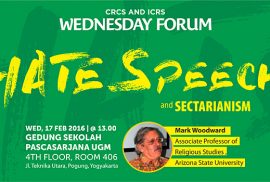
Hate speech is one of the factors contributing to sectarian and ethnic conflict. It typically includes social/psychological processes of dehumanization and demonization that define others as less than human and archetypes of evil. Often others are described as existential threats to the very existence of the speaker’s community. It is used to incite or justify violence, sometimes rising to the level of genocide. It is nearly often entirely inaccurate.
Hate speech is an under theorized mode of contentious discourse. It is easy to recognize and difficult to define precisely. In this paper I located hate speech within a four-point typology of contentious discourse: 1. Dialog concerning religious differences; 2. Unilateral condemnation of the beliefs and practices others; 3. Dehumanization and demonization of others and implicit justification of violence; 4. Explicit provocation of violence. For examples I rely primarily on the violent rhetoric of the Indonesian Islamic Defenders Front.
Dehumanization and demonization are the psychological processes that distinguish between civil discourse and hate speech. Levels 1 and 2 are critiques located within the limits of civil discourse because they do not implicitly or explicitly threaten others. Levels 3 and 4 are hate speech. They make symbolic associations that are inherently threatening.
Some forms of hate speech are universal or nearly so. Among these are the description of others as animals, evil, heretics and/or of engaging in “inappropriate” sexual conduct. Others are culturally or religiously specific. More research is required to understand the semantics of hate speech and how it transcends religious and ethnic boundaries.
There is an inevitable contradiction between defending freedom of speech, as guaranteed by Article 19 of the Universal Declaration of Human Rights,and protecting people, usually minorities, from the psychological harm hate speech causes and the risk of physical violence it exposes them to.Legal restrictions do not eliminate hate speech; they only drive in from the public sphere. Most laws restricting hate speech were drafted long before the Internet and social media existed. Now, they are largely ineffective. Countering hate speech requires concerted effort by religious and political leaders and netizens across a range of media, including those used most frequently, including social media, by extremists who promote it. In this presentation I rely on examples from Front Pembela Islam (Islamic Defenders Front/FPI).
SPEAKER
Mark Woodward is Associate Professor of Religious Studies and is also affiliated with the Center for the Study of Religion and Conflict at Arizona State University. His research focuses on religion-state-society relations and religion and conflict in Southeast Asia. He is author of Islam in Java. Normative Piety and Mysticism in the Sultanate of Yogyakarta, Defenders of Reason in Islam (1989)and Java, Indonesia and Islam (2010) .He has published more than fifty scholarly articles in the US, Europe, Indonesia and Singapore, many co-authored with Southeast Asian scholars. He his currently directing a trans-disciplinary, multi-country project on counter-radical Muslim discourse.
Azis Anwar Fachrudin | CRCS | Book Review
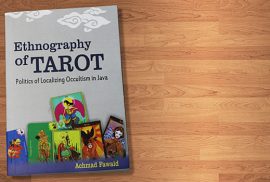
How has Tarot, which was originally foreign to Indonesians, been practiced by Javanese people? Has there been any kind of adaptation of the practice to embrace Javanese local culture? Using etnography as a research method, the book by Achmad Fawaid entitled Ethnography of Tarot: Politics of Localizing Occultism in Java provides historical accounts and analitical study of the localization of the practice in Java.
The main question addressed by the book, originating from Fawaid’s master’s thesis at CRCS, UGM, is how Javanese belief system has made influences on Tarot and its Javanese practitioners. Many of the book’s data are based on interviews with Javanese Tarot practitioners themselves, examined by using the lenses of the theories developed on etnographic studies or anthropology. The book then argues that Javanese Tarot practitioners have “localized” the global “occult” practice and that this localization could be understood in terms of “adaptation”, “acculturation”, indigenization”, or “hybridization”—each of these concepts are elaborated in the book.
 The book suggests that in the process of localization the Western Tarot practice has been intertwined with Javanese esoteric occultism. The kebatinan ideas, quite popular among Javanese people, such as tapa, samadi, mutih, wayang performance, and Javenese traditional healing, have been absorbed and carried out in the process of localization—this is the fact that some Javanese Muslims later accuse the practice to be deviant constituting a form of shirk, klenik, perdukunan or a kind of shamanism.
The research findings the book poses is that (1) Javanese Tarot practitioners have negotiated themselves in the cultic milieu they are living in by “localizing their alias, communities, Tarot reading strategies, Tarot decks, and their personal preference to gather in candi”; and that (2) Tarot practice in Java has closely been connected to some Javanese belief systems, such as rasa and kahanan, and this makes the practitioners practice Javanism, either consciously or unconsciouly, while playing Tarot. Because of these two, Fawaid argues, the localization of Tarot in Java has lead to a “cultural ambivalence” as an implication that the practitioners cannot be free from it as they are practicing global occult practice while maintaining Javanese cultural identity.
In the end, as stated in the epilogue of the book, Fawaid argues that this process of localization as a way of examinig Tarot practices should be a contribution to “occult discourse”. He critizes the common assumption that Tarot reading is strictly divided into three characteristics: psychology, intuition, and spirituality. Fawaid poses one element missing, that is, localization in the forms of abovementioned concepts which should be added in the discourse and which shows a hybridity within Tarot practices between local beliefs and global practices.
Overall, the book lays a foundation for further research on the case; the etnographic accounts of Javanese Tarot have been quite deeply examined in the book. If there is one question to stimulate further research, it can be a more philosophical discussion, that is, why Tarot is considered an occult practice. The book elaborates anthropological concepts (acculturation, indigenization, hybridity, etc.) but for the most part, it seems, it takes the concept of occultism for granted. Occultism, like the concept of religion, which may contain a modern construction of meaning, should be more philosophically discussed and critically examined in the first place. In fact, this has become within the heart of the problem when Javanese Tarot practitioners try to negotiate their identity with religious milieu of Javanese people.
Ethnography of Tarot: Politics of Localizing Occultism in Java | Author: Achmad Fawaid | Publisher: Ganding Pustaka, Yogyakarta | Year Publishing: November 2015 | Pages: 208 pages

Abstract
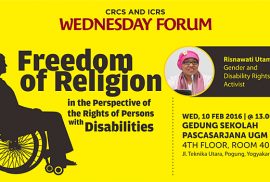
The freedom to express one’s beliefs and participate fully in one’s religious community is one of the fundamental human rights explicitly stated in the International Convention on Civil and Political Rights. However,in Indonesia like in many other countries, persons with disabilities are one of the groups excluded from enjoying their full human rights.
Two kinds of barriers keep person with disabilities from access houses of worship. Attitudinal barriers including misconceptions in the mindsets of religious leaders about the concept of disability, stigma and prejudice keep persons with disabilitesfrom contributing significantly to or even being involved in their religious communities. Environmental barriers resulting from design and architectural factors prevent persons with disabilities from physical access to the houses of worship and from exercising their spiritual needs equally with everyone else.
The paper will explore how disability is an evolving concept that results from the interaction between persons with impairment and the attitudinal and environmental barriers that hinders their full and effective participation in society on an equal basis with others. In addition, it will explore the policy review, strategies and recommendations based on the UN Convention on the Right of Persons with Disabilities’ ratification through Law number 19/2011 and local regulations/Perda number 9/2015 on the Protection and Fulfillment of the Rights of Persons with Disabilities in Bali Province that seek to ensure the right to freedom of religion is part of human rights of persons with disabilities.
Speaker
Risnawati Utami has been a gender and disability rights activist since 1999 and currently speaks throughout Indonesia and abroad advocating the rights of persons with disabilities and development within the United Nations Conference of State Parties to the Convention on the Rights of Persons with Disabilities. A graduate of the Faculty of Law, University of March 11, Solo,in 2006, she was awarded a Ford Foundation International Fellowship Program to earn Master Degree in International Health Policy and Management at Brandeis University, Massachusetts, USA. Currently, she works for OHANA, a non-profit organization in Yogyakarta which focuses on disability rights advocacy and policy studiesand actively promotes “disability inclusive development” in the Agenda 2030/Sustainable Development Goals at the local, national and global levels.

Wednesday Forum is a weekly discussion on religion-related ideas and practices organized by both the Center for Religious and Cross-cultural Studies (CRCS), Graduate School of Universitas Gadjah Mada and Indonesian Consortium for Religious Studies (ICRS), Yogyakarta. This forum is an academic space open for public, encouraged especially for our graduate students, faculties, professors, researches, Indonesian and overseas scholars. It is aimed for scholars to share their research on the field related to religion. Therefore, we invite those who have research, papers, ongoing papers, or short documentary film on the field to do presentation in the forum.
Themes
The themes discussed are including, but not limited to, interfaith dialogue; conflict resolution and peace building; religious education; art and spirituality or mysticism; religion and pop culture; religious violence and radicalism; indigenous religions; religion and ecology; religion and politics; and philosophical ideas on religion, etc.
Attendees
The forum is attended by CRCS and ICRS graduate students and faculty members, lecturers, visiting professors, activists, and students from other universities. Basically the forum is open for public.
Date and Venue
The forum is held every Wednesday, from 1 to 2.30 pm, in the Room 406 of the Graduate School Building, Sekolah Pascasarjana Universitas Gadjah Mada, Jl. Teknika Utara, Pogung, Yogyakarta. For the coming semester, the forum will start from 10th February to 11th May 2016 and from September to December 2016.
Application
Application to be a presenter can be made by sending an email to the organizer: najiyah.martiam@ugm.ac.id. Send the abstact of your research and your brief CV, primarily your study background, activities, and research. The Wedforum committees will evaluate the applications and choose the presenters.