
CRCS Field Trip to Borobudur: Amerta Movement
Fiqh Vredian – 15 March 2018
Accepting an invitation from Suprapto Suryodarmo, a world-famous Javanese artist from Padepokan Lemah Putih Solo, to join the Borobudur Moving Life program CRCS and ICRS students and one lecturer went to Borobudur to meet Pak Prapto and his collaborators at the Pondok Tingal Hotel, Magelang, on Friday, February 2, 2018. This program challenged us to explore Borobudur as more than a commodified tourist attraction; as inviting us to explore its intricate iconography representing rich and valuable ideas with various majestic forms, images, and symbols. This was part of the “Move into Life” annual bodily movement training directed by Sandra Reeve, Ph.D., an ecological therapist from UK, who has cooperated with Suprapto for holding training in Indonesia and abroad for many years.
In this program, Suprapto invited us to practice the training he offers in the spiritual bodily movement he has named Joget Amerta (Amerta dance). This dance is based on his reading on Borobudur in a meditative way by embodying social and spiritual teachings explored from meaningful forms of mudra, symbolic bodily gestures of Buddha statue from the highest level of Borobudur (Arupadhatu) (formlessness). He was also inspired by Vipassana Buddhist meditation and Sumarah, a Javanese method of meditation and belief. By these combinations, he modified several gestures of mudra with various motions which expressed dialogue in curiosity with other people and nature to develop intuition by “touching, feeling, and witnessing the earth”.

Many visitors from around the world participated in this training, seeking for self-transformation. Seung-jun Lee, a participant from Won Buddhism (a new branch of Buddhism in Korea), described Amerta dance as a “moving meditation”. Different from the usual meditation, this practice tried to connect to the world through movement rather than from motionlessness. As Suprapto explained, the movement is learned “from the Buddha walking, rather than from the Buddha sitting”. Keith Miller, an archeologist from UK, felt this movement revived the sensory device of human that strengthened the awareness and the meaning of living in daily life. A participant from the Czech Republic related the attention of participants with ‘post-Cartesian’ trends in the West that attempt to go beyond the opposition of being and reason and the fashion of secular, rationalistic thought. Ditty Dokter, a dramatherapist from UK, told how her experience of the spiritual journey with Borobudur and Amerta dance has given her valuable metaphorical sources for her as a story-teller and activist working to emancipate refugee childern.
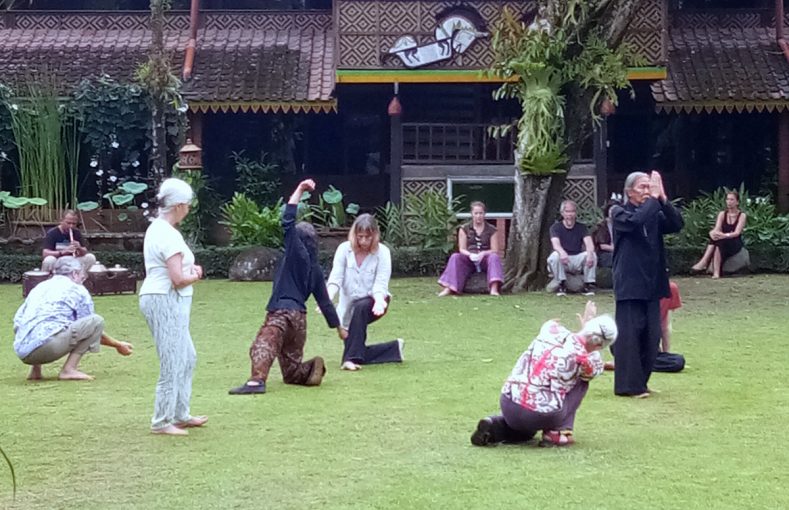
Besides combining spirituality and art, Amerta dance is based on basic movements of daily life, such as sitting, standing, walking, sleeping, crawling, handling up, and so on. Hence the practice used free or non-stylised daily movement to get existential, conscious experience with reflexivity and enjoyment. “Do not think too much; follow your feeling and body, and be united on the ground!” One participant said to me. The following day, CRCS and ICRS students and a lecturer had the opportunity to practice Amerta dance together with participants in Karmawibhangga Museum yard after visiting Borobudur.

When practicing, I felt that this movement rejuvenated my consciousness to be sensitively aware of my bodily experience and surrounding natural environment. This movement also rehabilitated the interpersonal and social relationships. Before the movement started, Suprapto also encouraged us to disengage with the image of the enemy in our mind in living with others.
Amerta dance emphasized the interconnectedness of humanity, spirituality, and ecology. Sandra Reeve explained that when we are nowadays facing ecological crises, this movement could remind people of being part of the world to have a renewed sense of place. Previously, Sandra wrote a dissertation about the “ecological body” through a study case of Amerta dance. She stated that this practice, as a creative response to the on-going environmental degradation, provides an ecological lens to engage in a changing environment, rather than a static isolated individual, through ecological embodiment de-separating body and nature. This kind of intersubjective relation places humans equally as one organism living in nature beyond cultural difference and anthropocentric superiority.

Thank you for this wonderful report! Very important that people find out about this great practise.
Thank you Fiqh for your lucid report.i just posted Embodied Lives to your department. All the very best with your studies. Sandra