
• Tentang UGM
  • Portal Akademik
  • Pusat TI
  • Perpustakaan
  • Penelitian
Universitas Gadjah Mada
  • About Us
    • About CRCS
    • Vision & Mission
    • People
      • Faculty Members and Lecturers
      • Staff Members
      • Students
      • Alumni
    • Facilities
    • Library
  • Master’s Program
    • Overview
    • Curriculum
    • Courses
    • Schedule
    • Admission
    • Scholarship
    • Accreditation and Certification
    • Academic Collaborations
      • Crossculture Religious Studies Summer School
      • Florida International University
    • Academic Documents
    • Student Satisfaction Survey
  • Article
    • Perspective
    • Book Review
    • Event Report
    • Class Journal
    • Interview
    • Wed Forum Report
    • Thesis Review
    • News
  • Publication
    • Reports
    • Books
    • Newsletter
    • Monthly Update
    • Infographic
  • Research
    • CRCS Researchs
    • Resource Center
  • Community Engagement
    • Film
      • Indonesian Pluralities
      • Our Land is the Sea
    • Wednesday Forum
    • ICIR
    • Amerta Movement
  • Beranda
  • Class Journal
  • CRCS Field Trip to Borobudur: Amerta Movement

CRCS Field Trip to Borobudur: Amerta Movement

  • Class Journal
  • 15 March 2018, 12.05
  • Oleh: ardhy_setyo
  • 2

CRCS Field Trip to Borobudur: Amerta Movement

Fiqh Vredian – 15 March 2018

Accepting an invitation from Suprapto Suryodarmo, a world-famous Javanese artist from Padepokan Lemah Putih Solo, to join the Borobudur Moving Life program CRCS and ICRS students and one lecturer went to Borobudur to meet Pak Prapto and his collaborators at the Pondok Tingal Hotel, Magelang, on Friday, February 2, 2018. This program challenged us to explore Borobudur as more than a commodified tourist attraction; as inviting us to explore its intricate iconography representing rich and valuable ideas with various majestic forms, images, and symbols. This was part of the “Move into Life” annual bodily movement training directed by Sandra Reeve, Ph.D., an ecological therapist from UK, who has cooperated with Suprapto for holding training in Indonesia and abroad for many years.

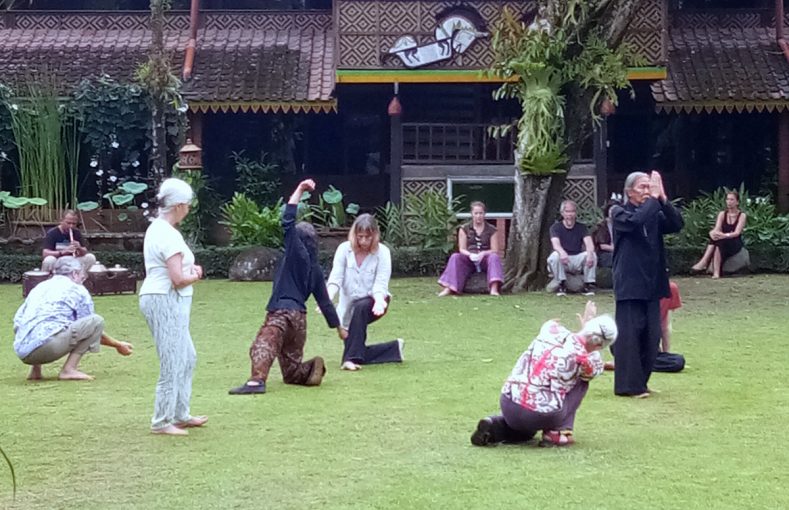
In this program, Suprapto invited us to practice the training he offers in the spiritual bodily movement he has named Joget Amerta (Amerta dance).  This dance is based on his reading on Borobudur in a meditative way by embodying social and spiritual teachings explored from meaningful forms of mudra, symbolic bodily gestures of Buddha statue from the highest level of Borobudur (Arupadhatu) (formlessness). He was also inspired by Vipassana Buddhist meditation and Sumarah, a Javanese method of meditation and belief. By these combinations, he modified several gestures of mudra with various motions which expressed dialogue in curiosity with other people and nature to develop intuition by “touching, feeling, and witnessing the earth”.

Many visitors from around the world participated in this training, seeking for self-transformation. Seung-jun Lee, a participant from Won Buddhism (a new branch of Buddhism in Korea), described Amerta dance as a “moving meditation”. Different from the usual meditation, this practice tried to connect to the world through movement rather than from motionlessness. As Suprapto explained, the movement is learned “from the Buddha walking, rather than from the Buddha sitting”. Keith Miller, an archeologist from UK, felt this movement revived the sensory device of human that strengthened the awareness and the meaning of living in daily life. A participant from the Czech Republic related the attention of participants with ‘post-Cartesian’ trends in the West that attempt to go beyond the opposition of being and reason and the fashion of secular, rationalistic thought. Ditty Dokter, a dramatherapist from UK, told how her experience of the spiritual journey with Borobudur and Amerta dance has given her valuable metaphorical sources for her as a story-teller and activist working to emancipate refugee childern.

Besides combining spirituality and art, Amerta dance is based on basic movements of daily life, such as sitting, standing, walking, sleeping, crawling, handling up, and so on. Hence the practice used free or non-stylised daily movement to get existential, conscious experience with reflexivity and enjoyment. “Do not think too much; follow your feeling and body, and be united on the ground!” One participant said to me. The following day, CRCS and ICRS students and a lecturer had the opportunity to practice Amerta dance together with participants in Karmawibhangga Museum yard after visiting Borobudur.

When practicing, I felt that this movement rejuvenated my consciousness to be sensitively aware of my bodily experience and surrounding natural environment. This movement also rehabilitated the interpersonal and social relationships. Before the movement started, Suprapto also encouraged us to disengage with the image of the enemy in our mind in living with others.

Amerta dance emphasized the interconnectedness of humanity, spirituality, and ecology. Sandra Reeve explained that when we are nowadays facing ecological crises, this movement could remind people of being part of the world to have a renewed sense of place. Previously, Sandra wrote a dissertation about the “ecological body” through a study case of Amerta dance. She stated that this practice, as a creative response to the on-going environmental degradation, provides an ecological lens to engage in a changing environment, rather than a static isolated individual, through ecological embodiment de-separating body and nature. This kind of intersubjective relation places humans equally as one organism living in nature beyond cultural difference and anthropocentric superiority.

Tags: field trip fiqh vredian

Leave A Comment Cancel reply

Your email address will not be published. Required fields are marked *

*

Comment (2)

  1. Rena Milgrom 8 years ago

    Thank you for this wonderful report! Very important that people find out about this great practise.

    Reply
  2. Sandra Reeve 8 years ago

    Thank you Fiqh for your lucid report.i just posted Embodied Lives to your department. All the very best with your studies. Sandra

    Reply

Instagram

crcs_ugm

Sedang tidak baik-baik saja, kamu biasanya mencari Sedang tidak baik-baik saja, kamu biasanya mencari apa di internet?

Banyak anak muda hari ini menemukan ketenangan, nasihat, bahkan jawaban atas kegelisahan melalui media sosial, konten keagamaan, akun kesehatan mental, hingga AI chatbot. Namun, bagaimana sebenarnya pengalaman itu terjadi?
Kami sedang melakukan penelitian untuk memahami bagaimana generasi muda usia 10–24 tahun mencari informasi keagamaan maupun kesehatan mental saat menghadapi masa-masa sulit.
Jika kamu merasa topik ini dekat dengan pengalamanmu, kami mengundangmu menjadi responden.
Partisipasi bersifat sukarela dan seluruh jawaban dijaga kerahasiaannya.
Kamu bisa langsung kirim DM jawabanmu atau mau tanya-tanya dulu juga boleh.

Kami tunggu ya.
Katanja koeliah S2 itoe mahal? Eitss , djangan s Katanja  koeliah S2 itoe mahal? 
Eitss , djangan salah
Bersama keempat mahasiswa angkatan 2025, kita akan ngobrolin djoeroes-djoeroes djitoe mendapatkan beasiswa di CRCS UGM

Begitoe?
Before petroleum fueled the world, it fractured th Before petroleum fueled the world, it fractured the archipelago

The raise of the colonial petroleum industry in the Dutch East Indies was also the emergence of new spatial inequalities. Outer Java was not merely discovered as a resource zone. It was politically produced as an extractive territory through imperial concessions, colonial state-building, and global struggles over resource control.

Join us in this presentation on capitalism, oil, and the colonial fractures that continue to haunt the geography of modern Indonesia. We provide snacks and drinks, don't forget to bring your tumbler. This event is free and open to public.
M B G Satu kotak makan berisi nasi putih pulen seb M B G
Satu kotak makan berisi nasi putih pulen sebagai sumber karbohidrat utama, dimasak dari beras medium pilihan, air, sedikit garam, dan beberapa tetes minyak agar tidak cepat basi. Di sampingnya terdapat ayam semur kecap, dibuat dari potongan daging ayam, bawang merah, bawang putih, kecap manis, daun salam, lengkuas, garam, dan sedikit gula sehingga memberi asupan protein hewani yang cukup untuk pertumbuhan. Sebagai pendamping lauk utama, disediakan tempe orek manis gurih dari tempe iris tipis, bawang merah, bawang putih, cabai, kecap, dan gula merah. Tempe ini berfungsi menambah protein nabati sekaligus membuat kotak makan tampak lebih penuh, sebab protein memang sering lebih meyakinkan bila hadir rangkap dua. Untuk unsur sayuran, ada tumis wortel dan buncis yang dimasak dari wortel segar, buncis, sedikit kol, bawang putih, garam, merica, dan minyak sayur. Warna oranye-hijau pada sayur ini penting: bukan hanya untuk vitamin A dan serat, tetapi juga agar foto dokumentasi tidak terlihat terlalu pucat.Sebagai pelengkap vitamin alami, satu buah pisang atau sepotong pepaya matang diletakkan di sudut kotak. Buah dipilih yang murah, tahan banting, tidak gampang memar, dan cukup fotogenik ketika dibagikan massal. Terakhir, ditambahkan susu UHT kotak kecil berbahan susu sapi, gula, dan fortifikasi vitamin, atau kadang telur rebus utuh sebagai penutup protein tambahan.

Berbuih-buih seperti pelaksanaannya ...
Follow on Instagram

Twitter

Tweets by crcsugm

Universitas Gadjah Mada

Gedung Sekolah Pascasarjana UGM, 3rd Floor
Jl. Teknika Utara, Pogung, Yogyakarta, 55284
Email address: crcs@ugm.ac.id


© CRCS - Universitas Gadjah Mada

KEBIJAKAN PRIVASI/PRIVACY POLICY