• Tentang UGM
  • Portal Akademik
  • Pusat TI
  • Perpustakaan
  • Penelitian
Universitas Gadjah Mada
  • About Us
    • About CRCS
    • Vision & Mission
    • People
      • Faculty Members and Lecturers
      • Staff Members
      • Students
      • Alumni
    • Facilities
    • Library
  • Master’s Program
    • Overview
    • Curriculum
    • Courses
    • Schedule
    • Admission
    • Scholarship
    • Accreditation and Certification
    • Academic Collaborations
      • Crossculture Religious Studies Summer School
      • Florida International University
    • Academic Documents
    • Student Satisfaction Survey
  • Article
    • Perspective
    • Book Review
    • Event Report
    • Class Journal
    • Interview
    • Wed Forum Report
    • Thesis Review
    • News
  • Publication
    • Reports
    • Books
    • Newsletter
    • Monthly Update
    • Infographic
  • Research
    • CRCS Researchs
    • Resource Center
  • Community Engagement
    • Film
      • Indonesian Pluralities
      • Our Land is the Sea
    • Wednesday Forum
    • ICIR
    • Amerta Movement
  • Beranda
  • Wednesday Forum News
  • AI and Religion

AI and Religion

  • Wednesday Forum News
  • 3 April 2022, 15.48
  • Oleh: crcs ugm
  • 0

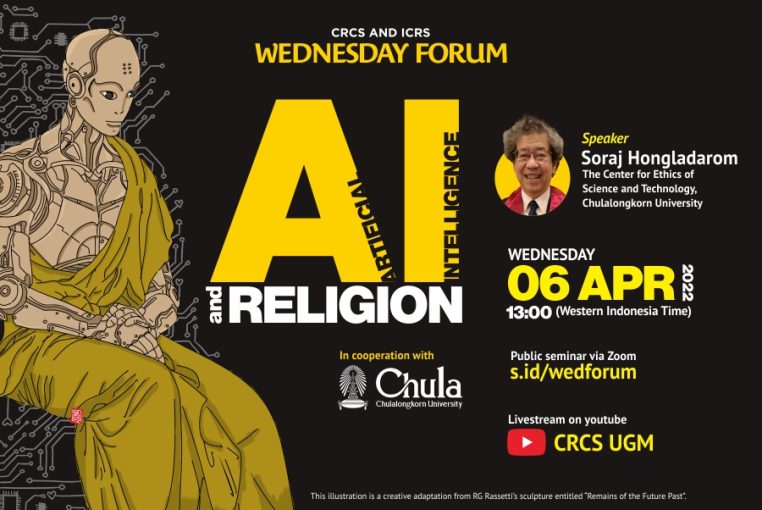
AI and Religion

Wednesday Forum – 06 April 2022

In this talk I would like to talk about the role that AI can play regarding religion. Since I come from a Buddhist culture, my example will be mostly from Buddhism, but I intend that my talk will be applicable to AI and other religions too. Among the questions that I will be addressing are: With the advent and rapid development of AI, what kind of impact will AI have on religion? There are many aspects of the impact that we can discuss. AI can be used to help the practicing of religion in various ways. An example of this is the robot monk in Japan. The robot can recite Buddhist sutras and practitioners can gather around it to listen to the sutra. Secondly, AI can be used to help with analyzing religious texts, such as doing concordances and searching for passages. This can be of great help to those who have to go through a large amount of texts everyday. Thirdly, AI can be used as an engine inside apps that aid with meditation. There are several apps that claim to do this. I will then reflect on these developments and will ask what do AI’s increasing roles in our religious lives and practices actually mean. Can AI itself become religious? If so, what does this signify in terms of our religions?

Soraj Hongladarom is Professor of Philosophy and Director of the Center for Ethics of Science and Technology at Chulalongkorn University in Bangkok, Thailand. He has published books and articles on such diverse issues as bioethics, computer ethics, and the roles that science and technology play in the culture of developing countries. His concern is mainly on how science and technology can be integrated into the life-world of the people in the so-called Third World countries, and what kind of ethical considerations can be obtained from such relation. A large part of this question concerns how information technology is integrated in the lifeworld of the Thai people, and especially how such integration is expressed in the use of information technology in education. He is the author of The Online Self and A Buddhist Theory of Privacy, both published by Springer. His articles have appeared in The Information Society, AI & Society, Philosophy in the Contemporary World, and Social Epistemology, among others.

The full poster of this event is available here.
Tags: AI buddhism

Leave A Comment Cancel reply

Your email address will not be published. Required fields are marked *

*

Instagram

What is well-being? Indonesia today: land taken, f What is well-being?
Indonesia today: land taken, forests cleared, plantations marching under the banner of food security. Officials call it progress, yet Indigenous ground tells another story. Baduy farmers keep ngahuma alive: rice, ritual, survival, all tied together. Wellbeing here isn’t profit. It’s balance when human and earth still holding on.

Join us for the next  #wednesdayforum discussion at the 3rd floor of the UGM Graduate School building. We're offering a free iftar, so please register. This event is free and open to the public.
yuk, pendaftaran sudah dibuka ... cek syarat-syara yuk, pendaftaran sudah dibuka ...
cek syarat-syaratnya ...
jika ada yang mau tanya-tanya,
langsung meluncur ke kolom komentar ya ...
K U D A A P I Kehidupan kadang hadir seperti kuda K U D A  A P I
Kehidupan kadang hadir seperti kuda, ia tak benar-benar bisa ditambatkan. Hidup terus bergerak bukan karena sebuah kepastian, melainkan untuk menolak padam meskipun tak tahu ke mana yang akan dituju. Ke mana pun tujuanmu di tahun ini,  semoga barakah selalu menyala dalam bara.

xin nian kuaile, gongxi facai
Why has democracy declined in Tunisia and Turkey, Why has democracy declined in Tunisia and Turkey, yet remained resilient in Indonesia?
Do Muslim mass organizations, elite consensus, and the negotiated relationship between religion and citizenship hold the key? Or are there deeper structural forces at play?
Join us and be part of the conversation. Let’s rethink what sustains (or undermines?) democracy in muslim-majority societies.

Come and join new round of  #wednesdayforum 2026 discussion at UGM Graduate School building, 3rd floor.  We provide snacks and drinks, don't forget to bring your tumbler. This event is free and open to public.
Follow on Instagram

Twitter

Tweets by crcsugm

Universitas Gadjah Mada

Gedung Sekolah Pascasarjana UGM, 3rd Floor
Jl. Teknika Utara, Pogung, Yogyakarta, 55284
Email address: crcs@ugm.ac.id


© CRCS - Universitas Gadjah Mada

KEBIJAKAN PRIVASI/PRIVACY POLICY