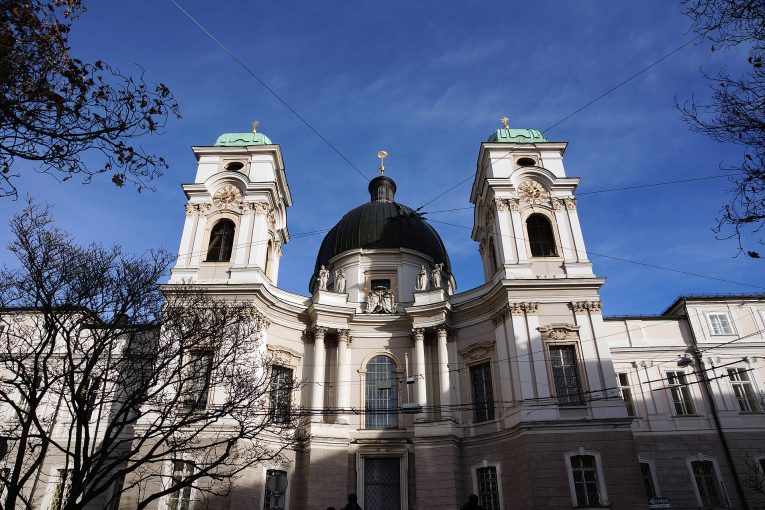
That morning, church bells echoed through the air as I walked along the streets of Altstadt, Salzburg’s historic old town. From one corner, the green dome of Salzburg Cathedral rose above rows of pastel-colored buildings. Not far away, another church tower appeared behind a narrow alley crowded with tourists. Within just a few hundred meters, I passed more churches than I would normally encounter in an entire day. In Salzburg, religion is present not only in prayer and ritual, but also in the very landscape of the city.
I came to Salzburg as a participant in the Crossculture Religious Studies Summer School 2026, Paris Lodron University of Salzburg, interested in questions surrounding the body across religions and cultures. Yet one of the most memorable lessons emerged outside the classroom. During an excursion guided by Peter Staudinger, we traced the legacy of Baroque art and architecture that continues to shape the city today. It was through this short journey that I began to realize that religion can be read not only through sacred texts and doctrines, but also through stone, light, and space.
Salzburg: Rome of the North
Salzburg is often described as one of the most important Baroque cities in Europe. While the term “Baroque” may sound familiar, its meaning is not always immediately clear. Broadly speaking, Baroque refers to an artistic and architectural style that flourished between the seventeenth and eighteenth centuries. It is characterized by visual grandeur, expansive spaces, dramatic uses of light, as well as richly ornamented forms filled with movement. Whereas modern architecture often emphasizes simplicity and efficiency, Baroque architecture sought to create emotionally powerful experiences. Behind its grandeur, Baroque art was shaped by the twin impulses of memento mori and carpe diem—a reminder of life’s transience and an invitation to live meaningfully in the present.
The emergence of the Baroque style cannot be separated from the history of the Catholic Church during the Counter-Reformation. Following the upheaval caused by the Protestant Reformation in the sixteenth century, the Catholic Church sought new ways to strengthen religious life among the faithful. One of these ways was through art. The Church did not merely want believers to understand faith; they wanted them to feel it. Architecture, paintings, sculptures, and spatial design were employed to evoke awe, wonder, and a sense of connection with the divine. In this context, art became an integral part of religious experience itself.
This development found particularly fertile ground in Salzburg. For centuries, the city derived immense wealth from the salt (German word Salz for salt) trade, which served as the foundation of its prosperity. Salt was often referred to as “white gold” because of its extraordinary value at the time. This wealth was controlled by the Prince-Archbishops, unique figures who held both political and religious authority. They were not only church leaders but also territorial rulers.
One of the most influential among them was Wolf Dietrich von Raitenau, who governed Salzburg at the end of the sixteenth century. Inspired by artistic developments in Italy, he envisioned transforming Salzburg into a city that could rival the splendor of Rome. Architects and artists were invited to the city, churches were renovated, and Salzburg’s urban landscape gradually changed. His successors continued this ambitious project, eventually earning Salzburg the nickname “Rome of the North.” The title refers not merely to the number of churches found in the city, but also to the profound way religion shaped its urban form and public life.
One particularly fascinating example is the Dreifaltigkeitskirche, or Church of the Holy Trinity, which we visited during our excursion. From the outside, the building appears relatively modest compared to some of Salzburg’s larger churches. Yet that impression changes the moment one steps inside.
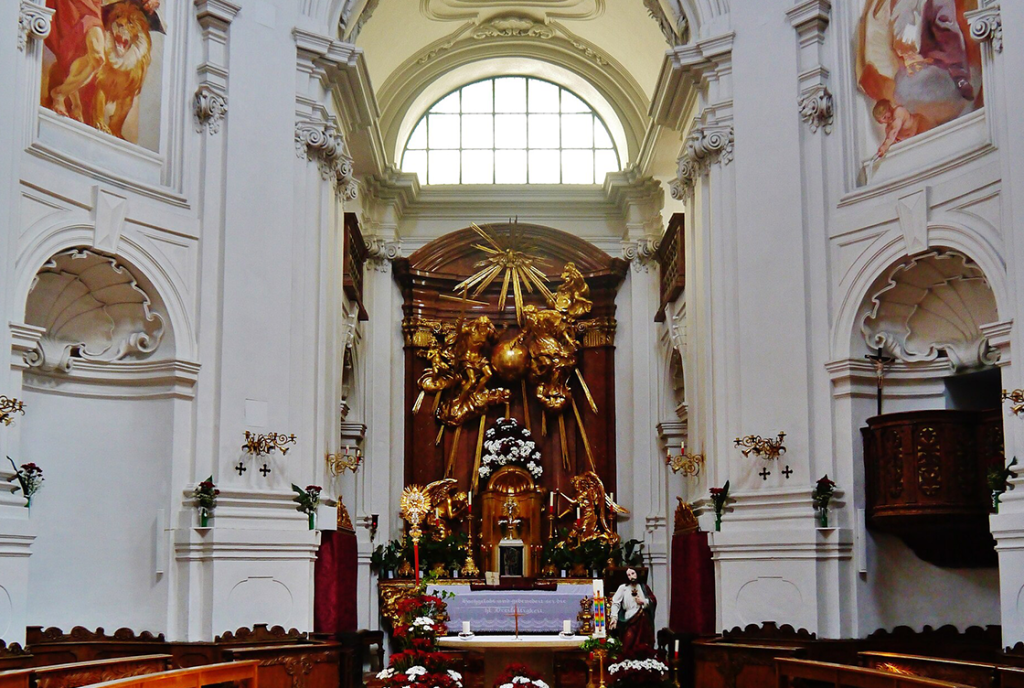
The church’s central space is oval-shaped and immediately draws attention toward the altar. Light filters through high windows beneath the dome, creating an atmosphere that is both luminous and reverent. The curves of the walls, the manipulation of perspective, and the proportions of the interior seem carefully designed to direct both the body and the gaze toward the sacred center of the space. In other words, the Baroque church did not just speak to the mind. It works through the body. The eyes are directed towards the altar, the neck is turned towards the dome, while the light from above and the reverberation of sound create an atmosphere of awe. Religious experiences are not just understood, but felt physically.
I experienced this bodily dimension quite personally. As a Muslim visitor, sitting on the floor and looking up at the overwhelming images of God, I felt a strange mixture of awe, intimacy, and uneasiness. I was encountering a way of imagining and experiencing the divine that was different from my own. Perhaps this is precisely what makes Baroque space so powerful. It doesn’t simply tell us what to believe. It shapes how we encounter, feel, and interact with the sacred.
This helped me understand Peter Staudinger’s remark that Salzburg is a city shaped by the logic of the Baroque—rather than merely a city with Baroque. He was referring to the way the city’s entire landscape has been designed to produce particular experiences for those who inhabit, interact, and move through it.
When Stone, Light, and Space Speak
This experience brought to mind Henri Lefebvre’s concept of the production of space. For Lefebvre (1974), space is never neutral. It is always shaped by relations of power, values, and social practices. In other words, space is not merely a container in which life unfolds; it actively shapes the way people perceive and understand the world. Space is also relational. It emerges through connection between people, building, institutions, practices, and memories. For example, a muslim entering a Baroque church doesn’t simply enter a pre-existing sacred space. The architecture evokes memories, invites interpretation, as well as urges particular bodily responses. Through these encounters, each person participates in producing the lived space anew.
From this perspective, Salzburg’s Altstadt is far more than a collection of historic buildings preserved from the past. The domes that dominate the skyline, the squares linking churches with centers of public activity, and the narrow streets that channel the movement of pedestrians all form part of a long historical process. These spaces are connected to one another and to the people who move through, inhabit, interact, and interpret them. Together, these elements subtly shape one’s experience of religion and sacredness, even when one arrives merely as a tourist.
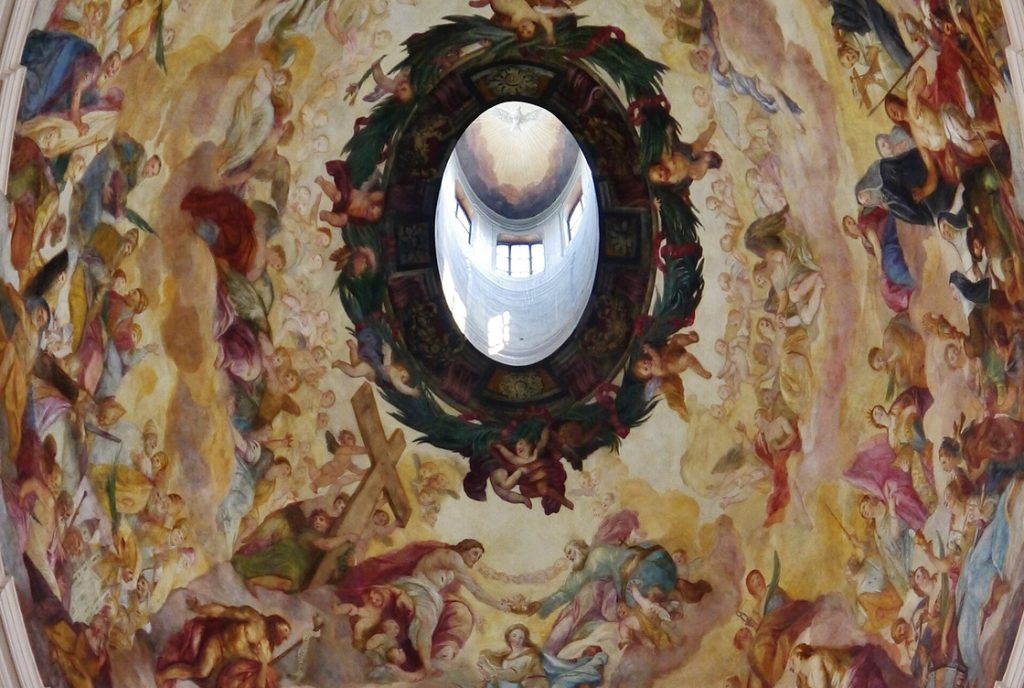
It is difficult to separate Salzburg’s Catholic history from the physical form of the city itself. The wealth generated by the salt trade, the authority of the Prince-Archbishops, and the religious aspirations of earlier centuries seem frozen into stone, towers, domes, and public spaces that remain in use today. To walk through Salzburg’s old town is to move through a religious landscape produced over centuries.
If Lefebvre helps explain how this religious landscape was produced, Pierre Nora offers another way of understanding it. Through his concept of sites of memory (lieux de mémoire), Nora (1989) argues that modern societies preserve their collective memories in particular places—such as monuments, buildings, archives, museums, and landscapes.
Seen in this light, Salzburg’s Baroque churches can be understood as living archives of memory. These memories are not preserved only in historical documents. They resonate through church bells that continue to ring each day, through paintings that cover church ceilings, or through angelic statues standing quietly at street corners. Collective memory also survives through the bodies that continue to inhabit the space. Every day, tourists walk through the same square, congregants sit in the same pews, and the bells are still heard by different ears across generations. Memory is not only stored in buildings, but also in the repeated bodily practices.
The longer I walked through Salzburg, the more I realized that the city offers a different way of learning about religion. Not every lesson is acquired in a classroom. Sometimes a church, a public square, or a beam of light falling from a dome can open questions as significant as those raised in an academic lecture. Salzburg reminded me that space is never merely a background to human life. It shapes memories and quietly teaches us how communities remember, interact, and belong.
______________________
m rizal abdi is a research coordinator at the Center for Religious and Cross-cultural Studies (CRCS), UGM Graduate School. Read other articles by abdi here.
Editor: Melanie Fersi (College of Interreligious Studies Munich, PhD student Paris Lodron University Salzburg)
Header Photo: Zairon (2015)/Wikimedia Commons CC-BY-SA 4.0