by Theresia Alit
In October 2012, during the Gelar Budaya Nusantara festival at Taman Mini Indonesia Indah, I met Mbah Prapto, the affectionate name for the late Suprapto Suryodarmo. At the event, he performed Umbul Donga, accompanied by sacred mantras from the Bhagavad Gita as an opening ritual. I was drawn into the rhythm of Umbul Donga, which flowed seamlessly with the dry Jakarta breeze. The audience was immersed in the solemnity of the sacred chants.
I was deeply captivated by Umbul Donga performed by Mbak Prapto and intrigued by the fluidity and stillness of his movements. When I had the chance to meet him backstage, I asked about his distinctive dance movement. In our brief conversation, he mentioned Joget Amerta, a movement practice rooted in awareness.
Suprapto Suryodarmo and Joget Amerta
Among dancers and choreographers, Mbah Prapto was a great source of inspiration. He was born and raised in Kampung Kemlayan, a neighborhood in Surakarta that produced several art maestros, including S. Ngaliman, Mlaya Widada, Guna Pangrawit, and Sardono W. Kusuma. Since childhood, Mbah Prapto was exposed to various movement forms such as classical Javanese dance, martial arts (silat and kungfu), as well as Vipassana and Sumarah meditation, which later significantly influenced his work in exploring nature and awareness.
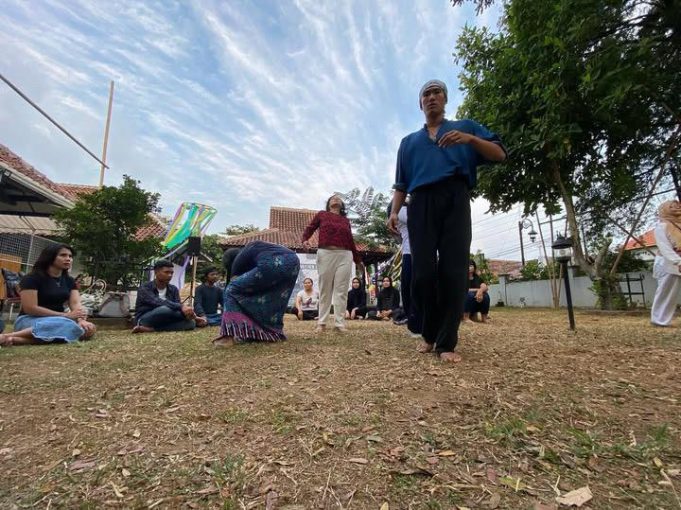
Joget Amerta is a practice of bodily attunement—a form of movement meditation grounded in awareness. Its essence is not mere expression but transformation. It is called Joget Amerta because it refers to the process of learning to dance from the very basics. However, it is not simply random physical movement; Mbah Prapto defined Joget Amerta as a human response to the surrounding environment. The practice flows naturally, adapting to the setting rather than adhering to rigid structures like conventional dance. This is why it is called jogèd (a term for dance in Javanese and Balinese), rather than tari or beksan, which imply more structured and choreographed movements.
Joget Amerta breaks away from rigid rules and seeks to return the body to its natural state. According to Mbah Prapto, dance should not be confined by strict structures or formal rules. Instead, movement should follow the rhythm of the heartbeat, flow with the wind, and respond to surrounding sounds. Traditional dancers are often bound by fixed choreography and judged based on the aesthetic appeal of their movements—assessed by external observers rather than based on the dancer’s inner experience. Joged Amerta is rooted in full awareness; every movement is consciously felt and experienced. It is derived from everyday actions such as sleeping, walking, and waving.
Philosophically, Joged Amerta stems from the traditional concept of the interconnectedness between humans, nature, and the Divine. A dancer’s process of experience and transformation must align with these three elements. Joget Amerta cultivates bodily sensitivity to everything occurring in its surroundings and fluidly responds to different environments, such as during events like Kumandhang Pasar, Srawung Seni Candi, Gelar Budaya Nusantara, etc.
The “Inner Movement” of Joget Amerta: Between Meditation, Awareness and Ritual
As Yongey Mingyur Rinpoche, a Tibetan Buddhist teacher, once explained, many people misunderstand meditation as simply emptying the mind or achieving total silence. However, the true essence of meditation is awareness—being conscious of breath, thoughts, and emotions. Traditional Javanese movement practices also often incorporate awareness, with the concepts of wiraga (body awareness), wirama (rhythmic awareness), and wirasa (emotional awareness). This focus on awareness aligns with the philosophy of Joget Amerta.
Sensing and sensory awareness are integral to the meditative quality of Joget Amerta. As Merleau-Ponty, a philosopher of phenomenology, described the role of sensing in perception: “Sensing is this living communication with the world that makes it present to us, the familiar place of our life. The perceived object and the perceiving subject owe their depth to sensing.” (Merleau-Ponty, 2012:53) In Joget Amerta, a dancer regulates their breath, performs a body scan or senses the body in their own way. Using perception and feeling, they direct focus onto the breath, sounds, air currents, ground, and becomes aware of thoughts. The movements in Joget Amerta arise from living experience—a response to daily life.
In meditation practice, we are familiar with the concept of the “monkey mind,” those restless, wandering thoughts. Similarly, dance is often noisy with standards and rigid conventions. Joget Amerta offers a release from these constraints, inviting the dancer to enter inner spaces of stillness and to move freely, unbound by a fixed movement vocabulary. A dancer consciously manages their breath, becomes familiar with the moving body, and accepts it as it is, without the need for pretense or judgment based on beauty or aesthetics. It is an invitation and an acceptance of the self and of the ongoing dialogue with everything one encounters. In Joget Amerta, there is no predetermined choreography; movement is driven by an “inner vibration” or arises as a response to the environment, nature, or other people encountered.
Therefore, Joget Amerta is often seen as healing, a ritual, a ceremony, or perhaps even as a dialogue with nature, fluid and able to be present anywhere, just like awareness in meditation. Joget Amerta becomes an aesthetic ritual born from everyday experience. Ritual does not always have to be associated with the sacred. It is a form of collective memory encoded in action. Every day, humans perform many rituals: from religious to everyday rituals, from life roles to professional duties. Rituals are often categorized into two main types: sacred rituals and secular rituals. Sacred rituals are associated with religious beliefs and often involve communication, mantras, prayers, or supernatural forces. In contrast, secular rituals are associated with daily life practices. Joget Amerta is a fusion of both, activating awareness in response to the body, nature, environment, and the Divine. It allows a dancer to embody a mantra, transforming it into movement as a form of prayer. Joget Amerta harmonizes the body, movement, and meditation, reviving the tradition of balancing human-nature-God relationships.
Beyond responding to space and surroundings, a dancer practicing Joget Amerta must also become aware of and liberate the body from all forms of attachment. With its fluid, unstructured movements, Joget Amerta emphasizes the process over the outcome—its value is not measured by the number of spectators. Ultimately, it manifests as living awareness in motion, guiding practitioners to rediscover themselves and cultivate sensitivity.
References
Lavalle, Lise. (2006). The Roots of Amerta Movement: an Introduction to the Movement Improvisation of Suprapto Suryodarmo. Centre for Languages and LiteratureLund University: Lund.
Merleau-Ponty, M. (2012). Phenomenology of Perception. Diterjemahkan oleh Donald A. Landers. London: Routledge.
Reeve, Sandra, dkk (ed.) (2014). Embodied Lives: Reflections on the Influence of Suprapto Suryodarmo and Amerta Movement. Devon: Triarchy Press.
Schechner, Richard. (2013). Performance Studies: an Introduction. London & New York: Routledge.
Video:
Yongey Mingyur Rinpoche : The Essence of Meditation, https://youtu.be/une3UM9k21s?si=XoVH0vfay9kfGyMY diakses 20 Februari 2025, pukul 15.35 WIB
Click this link for article in bahasa Indonesia
______________________
Theresia Alit studied Javanese literature and traditional philology in Solo, then continued her studies in Yogyakarta. She met the late Mbah Prapto at the Nusantara cultural event in October 2012 at Taman Mini Indonesia Indah (TMII). She has attended several performances at cultural events held in Lemah Putih, such as Undisclosed Territory. Additionally, Theresia often witnessed the umbul donga led by the late Mbah Prapto during events like Srawung Seni Candi and other cultural gatherings in Solo.