• Tentang UGM
  • Portal Akademik
  • Pusat TI
  • Perpustakaan
  • Penelitian
Universitas Gadjah Mada
  • About Us
    • About CRCS
    • Vision & Mission
    • People
      • Faculty Members and Lecturers
      • Staff Members
      • Students
      • Alumni
    • Facilities
    • Library
  • Master’s Program
    • Overview
    • Curriculum
    • Courses
    • Schedule
    • Admission
    • Scholarship
    • Accreditation and Certification
    • Academic Collaborations
      • Crossculture Religious Studies Summer School
      • Florida International University
    • Academic Documents
    • Student Satisfaction Survey
  • Article
    • Perspective
    • Book Review
    • Event Report
    • Class Journal
    • Interview
    • Wed Forum Report
    • Thesis Review
    • News
  • Publication
    • Reports
    • Books
    • Newsletter
    • Monthly Update
    • Infographic
  • Research
    • CRCS Researchs
    • Resource Center
  • Community Engagement
    • Film
      • Indonesian Pluralities
      • Our Land is the Sea
    • Wednesday Forum
    • ICIR
    • Amerta Movement
  • Beranda
  • Articles
  • Museums for Society: A Place to Learn Pluralism

Museums for Society: A Place to Learn Pluralism

  • Articles, Headline, News, Wednesday Forum Report
  • 20 February 2017, 11.06
  • Oleh: ardhy_setyo
  • 0

Meta Ose Ginting | CRCS | WedForum Report

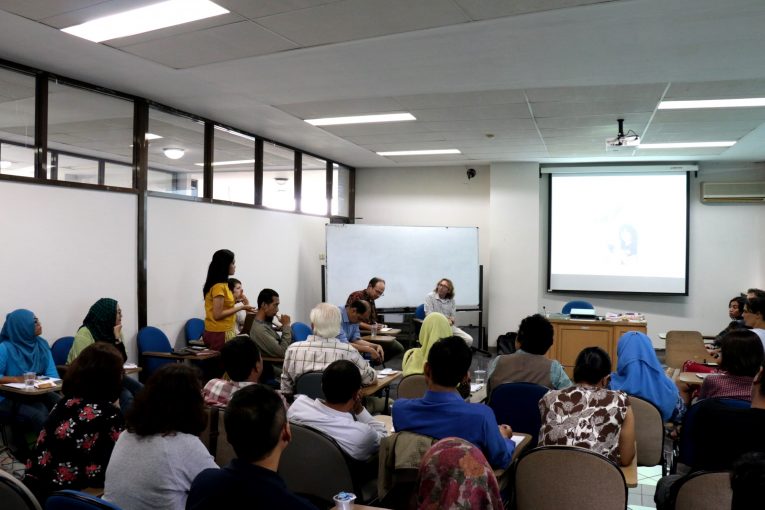
Jonathan Zilberg, a cultural anthropologist whose research and advocacy focuses on museum ethnography, argued that Indonesian museums face such problems as performance, transparency and accountability, but they have the potential power to promote pluralism to the public. In his February 1st Wednesday forum presentation, he raised questions as to how Indonesian museums can be a strong bond to serve Indonesia’s diversity.

Based on his research in National Museum of Indonesia in Central Jakarta, Zilberg argued that museums are an extension of culture and identity. He conducted his research by closely examining the activities of visitors of National Museum. He took photos from different angles and then reflected on how visitors interact with the objects on display. He stressed that a museum that functions well should be a place to learn and display democracy. Different people come to the museum with various interests. These differences can lead them to learn about pluralism in comfortable ways.

In museums, Zilberg argued, people need to engage with the objects displayed. Self-engagement is important because objects only become alive when viewers ask questions. In the act of raising questions, they not only identify the sculpture but also identify their own selves. For museums to promote pluralism, they need to offer spaces to create stories rather than only technical information.

Especially since the National Museum was re-organized, many people are no longer connected to the sculptures displayed there. There is distance of the visitors and the object. Zilberg stated that a meaningful experience in museum can be had by touching the object and being involved with them. Reaching is an act of identification. There does not need to be any process of mediation in the museum. According to Zilberg, storylines in museum lead to simplification; they narrow the space for audience to create their own stories, especially for children.
At the end, Zilberg restated his opinion about the potential roles of Indonesian museums for being promotors of pluralism and for educating the public about national cultural and religious diversity and the history of the archipelago. Indonesian museums can be supporting units of education for diversity, but one major problem is that schools do not typically have the resources for school visits at the museums. On their own, he and members of the audience sensed, Indonesians do not go to their museums and have little, if any, interest in them.

In the question and answer session, the discussion focused on Zilberg’s argument that storylines go against pluralism because they can be controlling while people should create their own stories. For him, museums are alive when people are involved in asking questions. In the museum people shouldn’t tell people what they need to know.  Instead people need to ask questions to experience the museum for themselves.
See some video clips of this wedforum event in Youtube.

*Meta Ose Ginting is CRCS student of the 2015 batch
Tags: Indonesia jonathan zilberg Museum Pluralism Wednesday Forum

Leave A Comment Cancel reply

Your email address will not be published. Required fields are marked *

*

Instagram

Much has been said about faith and ecology—but one Much has been said about faith and ecology—but one question often slips through the cracks: who is actually paying for it?
Behind every conservation effort, there are financial choices, priorities, and actors shaping what is possible. This talk with dives  into the often-overlooked terrain of sustainable financing in the intersection of religion, ecology, and conservation in Indonesia. 
Come and join in a thought-provoking discussion with @sofjandicky at UGM Graduate School building, 3rd floor. We provide snacks and drinks, don't forget to bring your tumbler. This event is free and open to public.
Kuliah itu SCAM? Apa sih bedanya SCAM versi anak Kuliah itu SCAM?

Apa sih bedanya SCAM versi anak CRCS UGM?
 #skill #connection #attitude #mindset #fyp
B A T A S Ada momen ketika agama hadir sebagai ba B A T A S 
Ada momen ketika agama hadir sebagai bahasa terakhir untuk bertahan. Seperti perempuan-perempuan di Sudan yang mempertanyakan apakah bunuh diri bisa menjadi jalan pulang yang lebih manusiawi daripada hidup dalam kekerasan. Ini merupakan situasi ekstrem ketika dosa dan keselamatan tidak lagi nyata dalam keseharian sementara dunia memilih diam. Pada titik itu, mereka memilih untuk berbicara "langsung" kepada Tuhan melalui jalan yang kelam.

Simak refleksi @safinatul_aula tentang bunuh diri dan agensi "kesalehan" di situs web crcs
A N G K E R Makam menjadi ruang pisah antara yang A N G K E R
Makam menjadi ruang pisah antara yang hidup dan mati. Mereka yang masih bernyawa melanjutkan cerita, mereka yang mati bersemayam di makam. Pada titik ini, makam memisahkan antara yang sakral dan profan, yang adi kodrati dan yang sehari-hari. Namun, makam juga menjadi ruang jumpa antarkeduanya. Yang hidup menceritakan ulang kisah yang meninggal sehingga mendiang terus mengada. Selama kisah diceritakan dan nama terus diumbulkan ke langit, selama itu pula mereka mengabadi. Karenanya, makam itu angker, sebuah jangkar yang menakutkan dan menautkan sekaligus. 

Simak catatan lapangan @yohanes_leo27 terkait makam di situs web crcs.
Follow on Instagram

Twitter

Tweets by crcsugm

Universitas Gadjah Mada

Gedung Sekolah Pascasarjana UGM, 3rd Floor
Jl. Teknika Utara, Pogung, Yogyakarta, 55284
Email address: crcs@ugm.ac.id


© CRCS - Universitas Gadjah Mada

KEBIJAKAN PRIVASI/PRIVACY POLICY