
• Tentang UGM
  • Portal Akademik
  • Pusat TI
  • Perpustakaan
  • Penelitian
Universitas Gadjah Mada
  • About Us
    • About CRCS
    • Vision & Mission
    • People
      • Faculty Members and Lecturers
      • Staff Members
      • Students
      • Alumni
    • Facilities
    • Library
  • Master’s Program
    • Overview
    • Curriculum
    • Courses
    • Schedule
    • Admission
    • Scholarship
    • Accreditation and Certification
    • Academic Collaborations
      • Crossculture Religious Studies Summer School
      • Florida International University
    • Academic Documents
    • Student Satisfaction Survey
  • Article
    • Perspective
    • Book Review
    • Event Report
    • Class Journal
    • Interview
    • Wed Forum Report
    • Thesis Review
    • News
  • Publication
    • Reports
    • Books
    • Newsletter
    • Monthly Update
    • Infographic
  • Research
    • CRCS Researchs
    • Resource Center
  • Community Engagement
    • Film
      • Indonesian Pluralities
      • Our Land is the Sea
    • Wednesday Forum
    • ICIR
    • Amerta Movement
  • Beranda
  • Wednesday Forum News
  • Place, Time and Conditions in the Art of Intercultural Dialogue

Place, Time and Conditions in the Art of Intercultural Dialogue

  • Wednesday Forum News
  • 11 April 2022, 21.35
  • Oleh: crcs ugm
  • 0

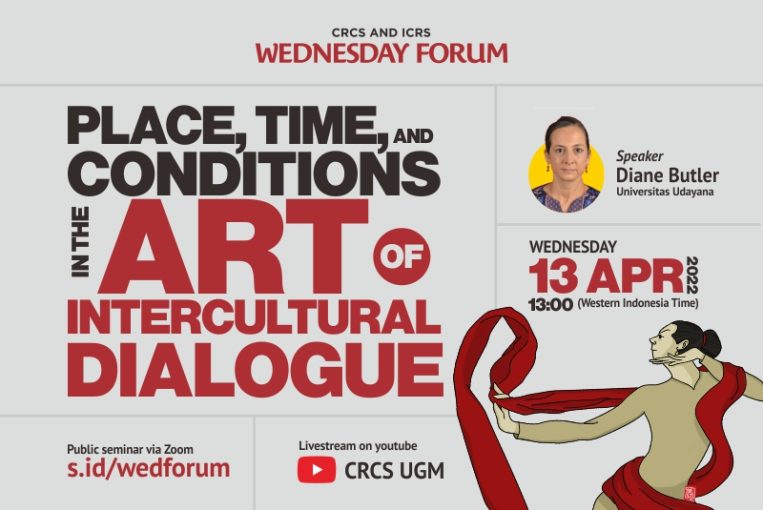
Place, Time and Conditions in the Art of Intercultural Dialogue

Wednesday Forum – 13 April 2022

How can mutual understanding and exchanges among people of different cultures and ethnicities be supported in a manner that recognizes the variety of their worldviews and spatial-temporal-kinesthetic knowledge and cultural and spiritual values? In Diane’s experience, a practice-based approach to the art of intercultural dialogue does not stem from a predetermined method but rather is an organic process that grows from the interactions of the people involved, which will evolve differently in each place depending on its historical and current conditions. One approach that she has greatly appreciated in Indonesia, which has given good results, is by taking into account the place, time and conditions. With this in mind, she will share some aspects one might consider in the fostering of a common field for dialogue.

Diane Butler, PhD is a dance-movement artist, teacher and cultural program director who has collaborated with artists from varied cultures and faiths in the Americas, Europe and Asia for over 35 years and since 2001 resided in Bedulu and Tejakula in Bali, Indonesia. She co-founded Dharma Nature Time, an international foundation to support interculture in cultural environments through sharing in the arts, religiosity and nature. Diane is the first non-Indonesian to earn a Ph.D. in Kajian Budaya from Universitas Udayana, Bali where soon after the Rector appointed her as a volunteer Associate Professor.

The full poster of this event is available here.

Tags: diane butler interreligious dialogue

Leave A Comment Cancel reply

Your email address will not be published. Required fields are marked *

*

Instagram

Much has been said about faith and ecology—but one Much has been said about faith and ecology—but one question often slips through the cracks: who is actually paying for it?
Behind every conservation effort, there are financial choices, priorities, and actors shaping what is possible. This talk with dives  into the often-overlooked terrain of sustainable financing in the intersection of religion, ecology, and conservation in Indonesia. 
Come and join in a thought-provoking discussion with @sofjandicky at UGM Graduate School building, 3rd floor. We provide snacks and drinks, don't forget to bring your tumbler. This event is free and open to public.
Kuliah itu SCAM? Apa sih bedanya SCAM versi anak Kuliah itu SCAM?

Apa sih bedanya SCAM versi anak CRCS UGM?
 #skill #connection #attitude #mindset #fyp
B A T A S Ada momen ketika agama hadir sebagai ba B A T A S 
Ada momen ketika agama hadir sebagai bahasa terakhir untuk bertahan. Seperti perempuan-perempuan di Sudan yang mempertanyakan apakah bunuh diri bisa menjadi jalan pulang yang lebih manusiawi daripada hidup dalam kekerasan. Ini merupakan situasi ekstrem ketika dosa dan keselamatan tidak lagi nyata dalam keseharian sementara dunia memilih diam. Pada titik itu, mereka memilih untuk berbicara "langsung" kepada Tuhan melalui jalan yang kelam.

Simak refleksi @safinatul_aula tentang bunuh diri dan agensi "kesalehan" di situs web crcs
A N G K E R Makam menjadi ruang pisah antara yang A N G K E R
Makam menjadi ruang pisah antara yang hidup dan mati. Mereka yang masih bernyawa melanjutkan cerita, mereka yang mati bersemayam di makam. Pada titik ini, makam memisahkan antara yang sakral dan profan, yang adi kodrati dan yang sehari-hari. Namun, makam juga menjadi ruang jumpa antarkeduanya. Yang hidup menceritakan ulang kisah yang meninggal sehingga mendiang terus mengada. Selama kisah diceritakan dan nama terus diumbulkan ke langit, selama itu pula mereka mengabadi. Karenanya, makam itu angker, sebuah jangkar yang menakutkan dan menautkan sekaligus. 

Simak catatan lapangan @yohanes_leo27 terkait makam di situs web crcs.
Follow on Instagram

Twitter

Tweets by crcsugm

Universitas Gadjah Mada

Gedung Sekolah Pascasarjana UGM, 3rd Floor
Jl. Teknika Utara, Pogung, Yogyakarta, 55284
Email address: crcs@ugm.ac.id


© CRCS - Universitas Gadjah Mada

KEBIJAKAN PRIVASI/PRIVACY POLICY