by Sephia Putri Fatima
Suprapto Suryodarmo was the initiator of the Joget Amerta. His approach emphasised the depth required of a dancer, beginning with self-awareness, awareness of nature and the environment, and a reflective attitude toward movement. From childhood, he was familiar with movement forms, ranging from classical Javanese dance and silat to kung fu. He later studied Vipassana Buddhist meditation and the Javanese Sumarah teachings, which he found invaluable in exploring nature and consciousness. (Suryodarmo, n.d.)
Amerta Movement is a free-style movement practice. It is both a concept and a practice, viewing life as a continuous process of change. Based on ordinary everyday movements, and emphasizing awareness and attitude, Amerta Movement employs simple techniques to facilitate human growth, develop potential, and deepen understanding. The physical body explores identity, self-expression, and communication, with the potential for artistic expression. His movement is not just a language of communication but also an expression of existence (Isnanto, 2019).
Many practitioners of Amerta Movement are Westerners or individuals from various regions across Asia and the Pacific, coming from all walks of life. His students come from various artistic disciplines—dance, architecture, fine arts, theater—as well as body-related fields, including professional dance and movement therapy. Therefore, Amerta Movement has been applied in diverse fields, including movement education, health and therapy, the arts, environmental art, and new ritual arts. (Lavelle, 2006)
In his exploration of natural movement, Suprapto Suryodarmo used these movements as an entry point to develop what would later be called Joget Amerta. However, Joget Amerta is not merely an individual’s physical movement; rather, it is a human response to the surrounding environment. This response originates in the body and gradually transforms into movement that reflects a given situation. As a result, Joget Amerta continuously adapts to its surroundings, following expressive movement that break free from conventional structures or rigid choreography.
Suprapto Suryodarmo passed away on Sunday, December 29, 2019, in Solo. He has dedicated his life to developing, embodying, teaching, and sharing the practice of Amerta Movement. Throughout his life, Mbah Prapto worked with students and colleagues from all walks of life, including renowned artists, performers, practitioners, and internationally recognized teachers—whom he simply regarded as “friends.” He encouraged these “friends” to share and spread their understanding of his work.
Commemorating Five Years Since Mbah Prapto’s Passing
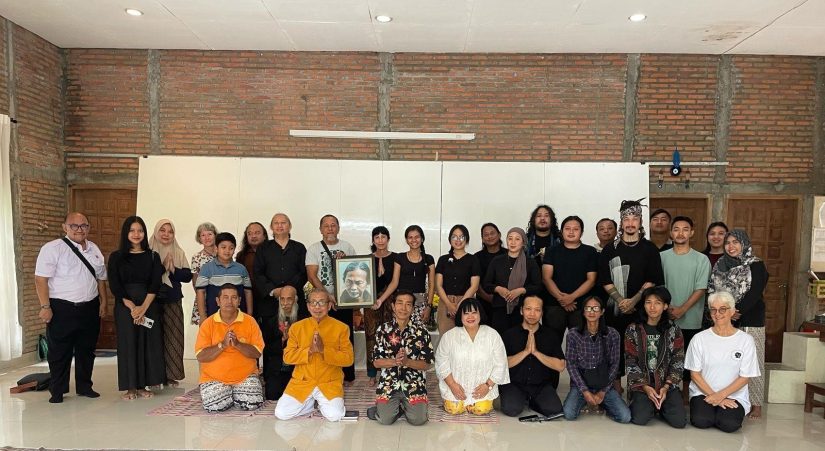
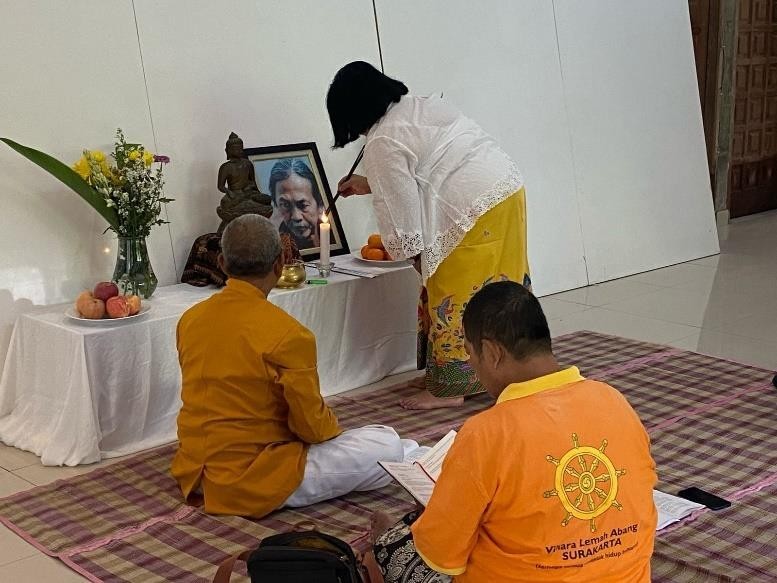
On December 29, 2024, exactly five years after Mbah Prapto’s passing, his family and students gathered to remember and pray for him. The family held a prayer session with Banthe (a Buddhist monk) and Mbah Prapto’s closest relatives. The event took place at Studio Plesungan, Mojosongo, Surakarta, the residence of Mbak Melati, Mbah Prapto’s daughter.
During the discussion, Mbah Prapto’s students shared their experiences of learning under him, reflecting on their artistic journeys. One of his students, Mbah Mugi, recounted how Mbah Prapto imparted knowledge—emphasizing a return to basics and tradition, the importance of self-exploration in art, and the role of meditation and movement concentration in understanding performance and stage presence.
Mbah Prapto taught the learning process through movement and vocabulary, helping students recognize when their movements deviated from tradition and guiding them back to their foundational roots. His teachings encouraged freedom of movement and idea exploration, frequently using symbols in meditation—such as bamboo meditation—to enhance concentration.
In Mbah Mugi’s words:
“Mbah Prapto always said, ‘pulang’ (go home). I kept wondering, what does ‘going home’ mean? After exploring movement, I eventually incorporated Javanese movement vocabulary. When I danced with Javanese movement, Mbah Prapto said, ‘Yes, that’s it.’ That’s when I realized: I had to return to my roots. Before, I danced with all sorts of unfamiliar movements—Westernized or something else—perhaps they didn’t align with my tradition. After that, I understood: ‘Going home’ means returning to my roots, to what I already have.’”
Amerta Movement: Ritual and Artistic Exploration
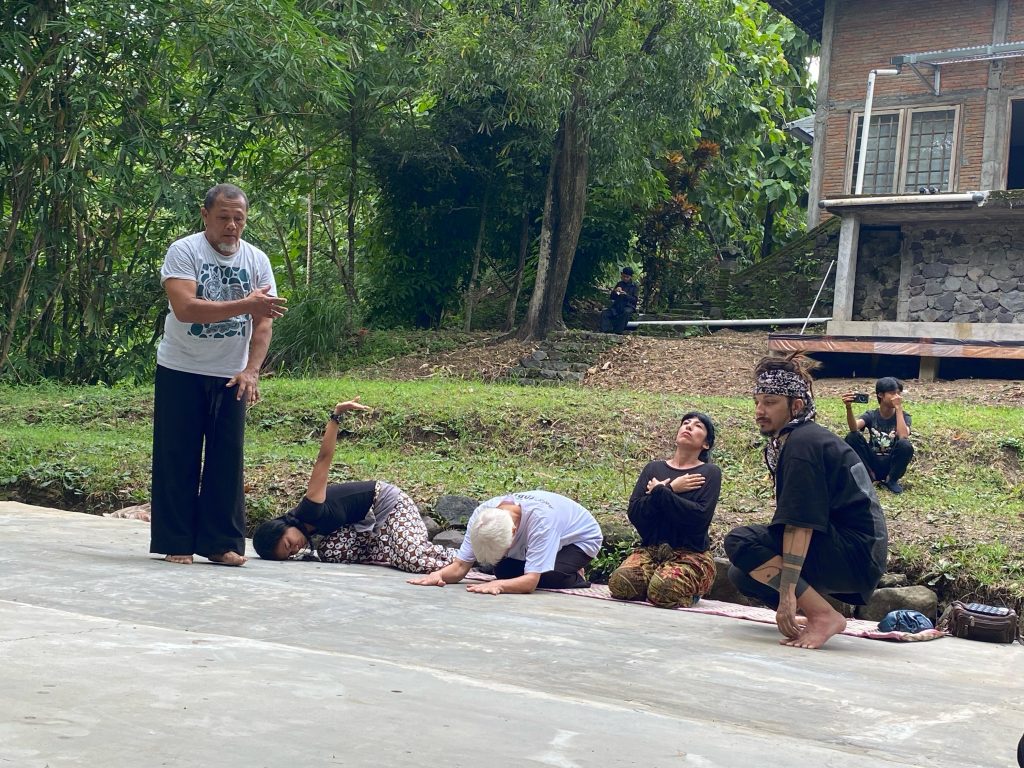
The Amerta Movement, developed by Suprapto Suryodarmo, is a unique approach to movement that integrates body awareness, space, and spirituality. As a practice, Joget Amerta emphasizes direct experience and improvisation, similar to the concept of liminality described by Victor Turner (1969) in ritual studies. In its process, practitioners enter an in-between space—free from rigid social structures—allowing spontaneous exploration that leads to communitas, or a deep sense of connection with oneself and others.
From a performance art perspective, Amerta Movement is not just a movement technique but also a contemporary ritual that transcends traditional boundaries between art, meditation, and everyday life. In this context, art serves as a medium for self-reflection and transformation. Thus, Joget Amerta presents art as a living and dynamic process, continuously evolving through both individual and collective practice. In conclusion, Joget Amerta is a form of ritual movement in art that invites full awareness of the body and space, emphasizing spontaneity and human connection.
References
Turner, V. (1969). The ritual process: Structure and anti-structure. Routledge.
Ardi Isnanto, B. (2019). Penari Senior Asal Solo, Suprapto Suryodarmo Tutup Usia. https://news.detik.com/berita-jawa-tengah/d-4839039/penari-senior-asal-solo-suprapto-suryodarmo-tutup-usia
Lavelle L. (2006). Amerta Movement of Java, 1986-1997: An Asian Movement Improvisation. https://www.lunduniversity.lu.se/lup/publication/386ee7a0-bf67-40d0-8724-8b01bcd5242f
Suprapto Suryodarmo. (n.d.). https://festival.borobudurwriters.id/bio/suprapto-suryodarmo/
Click this link for article in bahasa Indonesia
______________________
Sephia Putri Fatima originally from Semarang, entered the arts scene during her studies at ISI Surakarta, majoring in Ethnomusicology. She studied cultural writing about music. Sephia joined an internship program at the Omah Mili studio, learning from its owner, Ayu Wardani, a graduate in dance from ISI Surakarta. Sephia’s interest in Amerta began when Ayu introduced her to it (having been a student of Mbah Prapto). Sephia learned techniques such as the circle technique, body cleansing (basuh badan), and sapa jagad (greeting the world), which she developed into performances at national and international events. Ayu Wardani taught her from various perspectives and also invited her to train in Sardiwa, a development of Joged Amerta. As a continuation, Sephia is pursuing her postgraduate studies at Universitas Sebelas Maret to further develop cultural theory and write about Sardiwa.