
• Tentang UGM
  • Portal Akademik
  • Pusat TI
  • Perpustakaan
  • Penelitian
Universitas Gadjah Mada
  • About Us
    • About CRCS
    • Vision & Mission
    • People
      • Faculty Members and Lecturers
      • Staff Members
      • Students
      • Alumni
    • Facilities
    • Library
  • Master’s Program
    • Overview
    • Curriculum
    • Courses
    • Schedule
    • Admission
    • Scholarship
    • Accreditation and Certification
    • Academic Collaborations
      • Crossculture Religious Studies Summer School
      • Florida International University
    • Academic Documents
    • Student Satisfaction Survey
  • Article
    • Perspective
    • Book Review
    • Event Report
    • Class Journal
    • Interview
    • Wed Forum Report
    • Thesis Review
    • News
  • Publication
    • Reports
    • Books
    • Newsletter
    • Monthly Update
    • Infographic
  • Research
    • CRCS Researchs
    • Resource Center
  • Community Engagement
    • Film
      • Indonesian Pluralities
      • Our Land is the Sea
    • Wednesday Forum
    • ICIR
    • Amerta Movement
  • Beranda
  • Class Journal
  • Ruwat Rawat Borobudur for conserving a local and a world cultural heritage

Ruwat Rawat Borobudur for conserving a local and a world cultural heritage

  • Class Journal
  • 24 April 2018, 10.23
  • Oleh: ardhy_setyo
  • 0

Ruwat Rawat Borobudur for conserving a local and a world cultural heritage

Ira Chuarsa – 24 April 2018

The world’s biggest Buddhist monument Borobudur has captured the hearts of people all around the world. It is widely known as a tourism site, but the local people perceive Borobudur to be their cultural heritage even though most of them have no much knowledge of its history and few, if any, are practicing Buddhists.

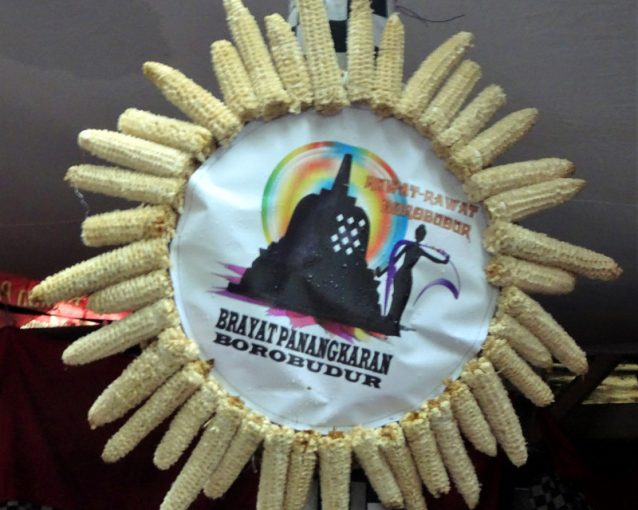
To gain more exposure to the many meanings of Borobudur, CRCS students taking the Advanced Study of Buddhism class accompanied by the lecturer Dr. Gregory Vanderbilt attended the fifteenth annual cultural event of the Ruwat Rawat Borobudur on April 18th, 2018. This event lasts for two months, with April 18th marking the peak of the event intentionally held on World Heritage Day, as Borobudur was declared a World Heritage Site by UNESCO in 1991.
Groups from all over Central Java came and took part in this event, as performers and participants. Various traditional art performances, such as Kirab Budaya, Festival Sanggar, Sastra Ruwat Rawat Borobudur and Gelar Sendratari Kidung Karmawibangga Borobudur enlivened the event.

The event took place in the house of Pak Sucoro, the first initiator of the Ruwat Rawat Borobudur, which is also simply known locally as Ruwatan. The mission of Ruwatan itself is to raise the awareness of the local people about the significance of the Borobudur temple. Through this event, Sucoro hopes that the local people will continue to protect and keep Borobudur as a precious cultural heritage for generations to come.


Two young girls opened the event with a beautiful dance called Sumilara, followed by an opening speech by Pak Sucoro. In his speech, Pak Sucoro reminded us that Ruwatan is a call for conserving Borobudur temple. The heritage is not only the physical heritage, which is the temple, but the most important is the cultural heritage. This is what makes this event as a cultural communication forum as well. No less than 61 arts groups from villages all over Central Java were participating in the folk arts festival (festival kesenian rakyat) during the Ruwat Rawat Borobudur event series to perform their traditional dances. The dances expressed how proud they are of Borobudur as their cultural heritage. With the help of Balai Konservasi (the Conservation Association), the concept of the dance was created with an inspiration from the reliefs carved in Borobudur temple.

uring the event, a new book written by Pak Sucoro titled Harmoni Kehidupan dalam Ruwat Rawat Borobudur was launched and given to three representatives. One book was given to the Central Java Governor Pak Ganjar Pranowo; another was given to Dr Gregory Vanderbilt as a representative from academia; and the last was for Pak Anwar from Balai Konservasi. With the hope that it will be widely spread, the book attempts at conveying a message of the sanctity of Borobudur and the importance of conserving it as a cultural heritage.

From Pak Sucoro’s Warung Info Jagad Cleguk, located just outside the exit gate from the tourist parking lot, we followed all performers and participants of the Ruwatan walking toward Borobudur temple, a distance of approximately two kilometers. Hundreds of people of all ages with various traditional costumes were marching like a carnival bringing offerings headed to the Borobudur temple. As we reached the temple, a ritual held as the most central moment of the event. On the grass field near the temple, musical poetry was performed by artists from all over Central Java. Through the reading of poem combined with dramatic motions that describes its meaning, they were delivering a message about the value of Borobudur

This annual series of events has its own significance. During the New Order regime, the government assignedmanagement of Borobudur to a state-owned corporation which has treated it more for economic benefit resource as a tourism object rather than a valuable cultural and educational resource. Pak Sucoro’s own home was in one of the villages closest to the stupa moved in order to make way for the expansive park and parking lot that now surround the monument. 

From another perspective, the fact that the people involved and participating in the Ruwatan are mostly non-Buddhists may be a reminder for all Indonesians that in our diversity, we share a concern in common: the significance of the Borobudur not only as a tourism site or a Buddhist temple but also a living sacred site, a cultural heritage or, even further, as what may define Indonesia.


__________________
Photo courtesy: Gregory Vanderbilt

Tags: field trip Ruwat Rawat Borobudur

Leave A Comment Cancel reply

Your email address will not be published. Required fields are marked *

*

Instagram

crcs_ugm

Sedang tidak baik-baik saja, kamu biasanya mencari Sedang tidak baik-baik saja, kamu biasanya mencari apa di internet?

Banyak anak muda hari ini menemukan ketenangan, nasihat, bahkan jawaban atas kegelisahan melalui media sosial, konten keagamaan, akun kesehatan mental, hingga AI chatbot. Namun, bagaimana sebenarnya pengalaman itu terjadi?
Kami sedang melakukan penelitian untuk memahami bagaimana generasi muda usia 10–24 tahun mencari informasi keagamaan maupun kesehatan mental saat menghadapi masa-masa sulit.
Jika kamu merasa topik ini dekat dengan pengalamanmu, kami mengundangmu menjadi responden.
Partisipasi bersifat sukarela dan seluruh jawaban dijaga kerahasiaannya.
Kamu bisa langsung kirim DM jawabanmu atau mau tanya-tanya dulu juga boleh.

Kami tunggu ya.
Katanja koeliah S2 itoe mahal? Eitss , djangan s Katanja  koeliah S2 itoe mahal? 
Eitss , djangan salah
Bersama keempat mahasiswa angkatan 2025, kita akan ngobrolin djoeroes-djoeroes djitoe mendapatkan beasiswa di CRCS UGM

Begitoe?
Before petroleum fueled the world, it fractured th Before petroleum fueled the world, it fractured the archipelago

The raise of the colonial petroleum industry in the Dutch East Indies was also the emergence of new spatial inequalities. Outer Java was not merely discovered as a resource zone. It was politically produced as an extractive territory through imperial concessions, colonial state-building, and global struggles over resource control.

Join us in this presentation on capitalism, oil, and the colonial fractures that continue to haunt the geography of modern Indonesia. We provide snacks and drinks, don't forget to bring your tumbler. This event is free and open to public.
M B G Satu kotak makan berisi nasi putih pulen seb M B G
Satu kotak makan berisi nasi putih pulen sebagai sumber karbohidrat utama, dimasak dari beras medium pilihan, air, sedikit garam, dan beberapa tetes minyak agar tidak cepat basi. Di sampingnya terdapat ayam semur kecap, dibuat dari potongan daging ayam, bawang merah, bawang putih, kecap manis, daun salam, lengkuas, garam, dan sedikit gula sehingga memberi asupan protein hewani yang cukup untuk pertumbuhan. Sebagai pendamping lauk utama, disediakan tempe orek manis gurih dari tempe iris tipis, bawang merah, bawang putih, cabai, kecap, dan gula merah. Tempe ini berfungsi menambah protein nabati sekaligus membuat kotak makan tampak lebih penuh, sebab protein memang sering lebih meyakinkan bila hadir rangkap dua. Untuk unsur sayuran, ada tumis wortel dan buncis yang dimasak dari wortel segar, buncis, sedikit kol, bawang putih, garam, merica, dan minyak sayur. Warna oranye-hijau pada sayur ini penting: bukan hanya untuk vitamin A dan serat, tetapi juga agar foto dokumentasi tidak terlihat terlalu pucat.Sebagai pelengkap vitamin alami, satu buah pisang atau sepotong pepaya matang diletakkan di sudut kotak. Buah dipilih yang murah, tahan banting, tidak gampang memar, dan cukup fotogenik ketika dibagikan massal. Terakhir, ditambahkan susu UHT kotak kecil berbahan susu sapi, gula, dan fortifikasi vitamin, atau kadang telur rebus utuh sebagai penutup protein tambahan.

Berbuih-buih seperti pelaksanaannya ...
Follow on Instagram

Twitter

Tweets by crcsugm

Universitas Gadjah Mada

Gedung Sekolah Pascasarjana UGM, 3rd Floor
Jl. Teknika Utara, Pogung, Yogyakarta, 55284
Email address: crcs@ugm.ac.id


© CRCS - Universitas Gadjah Mada

KEBIJAKAN PRIVASI/PRIVACY POLICY