
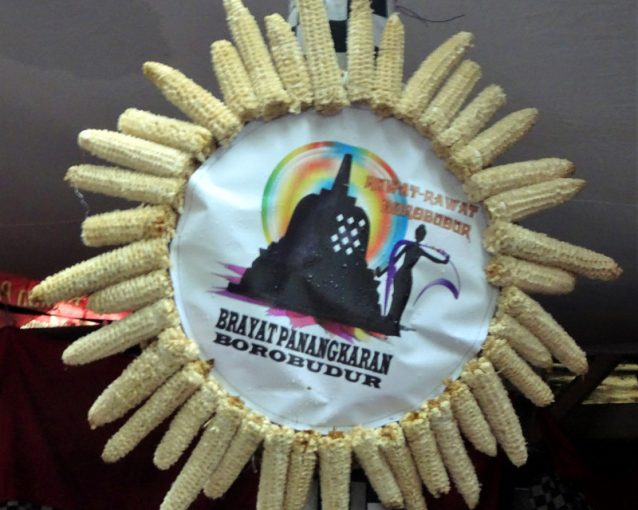
Ruwat Rawat Borobudur for conserving a local and a world cultural heritage
Ira Chuarsa – 24 April 2018
The world’s biggest Buddhist monument Borobudur has captured the hearts of people all around the world. It is widely known as a tourism site, but the local people perceive Borobudur to be their cultural heritage even though most of them have no much knowledge of its history and few, if any, are practicing Buddhists.
To gain more exposure to the many meanings of Borobudur, CRCS students taking the Advanced Study of Buddhism class accompanied by the lecturer Dr. Gregory Vanderbilt attended the fifteenth annual cultural event of the Ruwat Rawat Borobudur on April 18th, 2018. This event lasts for two months, with April 18th marking the peak of the event intentionally held on World Heritage Day, as Borobudur was declared a World Heritage Site by UNESCO in 1991.
Groups from all over Central Java came and took part in this event, as performers and participants. Various traditional art performances, such as Kirab Budaya, Festival Sanggar, Sastra Ruwat Rawat Borobudur and Gelar Sendratari Kidung Karmawibangga Borobudur enlivened the event.
The event took place in the house of Pak Sucoro, the first initiator of the Ruwat Rawat Borobudur, which is also simply known locally as Ruwatan. The mission of Ruwatan itself is to raise the awareness of the local people about the significance of the Borobudur temple. Through this event, Sucoro hopes that the local people will continue to protect and keep Borobudur as a precious cultural heritage for generations to come.

Two young girls opened the event with a beautiful dance called Sumilara, followed by an opening speech by Pak Sucoro. In his speech, Pak Sucoro reminded us that Ruwatan is a call for conserving Borobudur temple. The heritage is not only the physical heritage, which is the temple, but the most important is the cultural heritage. This is what makes this event as a cultural communication forum as well. No less than 61 arts groups from villages all over Central Java were participating in the folk arts festival (festival kesenian rakyat) during the Ruwat Rawat Borobudur event series to perform their traditional dances. The dances expressed how proud they are of Borobudur as their cultural heritage. With the help of Balai Konservasi (the Conservation Association), the concept of the dance was created with an inspiration from the reliefs carved in Borobudur temple.
uring the event, a new book written by Pak Sucoro titled Harmoni Kehidupan dalam Ruwat Rawat Borobudur was launched and given to three representatives. One book was given to the Central Java Governor Pak Ganjar Pranowo; another was given to Dr Gregory Vanderbilt as a representative from academia; and the last was for Pak Anwar from Balai Konservasi. With the hope that it will be widely spread, the book attempts at conveying a message of the sanctity of Borobudur and the importance of conserving it as a cultural heritage.
From Pak Sucoro’s Warung Info Jagad Cleguk, located just outside the exit gate from the tourist parking lot, we followed all performers and participants of the Ruwatan walking toward Borobudur temple, a distance of approximately two kilometers. Hundreds of people of all ages with various traditional costumes were marching like a carnival bringing offerings headed to the Borobudur temple. As we reached the temple, a ritual held as the most central moment of the event. On the grass field near the temple, musical poetry was performed by artists from all over Central Java. Through the reading of poem combined with dramatic motions that describes its meaning, they were delivering a message about the value of Borobudur
This annual series of events has its own significance. During the New Order regime, the government assignedmanagement of Borobudur to a state-owned corporation which has treated it more for economic benefit resource as a tourism object rather than a valuable cultural and educational resource. Pak Sucoro’s own home was in one of the villages closest to the stupa moved in order to make way for the expansive park and parking lot that now surround the monument.
From another perspective, the fact that the people involved and participating in the Ruwatan are mostly non-Buddhists may be a reminder for all Indonesians that in our diversity, we share a concern in common: the significance of the Borobudur not only as a tourism site or a Buddhist temple but also a living sacred site, a cultural heritage or, even further, as what may define Indonesia.

__________________
Photo courtesy: Gregory Vanderbilt