
• Tentang UGM
  • Portal Akademik
  • Pusat TI
  • Perpustakaan
  • Penelitian
Universitas Gadjah Mada
  • About Us
    • About CRCS
    • Vision & Mission
    • People
      • Faculty Members and Lecturers
      • Staff Members
      • Students
      • Alumni
    • Facilities
    • Library
  • Master’s Program
    • Overview
    • Curriculum
    • Courses
    • Schedule
    • Admission
    • Scholarship
    • Accreditation and Certification
    • Academic Collaborations
      • Crossculture Religious Studies Summer School
      • Florida International University
    • Academic Documents
    • Student Satisfaction Survey
  • Article
    • Perspective
    • Book Review
    • Event Report
    • Class Journal
    • Interview
    • Wed Forum Report
    • Thesis Review
    • News
  • Publication
    • Reports
    • Books
    • Newsletter
    • Monthly Update
    • Infographic
  • Research
    • CRCS Researchs
    • Resource Center
  • Community Engagement
    • Film
      • Indonesian Pluralities
      • Our Land is the Sea
    • Wednesday Forum
    • ICIR
    • Amerta Movement
  • Beranda
  • Wednesday Forum News
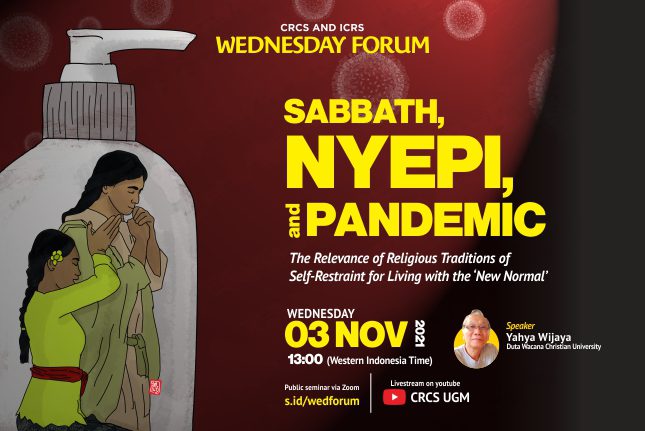
  • Sabbath, Nyepi, and Pandemic: The Relevance of Religious Traditions of Self-Restraint for Living with the ‘New Normal’

Sabbath, Nyepi, and Pandemic: The Relevance of Religious Traditions of Self-Restraint for Living with the ‘New Normal’

  • Wednesday Forum News
  • 2 November 2021, 18.26
  • Oleh: crcs ugm
  • 0

Sabbath, Nyepi, and Pandemic: The Relevance of Religious Traditions of Self-Restraint for Living with the ‘New Normal’

Wednesday Forum – 03 November 2021

This study focuses on the relevance of religious traditions of self-restraint, particularly Sabbath and Nyepi, in the context of the COVID-19 pandemic. From an economic perspective, the pandemic interrupts a lifestyle marked by an unceasing process of production and consumption that affects almost all aspects of life. Such a lifestyle, known as ‘productivism’, has been confronted with ‘antiproductivism’ promoted by groups of Marxism-inspired intellectuals and activists. Employing the method of public theology, this study reveals that religious traditions of self-restraint prepare humanity to anticipate interruptions of regularity, such as a pandemic, in a way that is critical of productivism yet distinct from antiproductivism. From a spiritual perspective, the pandemic and religious traditions of self-restraint should be perceived as synergistic appeals to a balanced lifestyle that is socially, economically, and ecologically harmonious.

Yahya Wijaya is professor of public theology at Duta Wacana Christian University, Yogyakarta, Indonesia, and affiliated faculty member ICRS. He holds a ThM from Princeton Theological Seminary and a PhD from the University of Leeds. He has authored and co-authored books on public theology and Christian ethics in English and Indonesian; and published in several international as well as Indonesian journals in the areas of theology, business ethics, and philosophy.

The full poster of this event is available here.

Tags: marxism nyepi pandemic sabbath

Leave A Comment Cancel reply

Your email address will not be published. Required fields are marked *

*

Instagram

What does Kendeng teach us about Indonesia’s ecolo What does Kendeng teach us about Indonesia’s ecological disasters today?
Years ago in the North Kendeng Mountains, women resisted cement mining to defend karst mountains, water sources, farmland, and Ibu Bumi. Today, as Indonesia faces floods, landslides, and other ecological disasters, their struggle feels increasingly urgent. Join this thought provoking discussion on how Ibu Bumi becomes a meeting point for Muslim and Sedulur Sikep ecological ethics at #wednesdayforum.
We provide snacks and drinks, don't forget to bring your tumbler. This event is free and open to public.
Can the body be a language of faith? Explore how C Can the body be a language of faith?
Explore how Confucian values are embodied through ritual, gestures, discipline, and everyday practices.
From li and xiao to colonial Indonesia and the Covid-19 pandemic, we will discover how the body becomes a site of virtue, faith, and social harmony.

Join this discussion at #wednesdayforum with @sutrisno.evi
We provide snacks and drinks, don't forget to bring your tumbler. This event is free and open to public.
Whose gaze am I carrying in my body? Over time, we Whose gaze am I carrying in my body?
Over time, we learn to watch ourselves through the eyes of others. What does it take for a body to loosen itself from these gazes? Perhaps it begins with simply staying present. Breathing. Not disappearing. Quietly refusing.
Join this thought provoking discussion at #wednesdayforum with @anquaerere
We provide snacks and drinks, don't forget to bring your tumbler. This event is free and open to public.
Family law is never just about the family. It’s al Family law is never just about the family. It’s also about who gets to shape the state.

Join this thought provoking discussion at #wednesdayforum. We provide snacks and drinks, don't forget to bring your tumbler. This event is free and open to public.
Follow on Instagram

Twitter

Tweets by crcsugm

Universitas Gadjah Mada

Gedung Sekolah Pascasarjana UGM, 3rd Floor
Jl. Teknika Utara, Pogung, Yogyakarta, 55284
Email address: crcs@ugm.ac.id


© CRCS - Universitas Gadjah Mada

KEBIJAKAN PRIVASI/PRIVACY POLICY