

Wednesday Forum on August 23, 2017, discussing the relationship between Indonesia's New Order government and Muslim groups. The speaker: Gde Dwitya Arief Metera from Northwestern University.
islam
Anna M. Maćkowiak, a doctoral student from Jagiellonian University presented her research in Wednesday Forum about how Islam has been perceived in her home country, Poland.
A. S. Sudjatna | CRCS | Event Report

Secara historis dan genealogis, Yahudi, Kristen, dan Islam mengklaim memiliki hulu yang sama, yakni dari Ibrahim atau Abraham. Ketiga agama ini kerap mendaku dirinya masing-masing sebagai agama penerus dari tradisi Ibrahimiah, Abrahamic religion, atau millah Ibrahim. Karenanya, tak heran jika sampai saat ini, ketiga agama ini kerap bersaing dalam klaim kebenaran sebagai yang paling Abrahamic, atau sebagai pewaris paling sah atas millah Ibrahim yang mendakwahkan monoteisme sebagai inti ajarannya.
Di Indonesia sendiri, para pemeluk Islam dan Kristen tak jarang terlibat konflik, baik secara terbuka maupun tertutup. Gesekan demi gesekan, kasus demi kasus dalam perebutan pengaruh dan klaim terus berlanjut hingga saat ini dengan tren fluktuatif. Faktor kekhawatiran atas kondisi semacam inilah yang kemudian menggerakkan Dr. H. Waryono Abdul Ghafur, Wakil Rektor Bidang Kemahasiswaan dan Kerjasama UIN Sunan Kalijaga, Yogyakarta, menulis sebuah buku berjudul Persaudaraan Agama-Agama: Millah Ibrahim dalam Tafsir al-Mizan. Harapannya, dengan memahami substansi dari millah Ibrahim sebagai hulu dari Islam dan Kristen serta Yahudi, setiap pemeluk agama-agama ini dapat menangkap kesan persaudaraan yang hadir di dalamnya.
Untuk tiba pada pemahaman akan hadirnya garis persaudaraan di antara agama-agama penerus millah Ibrahim ini, ada tiga terma penting yang harus dipahami terlebih dahulu, yakni millah, din dan syariat. Ketiga terma ini biasanya diterjemahkan dengan agama saja di dalam Bahasa Indonesia. Padahal ketiganya memiliki makna yang berbeda. Secara ringkas, din dapat dipahami sebagai agama secara umum; sedangkan millah dimaknai sebagai tradisi; dan syariat adalah cara atau jalan tertentu yang khusus bagi suatu umat atau dapat juga dipahami sebagai cara atau ajaran nabi tertentu terhadap umatnya yang akan berbeda dengan cara nabi lainnya, misalnya syariat shalat dan puasa umat Nabi Muhammad yang berbeda dengan syariat puasa dan shalatnya umat nabi-nabi terdahulu. Dalam hal ini, millah Ibrahim dapat dipahami sebagai tradisi Ibrahim di dalam beragama yang memiliki seperangkat cara/syariat tertentu.
Menanggapi buku setebal 274 halaman yang diterbitkan oleh penerbit Mizan ini, Dr. Abdul Mustaqim, Ketua Program Studi Ilmu Al-Quran dan Tafsir UIN Sunan Kalijaga, yang menjadi pembedah pertama buku tersebut, mengatakan bahwa konsep millah Ibrahim ini dapat menjadi basis teologis dan epistemologis kerukunan beragama, terutama tiga agama besar dunia, yakni Islam, Kristen dan Yahudi.
Secara lebih lanjut, ia lalu menjelaskan karakter dari millah Ibrahim yang telah dikonseptualisasikan oleh Dr. Waryono di dalam buku tersebut berdasarkan analisisnya terhadap tafsir al-Mizan, yakni fitrah, tauhid, hanif, islam dan iman. Fitrah berarti ajarannya itu sejalan dengan naluri kemanusiaan. Tauhid berarti mengesakan Tuhan. Hanif berarti condong kepada kebenaran atau lurus. Islam—dalam hal ini bukan Islam yang menjadi proper name agama—bermakna, di antaranya, kepasrahan sikap atau kepasrahan total terhadap Tuhan. Iman berarti konsistensi antara pengetahuan dan perbuatan, atau pembenaran terhadap sesuatu disertai dengan melakukan konsekuensinya. Dalam hal ini, suatu din atau agama dapat dikategorikan sebagai penerus millah Ibrahim jika memenuhi kriteria-kriteria tersebut.
Dr. Abdul Mustaqim juga menyoroti pembahasan mengenai Yahudi dan Nasrani yang dikategorikan sebagai ahli kitab di dalam pembahasan buku tersebut, termasuk pembagian Yahudi dan Nasrani yang dikategorisasi ke dalam dua bagian, yakni mukmin dan kafir. Ahli kitab yang kafir dicirikan dengan karakter thugyan (durjana/melampaui batas), ghuluw (ekstrem), melakukan penentangan, berbuat zalim dan nifaq. Menurutnya, ketika melakukan kategorisasi ini, Dr.Waryono sedang melakukan kajian tematik terma sekaligus tokoh. Disebut tematik terma karena Dr. Waryono banyak membahas soal terma-terma tertentu; disebut tematik tokoh karena ia memilih salah satu karya tokoh sebagai subjek bahasannya, yakni Thabathaba’i. Dalam hal ini, Dr. Abdul Mustaqim kemudian menyarankan bahwa karakter-karakter yang membuat ahli kitab dikategorikan sebagai kafir juga seharusnya direfleksikan terhadap muslim, sehingga ini dapat menjadi peringatan bagi umat Islam dalam beragama.
Memungkasi pembedahannya atas buku tersebut, Dr. Abdul Mustaqim mengatakan bahwa konsep millah Ibrahim ini dapat menjadi otokritik bagi klaim kebenaran yang tertutup terhadap para penganut abrahamic religion, yakni para penganut Islam, Kristen dan Yahudi, sebab semua agama secara historis memiliki potensi menyimpang. Dengan memahami ini, kita nantinya tak akan terjerumus kepada keberagamaan yang semu, melainkan akan memiliki keberagamaan yang otentik, yang menjadikan agama ini bukan untuk Tuhan, namun untuk kemaslahatan manusia. Selain itu, ia juga menegaskan bahwa fenomena perbedaan agama tidak semestinya dijadikan penghalang untuk merajut persaudaraan, sebab secara genealogis kita memiliki akar payung yang sama, yakni millah Ibrahim.
Pembedah kedua, Dr. Zainal Abidin Bagir dari CRCS, Sekolah Pascasarjana UGM, menyoroti soal signifikansi Ibrahim di dalam Islam. Menurutnya, kelekatan Islam terhadap Nabi Ibrahim sangat kentara. Selain dalam salat, sejatinya ibadah haji dapat pula disebut sebagi napak tilas Ibrahim. Ini sangat menarik, sebab Islam sebagai ajaran yang dibawa oleh Nabi Muhammad tidak melakukan napak tilas Muhammad, namun justru menapaktilasi Ibrahim di dalam salah satu ibadahnya.
Menyoroti terma-terma yang dibahas secara panjang lebar di dalam buku tersebut, terutama dengan istilah-istilah tauhid, kafir, iman, ihsan dan sebagainya, Dr. Zaenal Abidin Bagir mempertanyakan pemahaman mengenai terma-terma tersebut: apakah secara teologis ataukah etis. Menurutnya, jika dilihat dari maknanya, terma-terma semacam fitri, hanif, iman, islam, dan sejenisnya lebih dekat dengan persoalan etis ketimbang teologis. Di samping itu, dengan meletakkan terma-terma tersebut ke dalam landasan etis, maka nilai-nilai universal yang dapat hadir dan dimiliki bersama oleh ketiga agama yang mengklaim sebagai penerus millah Ibrahim ini lebih dapat mungkin untuk ditemukan dan dipertemukan, sehingga titik temu dan garis persaudaraan yang dimaksudkan dapat terlihat dengan lebih jelas. Selain itu, hal ini juga dikarenakan di dalam agama, menurutnya, aspek-aspek etis ini lebih ditekankan daripada teologis. Dalam hal ini, Dr. Zaenal Abidin Bagir mengingatkan penulis akan kalimatun sawa yang dideklarasikan di Jordan beberapa tahun lalu.
Menegaskan apa yang diajukan oleh Dr. Zaenal Abidin Bagir, di penghujung acara Dr. Abdul Mustaqim mengingatkan bahwa inti ajaran agama itu ada pada akhlak, atau persoalan etis, di mana Nabi Muhammad Saw. menegaskan di dalam haditsnya mengenai tujuan diutusnya, yakni untuk menyempurnakan akhlak, bukan melulu menegakkan aqidah, meski hal tersebut termasuk salah satu tugas kenabian. Ia kemudian menyampaikan bahwa sudah seharusnya kita mengubah paradigma dalam berteologi dari permusuhan menuju persaudaraan, dari kekerasan menuju kasih sayang, dari konflik menuju rukun, dari yang tercerai-berai menjadi bersatu, dari ekstremisme menuju moderasi, serta dari agama yang suka melaknat ke agama yang menebar rahmat.
Zainal Abidin Bagir | CRCS UGM | Opini

Tak sedikit tokoh, pejabat, politisi bahkan polisi yang memuji gelombang aksi protes terhadap ucapan Gubernur DKI Basuki Tjahaja Purnama (Ahok) yang kontroversial itu. Pujian-pujian itu beralasan, karena meskipun kelompok yang memobilisasi atau mendukung demo tampaknya berasal dari spektrum yang amat luas, mulai dari yang sangat moderat hingga yang disebut garis keras, tuntutan akhir mereka sama, yaitu menuntut agar Ahok diproses di jalur hukum, secara adil dan berkeadilan.
Supremasi hukum demi tegaknya keadilan tentu adalah jalan beradab, demokratis dan moderat. Tapi benarkah demikian? Saya khawatir, imajinasi tentang keadaban dan sikap moderat seperti ini terlalu cetek. Tentu tidak keliru, tapi tidak cukup. Penyelesaian masalah melalui jalur hukum harus dipuji, jika alternatifnya adalah respon kekerasan. Namun, khususnya dalam kasus “penistaan agama”, ada banyak alasan untuk meragukan bahwa seruan itu adalah jalan terbaik untuk memecahkan masalah, dan mungkin justru tak menjanjikan keadilan.
Sebab utamanya adalah bahwa peristiwa ini (ucapan Ahok dan pembingkaian atas peristiwa itu sebagai “penistaan agama”), jika masuk pengadilan, kemungkinan besar merujuk merujuk pada Pasal 156A KUHP, yang tidak memiliki karir gemilang dalam sejarah Indonesia. Ini adalah bagian dari pasal-pasal karet “kejahatan terhadap ketertiban umum” dalam KUHP. Pasal yang ditambahkan pada tahun 1969 atas perintah UU 1/PNPS/1965 ini memiliki nilai politis yang amat kuat. Target awalnya adalah untuk membatasi aliran-aliran kebatinan/kepercayaan yang terutama bersaing dengan kekuatan politik Islam pada tahun 1950 dan 1960an.
Setelah tahun 1998, target itu bergeser. Target lama tetap ada, meskipun bukan mengenai aliran-aliran kebatinan lama, tapi gerakan-gerakan baru seperti Salamullah yang dipimpin Lia Eden, atau Millah Abraham. Tak ada isu politik penting dalam mengejar kelompok-kelompok itu, namun alasan utamanya adalah “pemurnian” Islam (dan mungkin alasan soisal-ekonomi-politik lain). Selain itu, tujuan baru penggunaan pasal ini adalah sebagai upaya peminggiran intraagama, yaitu kelompok-kelompok dalam komunitas Muslim sendiri, seperti Ahmadiyah dan Syiah, yang sebetulnya sudah eksis di Indonesia sejak jauh sebelumnya. Dalam Kristen, ada beberapa kasus serupa. Pasal penodaan agama jarang digunakan sebagai ekspresi perselisihan antaragama, kecuali dalam beberapa kasus.
Melihat rentang wilayah penggunaan pasal KUHP itu, kita bisa segera mencurigai efektifitasnya. Bagaimana mungkin keyakinan (misalnya bahwa Nabi Muhammad adalah Rasul terakhir dalam Islam) dijaga dengan pasal yang sama yang memenjarakan orang selama 5 bulan karena memprotes speaker masjid yang terlalu keras (seperti di Lombok pada 2010; seorang perempuan Kristen yang mengomentari sesajen Hindu (seperti di Bali pada 2013); atau seorang “Presiden” Negara Islam Indonesia yang mengubah arah kiblat dan syahadat Islam, namun kemudian pada 2012 hakim memberi hukuman setahun, untuk dirawat di Rumah Sakit Jiwa. Itu hanyalah beberapa contoh yang bisa diperbanyak dengan mudah.
Selain rentang implementasi yang demikian luas, persoalan lain adalah amat kaburnya standar pembuktian kasus-kasus semacam itu. Kasus-kasus yang diadili dengan Pasal 156A tersebut biasanya menggunakan cara pembuktian serampangan, dengan pemilihan saksi ahli yang tak jelas standarnya pula (dalam satu kasus pada tahun 2012, seorang yang diajukan sebagai saksi ahli agama bahkan tidak lulus sekolah). Penistaan atau penodaan bukan sekadar pernyataan yang berbeda, tapi—seperti dinyatakan Pasal 156A itu—mesti bersifat permusuhan, penyalahgunaan atau penodaan, bahkan mesti ada maksud supaya orang tidak menganut agama apapun. Apakah Ahok, yang membutuhkan suara mayoritas Muslim Jakarta, berpikir untuk memusuhi mereka?
Selain itu, apakah ia dianggap menghina Islam, atau ulama? Yang dikritiknya adalah Muslim yang disebutnya membohongi pemilih DKI dengan menggunakan ayat 51 surat Al-Maidah. Apakah muslim seperti itu identik dengan Islam, sementara banyak ulama dan terjemahan Al-Qur’an memberikan tafsir berbeda?
Dalam kenyataannya, jika kasus ini masuk ke pengadilan, seperti dapat dilihat dalam banyak kasus, pertanyaan-pertanyaan tentang standar pembuktian kerap diabaikan. Yang menjadi pertimbangan yang tak kalah penting adalah “ketertiban umum” (yang menjadi judul Bab KUHP yang mengandung pasal tersebut). Persoalannya, ancaman terhadap “ketidaktertiban umum” itu lebih sering dipicu oleh pemrotes yang merasa tersinggung, dan bukan pelaku itu sendiri. Karena itulah, demonstrasi besar jilid satu dan dua pada 4 November nanti—dan bukan ucapan Ahok itu sendiri—menjadi penting sebagai dasar untuk menggelar pengadilan atas Ahok.
Pemurnian sebagai politik
Penting dilihat bahwa dalam kenyataannya, Pasal 156A dipakai hanya selama sekitar 10 kali sejak tahun 1965 hingga 2000, dan tiba-tiba dalam 15 tahun terakhir demikian populer, telah digunakan sekitar 50 kali! Apakah setelah Reformasi ada makin banyak para penoda agama atau orang-orang yang sesat? Atau ada penjelasan lain dengan melihat transisi politik pada 1998?
Seperti halnya pasal-pasal kriminal serupa di banyak negara lain tentang “penodaan”, “penistaan”, atau “blasphemy”, upaya seperti ini biasanya memang menggabungkan dua tujuan sekaligus: tujuan penjagaan “kemurnian agama” (tentu dalam versi kelompok yang memiliki kuasa untuk mendiktekannya) dan tujuan politik. Pasal ini menjadi instrumen efektif untuk menjalankan politik “pemurnian” agama, yaitu penegasan kuasa politik suatu kelompok keagamaan.
Pada tahun 2010, UU ini dan Pasal 156A diajukan ke Mahkamah Konstitusi. Benar MK mempertahankan pasal ini, namun perlu dilihat juga catatan panjang yang diberikan para hakim MK tentang kelemahan-kelemahannya, dan saran agar pasal ini direvisi supaya tidak diskriminatif serta mendukung pluralisme Indonesia. Bahwa ada unsur politik, bukan semata-mata pidana, dalam pasal ini, tampak dalam pertimbangan MK yang panjang, hingga mengelaborasi persoalan filosofis mengenai hubungan agama dan negara, dan sejarah Indonesia sebagai negara berketuhanan.
Bagaimana mengatasi Ahok: Imajinasi yang lebih kaya
Maka kita bisa bertanya, apa sebetulnya tujuan dari keinginan besar untuk mengadili Ahok sebagai penista agama? Soalnya mungkin bukan tentang umat Islam yang sudah seharusnya tersinggung atas upaya penistaan agamanya. Pertama, ketersinggungan itu mungkin dirasakan setelah pernyataan Ahok itu dibingkai orang dan kelompok tertentu, yang lalu memobilisasi massa. (Sekali lagi, ini mirip dengan kasus “penodaan” lain, seperti kasus kartun Denmark.)
Selain itu, jika tak ada alasan politik praktis menjelang pilgub DKI atau yang lain, tapi ini soal menjaga kemurnian agama, benarkah kita mau menggantungkan kemuliaan agama pada satu pasal karet yang sama yang telah digunakan untuk mengadili orang dengan gangguan kejiwaan, pencabut speaker masjid, seorang ibu rumah tangga yang mengomentari sesajen Hindu, atau banyak kasus-kasus lainnya?
Baca lagi –> https://islamindonesia.id/
_________
Penulis adalah seorang Dosen Center for Religious and Cross-cultural Studies – Universitas Gadjah Mada, Yogyakarta.
Robina Saha | CRCS | Article
Robina Saha is a Shansi Fellow to Indonesia. She taught english at the Center for Religious and Cross-cultural Studies, Gadjah Mada University Yogyakarta from August 2014 – to June 2016.
I first visited the city of Banda Aceh in the spring of 2009. As I stepped out of the airport and drove into town, I was greeted by a quiet Indonesian city framed by a gorgeous vista of mountains to the south, glittering coastline in the north, and tranquil rice paddies in between. Smooth, wide roads and fresh-faced buildings were the most telling signs of the city’s destruction at the hands of the 2004 tsunami and the investment that flowed into Aceh in its wake. The hotel where I stayed displayed photos of boats that had crashed into houses miles away from shore, some of which remain in situ today as memorials and tourist attractions. But it was hard to map these images of debris and desolation onto the clean, quiet little space I traversed between the hotel and the public school where I taught for a week.
At sixteen, I knew little about Aceh apart from its destructive encounter with the tsunami. Although I was born in Indonesia and lived in Jakarta for the first six years of my life, Aceh was geographically, culturally and politically as far removed as any other country. Until 2005, the region had been embroiled in a bloody conflict between the Indonesian military and the separatist Free Aceh Movement; at the time, travel to Aceh was rare and required special permits. Growing up in metropolitan cities where headscarves were rare and the vast majority of Indonesians I knew were from the island of Java, Aceh was something we only heard about on the news in relation to sharia law and ongoing violence. Looking back, I went to Aceh with an image not dissimilar to the one most Americans have of the Middle East, or Indians of Kashmir: Islamic fundamentalism and destruction.
Upon actually arriving in Banda Aceh, I felt a little foolish for being surprised, half-expecting to be accosted by the sharia police at every corner. While all the Indonesian women wore jilbabs (headscarves), I was never made to feel uncomfortable for leaving my frizzy nest of hair exposed. If anything, in a city more accustomed to Western NGO-workers, my face and arms were of interest mainly in order to determine whether I was possibly related to any Bollywood stars (specifically: Kajol; answer: I wish). Like many cities in Indonesia, there are mosques on every street, and I enjoyed seeing the variety of styles and sizes, from simple neighbourhood masjids to the toweringly beautiful Baiturrahman Grand Mosque. At prayer time, the entire city, warungs and all, would shut down, often leaving us to order room service nasi goreng or head to the lone Pizza Hut where we would sip on bottles of Coca Cola and wait it out.
In other words, my prevailing impression of Banda Aceh was of a quiet, conservative, and surprisingly lovely Muslim city populated by Indonesians just as friendly, curious and warmly hospitable as any other I’ve met. Later, upon reflection, I realised that as a visiting foreigner it was easy to glance over the strict policing of moral codes when I wasn’t the target. I never crossed the sharia police in their khaki uniforms, prowling the streets in pick-up trucks and lying in wait at roadblocks in search of unmarried Indonesian couples and uncovered Muslim women. After reading more about the region’s turbulent history, I came to appreciate that I had barely scratched at the surface layer of a city grappling with the process of constructing a contemporary social and political Islamic identity. The after-effects of a natural disaster popularly viewed as a punishment from Allah for decades of civil war had etched themselves far more deeply in the Acehnese psyche than I could have shallowly perceived.
Although I was born in, come from, and grew up in countries with significant Muslim populations, this was in many ways my first conscious confrontation with the blurred convergences between the Islam I saw in the media and what I observed on the ground. At times it can feel like staring at a double-exposure, trying to figure out where one image ends and the other begins. Looking back, although I wouldn’t have said it at the time, many of the decisions I made over the next six years—learning Arabic, studying Islamic culture and politics, writing my senior thesis on the post-9/11 display of Islamic art in Western museums, and ultimately coming back to Indonesia as a Shansi Fellow—could potentially be traced back to this first encounter with contemporary Islam and the questions it sparked in my mind about the representations and realities of Muslims around the world.
When I was first offered the Jogja fellowship in November 2013, I was deep in the process of writing my senior thesis, which was in part a critique of the Islamic art field for its exclusion of most non-Middle Eastern Islamic cultures. Having grown out of European colonial paradigms of Islam, the Middle East and Asia, what we call “Islamic art” is largely limited to the art and architecture of the Arabian Peninsula, Central Asia, Iran, Turkey and India. Islam first arrived in Southeast Asia through trade as early as the 12th century, and today the region makes up a quarter of the world’s Muslim population. It’s also one of many areas that are conspicuously absent from introductory textbooks, museum displays and courses of Islamic art. Specifically in the case of Indonesia, this too can be traced back to the impact of Dutch colonial scholarship, which focused on the archipelago’s Hindu and Buddhist heritage at the expense of its contemporary Islamic culture—partly as a way to delegitimize local Islamic resistance groups. Over time it became an accepted truth that Islamic cultures outside of the European-defined Orient were simply a corruption of the “real” Islam.
In a post-9/11 context where the international image of Islam is largely informed by the puritanical Wahhabism propagated by Saudi Arabia and the fundamentalist extremism carried out by ISIS, I argued in my thesis that the inclusion and visibility of Islamic culture from traditionally peripheral regions like Southeast Asia in displays and discussions of Islamic culture would help challenge the common misconception of a singular Islam located solely in the Middle East. At 200 million and counting, Indonesia has the single largest population of Muslims in the world, and yet most people would struggle to find it on a map. The Islamic culture that developed and spread here in the 15th and 16th centuries is certainly different and more syncretic in character due to its intermixing with pre-existing Hindu and Buddhist religions of the time. But to me this speaks more to the diversity of Islam across the world than the predominance of a single, “original” interpretation that has come to dictate the mainstream international discourse.

Jogja, as the heartland of Javanese culture and the seat of the last major Muslim kingdom in Java, with a majority-Muslim population and a thriving contemporary art scene, presented what seemed like a perfect opportunity to test the ideas I had put forward in my thesis. Despite having grown up in Southeast Asia, I still knew shamefully little about its history of Islamic culture, and I was about to spend two years in the heart of it all. This time, I wanted to come prepared with questions that would frame my thoughts and conversations here.
In the last 15 years, it seems that Indonesia has undergone a sharp Islamic revival, particularly among the younger middle-class generation. When my family left in 1999, it was still relatively rare to see women wearing jilbabs; indeed, for decades, the government had actively discouraged it as a threat to the pluralism that is enshrined in Indonesia’s political doctrine. These days, it’s uncommon for Muslim women not to wear one. Everyone I spoke to in the weeks leading up to my departure, from professors to old family friends, warned of increasing Muslim conservatism, even in a relatively liberal university town like Jogja. I was sharply reminded of my pre-Aceh expectations and the lessons I had learned since, but nonetheless packed a few scarves just in case.
The truth, as always, is a little more complicated. Islam here is certainly more visible than it has ever been. Schools are increasingly adopting policies that emphasise Islamic religious practices and uniforms, even in public universities. In any of my classes, out of roughly twenty-five students it’s rare to see more than two girls without a jilbab. According to a Muslim feminist activist I met a few months ago, this is a marked change from the Suharto era, when jilbabs were banned on school grounds and students and teachers alike could be expelled for wearing one. Wearing a jilbab in the Suharto days, it seems, became a form of symbolic resistance to the regime.
And yet, for many of the young Muslims I meet in Jogja, overt religious piety seems to function more as a public uniform that marks their identity and allows them to fit in. I still remember meeting my friend Imma at a café late one night, who turned out to be a student at the graduate school where I teach. Dressed in a chic powder-pink blouse, she wore her hair uncovered in a pretty shoulder-length bob. Upon discovering that I worked on the same campus as her, she grinned conspiratorially at me and said, “You probably won’t recognise me at school because I usually wear a jilbab.” When I responded with a confused blink, she laughed, explaining that she views the jilbab as a formal uniform for campus the way we wear blazers and heels to work in the West. As a Muslim woman she exercises her right to choose to cover up without compromising her beliefs. For her and her female Muslim friends, choosing not to wear the jilbab has become the new form of public resistance.
It was easy for me to think of Imma and her friends as an exception to the rule. Yet over the past two years I’ve met so many young Indonesians with their own approaches to the way they practice Islam, ranging from Muslims who cover their hair to those who sport chic haircuts; Muslims who identify as queer, gay and transgender; Muslims who have ringtones reminding them to pray during the day yet still drink alcohol at night. As I’ve come to know these people over extended karaoke sessions and late night café hangouts, it’s become clear that the way they practice their faith also constitutes a rejection of the idea of a single interpretation of Islamic law and culture.
A few months ago, Indonesia attracted international attention when it was featured in a New York Times article that described a film made by Nadhlatul Ulama (NU), Indonesia’s largest Muslim organisation, which denounces the actions of ISIS and promotes tolerance—or, as the author Joe Cochrane puts it, “a relentless, religious repudiation of the Islamic State and the opening salvo in a global campaign by the world’s largest Muslim group to challenge its ideology head-on.” The film is designed to introduce the world to NU and Islam Nusantara, or Indonesian Islam, as a tolerant and moderate alternative to fundamentalism and Wahhabist orthodoxy, rooted in traditionalist Javanese approaches.
Islam in Indonesia certainly can provide a model for tolerance and pluralism within a global Islamic framework. And like any other religious society, it also has its own tensions and fault lines. In Jogja it’s common for pro-LGBT and feminist events and film screenings to be shut down or cancelled by threats from radical groups like the Islamic Defenders Front (FPI) and the Front Jihad Islam (FJI). Many of these communities have been forced underground, and news is most often spread by word of mouth for fear of retaliation. My friends have been threatened and beaten at parties where the police have stood by and watched as FPI thugs lay waste to the venue. Just a few months ago, the city was plastered with anti-LGBT propaganda, and Pondok Pesantren Waria Al Fatah, an Islamic school for transgender Muslims, was forced to shut down amidst waves of extremist-led homophobic rallies.
In discussions about Islam and extremism, I often hear non-Muslim friends, family and colleagues calling upon Muslim communities to reject Islamic fundamentalism. That it is the responsibility of the moderate Muslims of the world to provide proof that they exist, to drown out the noise of radicalism that has dominated the airwaves. I’ve always felt uncomfortable with this idea because it ignores the fact that Muslims themselves are already the single largest victim of fundamentalist violence and oppression. For every beating, cancelled event and anti-progressive demonstration, there are Indonesian Muslims fighting back on the ground and on social media, rejecting the actions of these groups as un-Islamic—a word that continues to shift its meaning every time it is used.

Last December, I went back to Aceh to visit the Shansi fellows there. In many ways it was like being there for the first time; there was so much more to see and learn about beyond my limited initial experience. This time, armed with a motorbike, friends on the ground, and the ability to speak Indonesian again, I could finally start to fill in the outlines sketched in my mind six years ago with colour and complexity. One thing I didn’t notice the first time was the absence of cinemas, which were banned across Aceh under post-tsunami sharia law; men and women are not allowed to sit together in dark spaces, and foreign films are considered too promiscuous for Muslim audiences. The nearest movie theatre is in Medan, a fourteen-hour bus ride south.
Yet Acehnese film culture is far from dying. One night while we were staying in Banda Aceh, my co-fellow Leila was asked to judge a few short documentaries made by local filmmakers. We drove to a small studio tucked away on in a quiet street corner, where a group of young Muslim men greeted us with salak fruit and bottles of water. The corridor outside the screening room was lined with posters of short films and documentaries that, it turned out, had been organised and often produced by the same group. They provide resources for young filmmakers, run workshops, and organise screenings and programs like the Aceh Film Festival, which features short films and documentaries from Aceh, Indonesia and abroad. When I asked about the ban on cinemas, they expressed frustration at being unable to screen their films in a local theatre, but it hasn’t deterred them. If anything, the indie film scene has flourished in the wake of conservatism both in quantity and quality; Acehnese films are increasingly gaining recognition at national and international festivals.
In the six years I’ve spent studying Islamic culture and politics, I’ve learned that every one of these seeming contradictions constitutes a small part of the fascinating picture of the global religious, political and cultural phenomenon of Islam. When we allow the rich variety of opinions, practices and traditions across Islam’s broad geographic spread to be reduced to a single interpretation, we lose the shades of variation between depths and shallows, beauty and ugliness, tolerance and extremism. These last few months in particular—revisiting Aceh, travelling to Kashmir for the first time, and witnessing Jogja struggle visibly with surges of intolerance—have served to reinforce the importance of experiencing the broad spectrum of Islam firsthand. And the Islam I encounter in Jogja is as different from Acehnese Islam as it is from Kashmiri Islam, or Saudi Arabian Islam, or Iranian Islam.
I came to Indonesia with so many questions about Islam, and I will almost certainly leave it with just as many. But living here, witnessing the different facets of Islam Nusantara everyday has forced me to continuously confront my conceptions of Islam in a way that simply studying it from afar never could. Learning to recognise, understand and embrace these distinctions, contradictions and complexities has been a defining theme not only of my fellowship, but my entire understanding of contemporary Islam. Wherever my life takes me after Shansi, I hope I can continue to encounter Islam in all its various, beautiful, troubling, complex forms.
This article also published in http://shansi.org/
Azis Anwar Fachrudin | CRCS | Report
“Pengalaman mistis ialah pengalaman akan Yang Misterius, dan karena itu tak bisa diungkapkan dengan kata-kata,” demikian ungkap Dr. Ammar Fauzi, pengajar di Sekolah Tinggi Filsafat Islam (STFI) Sadra, Jakarta, dalam seminar tentang esoterisme Islam dan agama-agama lokal Indonesia pada 17 Mei 2016. “Orang yang bisa berkata-kata tentang pengalaman mistis,” lanjut Ammar mengutip Ibn ‘Arabi, “adalah orang yang tidak tahu.”
Dalam seminar yang diselenggarakan atas kerjasama Program Studi Agama dan Lintas Budaya (CRCS) dan STFI Sadra di Sekolah Pascasarjana UGM itu, Dr Ammar Fauzi berbicara tentang beberapa konsep kunci dalam esoterisme Islam, terutama yang dirumuskan oleh Ibn ‘Arabi. Di antara konsep kunci itu ialah bahwa dalam kondisi ketika seseorang telah tenggelam dalam pengalaman mistis berjumpa dengan Tuhan maka yang terjadi pada dirinya ialah kondisi “bingung” (tahayyur) yang tak bisa dirasionalisasi dalam konsep-konsep dan karena itu upaya membungkusnya dalam kata-kata sama dengan reduksi.
Paradigma inilah yang kemudian membawa Ibn Arabi untuk menafsirkan ayat “waman yusyrik billah faqad dhalla dhalalan ba’idan” tidak dalam pengertian yang secara umum dikenal (“siapa menyekutukan Allah maka ia teramat sesat”). Kata “yusrik” di situ, dengan ditakwil (dikembalikan ke makna asalnya), bisa pula bermakna “menyamai atau berbagi sifat (syāraka)”, sehingga kita seorang hamba ber-yusyrik kepada Tuhannya—dan dengan demikian semakin mendekat pada aras Wujud-Nya—semakin ia akan mengalami dhalla, “kehilangan arah”, yakni kondisi ketika realitas empiris dan distingsi-distingsi yang dibuat manusia tidak lagi relevan baginya. Karena tafsir seperti ini, Dr Ammar mengklaim, sebenarnya Ibn ‘Arabi bisa disebut lebih literaris ketimbang Ibn Taimiyah yang sering diklaim sebagai ulama literalis dan pernah mengkafirkan ajaran wahdatul-wujud ala Ibn ‘Arabi.
Hal lain yang dibincangkan Ammar ialah tentang pendekatan fenomenologis yang mutlak harus diikutkan dalam setiap perbincangan tentang esoterisme. Esoterisme Islam, juga sebenarnya agama-agama lain, berpusat pada pengalaman, dan karena itu ia diketahui dengan dialami, bukan semata diperbincangkan dalam konsep-konsep dan dianalisis dengan rasio. Orang yang sudah mengetahui sisi esoteris agama mestilah orang yang pernah mencerap pengalaman itu. Caranya ialah dengan melibatkan rasa, satu konsep yang juga merupakan kata kunci—bahkan sekaligus pusat—dalam dunia kebatinan Jawa.
Hal yang terakhir inilah antara lain yang menunjukkan adanya benang merah antara Ibn Arabi dan esoterisme Islam-Jawa sebagaimana diungkapkan oleh pembicara lain, Herman Sinung Janutama, seorang praktisi kebatinan Jawa. Bila dalam Ibn Arabi kondisi perjumpaan dengan Tuhan ditandai dengan tahayyur, maka dalam kebatinan Jawa kondisi bertemu atau manunggal dengan Gusti Kang Murbeng Dumadi atau Sangkan Paraning Dumadi (Asal Segala Wujud) adalah suwung, kondisi “kosong-sunyi”, ketika waktu dan tempat tak lagi relevan. Esoterisme Islam-Jawa, lanjut Herman, berbasis pada Jagad Alit atau alam mikrokosmos—sebagai kontras bagi Islam-eksoteris yang berbasis Jagad Agung atau alam makrokosmos.
Alam mikrokosmos itu, menurut Herman, merujuk pada Sapta Pratala Suksma, yakni fakta-fakta menyangkut realitas di alam esoteris manusia, yang untuk mengaksesnya membutuhkan rasa. Satu operasi jarwo-dhosok dilakukan secara menarik oleh Herman: kata “arsy”, yakni singgasana tempat ‘bersemayam’ Hyang Maha Suksma, ketika ditulis dalam aksara Hanacaraka menjadi ha-ra- sa, atau ra-sa. Maka olah rasa adalah keharusan dalam mencerap pengalaman esoteris dalam Islam-Jawa. (Hal terakhir ini turut mengingatkan satu ungkapan terkenal dalam tasawuf: “Qalbul-mu’min ‘arsyu-‘Llah,” hati orang beriman adalah singgasana Allah.)
Benang merah esoterisme Islam-Jawa itu juga tampak ketika Herman menunjukkan kitab Atassadhur Adammakna, serat karya Kanjeng Pangeran Harya (KPH) Cakraningrat atau Adipati Danureja VI, yang menulis serat itu berdasar pada ajaran dari Sri Sultan Hamengku Buwono V. Dalam serat Karana-Jati di kitab yang ditulis KPH Cakraningrat itu tampak terurai konsep-konsep kunci tentang manusia yang fana—yang sebenarnya tidak ada—yang bisa ada sebab mendapat limpahan wujud dari Sang Wujud, Dat kang Esa. Bahkan kata kunci seperti “tajalli” (pengejawantahan Tuhan) pun disebut secara eksplisit dalam serat itu. Pemahaman ini pada gilirannya membawa pada pemahaman selanjutnya bahwa karena segala yang ada di alam semesta adalah sesama pengejawantahan (tajalli)-Nya maka seorang manusia Jawa yang paripurna mestilah menjaga prinsip “hamemayu karyenak tyasing sasama”, senantiasa menjaga perasaan dan hati orang lain dengan kata-kata dan perilaku yang benar dan tepat, sebagai wujud menjaga keselarasan alam (hamemayu hayuning bawana) yang tak lain merupakan wadag pengejawantahan Tuhan.
Satu operasi etimologis juga sempat diutarakan oleh Herman tentang akar kehidupan manusia yang—dalam Wirid Hidayat Jati wejangan kedua, Wedharan Wahananing Dat (Penjabaran Wadag Dzat)—disebut “kayu”, yang kemungkinan berasal dari bahasa Arab, “hayyu”, yang hidup. (Maka wirid “ya kayu” berarti “ya hayyu”, memanggil satu dari asma Allah.) Hal ini direspon oleh Dr Ammar bahwa bisa jadi istilah itu berhubungan dengan konsep “hayulah” dalam filsafat Wujud. Kata Arab “hayulah” diambil dari bahasa Yunani, “hyle”, yang selain berarti substansi dari sesuatu, atau Forma dalam filsafat Plato, juga bisa berarti—dalam filsafat Aristoteles—“kayu” (wood), kayu sebagai materi yang mendasari perubahan. Operasi etimologis ini ialah satu dari sekian banyak hal yang menandakan adanya keterhubungan erat antara filsafat Wujud, khususnya dari Ibn Arabi, dan esoterisme Islam-Jawa.
Namun demikian, uraian dari kedua pembicara di atas ditanggapi oleh pembicara lain, Dr. Samsul Maarif, dosen CRCS, dengan secara kritis menawarkan alternatif perspektif yang sudah dikembangkan dalam studi mutakhir agama-agama lokal (indigenous religions). Agama-agama lokal, ujar Maarif, sering tidak direpresentasikan dengan tepat sebab dilihat dari kaca mata agama-agama dunia (world religions), khususnya agama-agama Abrahamik (Islam, Kristen, Yahudi). Perspektif agama-agama dunia (dengan konsep-konsep kunci tentang Tuhan dan spiritualitas) yang kemudian dipaksakan untuk membaca fenomena agama-agama lokal ini seringkali berujung pada penghakiman bahwa agama-agama lokal adalah penganut “animisme”, kepercayaan akan adanya spirit yang mendiami pohon, batu, gunung, dsb. Para penganut agama-agama lokal itu lalu dikira sedang menyembah pohon, batu, gunung, itu, yang tak pelak memunculkan vonis seperti pelaku paganisme, syirik, dll. Karena cara pandang seperti ini, agama-agama lokal kerap dikaji dengan perspektif agama-agama dunia secara misionaris, yakni dengan target membuat mereka melakukan konversi ke agama-agama dunia itu.
Bila Dr. Ammar menyatakan bahwa kita tak bisa mempelajari agama tanpa membahas konsep Tuhan, Dr Maarif mengkritik bahwa dalam agama-agama lokal kita bisa membicarakan agama tanpa harus mengikutsertakan konsep Tuhan. Kata “Tuhan” itu sendiri, menurut Maarif, sebenarnya adalah adaptasi yang dilakukan misionaris Kristen masa kolonial saat menerjemahkan Bible. Kata yang dipakai untuk menyebut Yesus dalam Bible adalah “Lord”, dan ketika dicarikan padanannya dalam bahasa pribumi diambillah kata “Tuan”, yang kemudian menjadi “Tuhan”. Dengan kata lain, konsep “Tuhan” adalah bias agama-agama Abrahamik. Bahkan agama Buddha sebenarnya tak mengenal konsep Tuhan sebagaimana dipahami dalam agama-agama Abrahamik (yakni, “Tuhan-personal”). Konteks politik Indonesia pasca-1965 menyebabkan penganut Buddhisme di Indonesia harus melakukan invensi konsep Tuhan dalam konstruksi teologis mereka.
Sebagai kritik terhadap bias epistemologis agama-agama Abrahamik dalam membaca agama-agama lokal itu, Dr Maarif mengambil konsep yang pernah diajukan antara lain oleh Nurit Bird-David dalam penelitiannya tentang orang-orang suku Nayaka di India. Bird-David mengkritik konsep animisme yang bias kolonialisme itu dan menawarkan konsep “epistemologi relasional” untuk membaca agama-agama lokal. Inilah alternatif perspektif yang, menurut Maarif, lebih tepat untuk merepresentasikan agama-agama lokal Indonesia. Dalam epistemologi relasional, yang terjadi bukanlah kepercayaan akan adanya spirit atau roh di balik pohon yang kemudian disembah, melainkan relasi eksistensial antar sesama wujud yang diperlakukan sama-sama sebagai person, satu perspektif yang kemudian dipandang secara lebih luas sebagai bagian dari upaya mewujudkan keselarasan kosmos.
Dalam relasi interpersonal ini, kosmos dihuni dua macam person, yakni manusia dan non-manusia. Keduanya berkedudukan setara, dan karena itu menentang hierarki culture-nature yang dominan dalam agama-agama dunia (modern). Setiap wujud itu menjadi person ketika ia berelasi dengan person lain. Eksistensi suatu person ditentukan pada kualitas relasionalnya dengan person lain. Dalam ungkapan lain, hanya dengan menjalin relasi itulah ke-person-an (personhood) suatu wujud dapat mengaktual. Dengan memodifikasi ungkapan Descartes “saya berpikir maka saya ada” (cogito ergo sum), epistemologi relasional ini bisa diformulasikan dengan ungkapan “saya berelasi maka saya ada.”
Dalam relasi interpersonal ini, lanjut Maarif, suatu person bisa menjadi perusak atau penyelaras. Hanya dengan etika tanggung jawab dan resiprositas secara interpersonal dengan person yang lain (baik manusia maupun non-manusia) keselarasan alam bisa lestari. Etika resiprositas ini diwujudkan antara lain dengan prinsip timbal-balik: bahwa bila seorang telah mengambil suatu dari alam maka dia wajib memberi balik ke alam. Seorang penganut agama lokal memahami tanah (adat) sebagai person lain yang karenanya dia bisa berelasi dan eksis, sehingga kehilangan tanah sama artinya dengan merenggut satu bagian penting dari eksistensinya. Berkat perspektif seperti inilah, ujar Maarif, agama-agama lokal belakangan dipandang sebagai satu alternatif yang tidak bisa diabaikan dalam diskursus mengenai ekologi dan pelestarian alam.
Tentu saja perspektif interpersonal ini bisa diragukan apakah ia berlaku secara universal untuk agama-agama lokal di seluruh dunia. Bukan tak mungkin, karena perkembangan zaman sudah banyak agama-agama lokal yang terpengaruh agama-agama dunia dan menyesuaikan diri dengan, misalnya, menginvensi konsep teologis yang sebelumnya tidak ada. Namun demikian, perspektif interpersonal ini setidaknya sanggup membawa pada kesadaran kritis untuk meminimalisasi bias-bias dalam merepresentasikan agama-agama lokal—bias-bias yang bukan hanya menghantui dunia akademis melainkan juga telah memengaruhi diskursus politik, tak terkecuali di Indonesia.

PEMBICARA
Dr. Ammar Fauzi
Sekolah Tinggi Filsafat Islam Sadra, Jakarta
“Esoterisme Islam: Aspek Kesejarahan dan Keperadaban dari Relasi Esoterisitas dan Rasionalitas”
Salah satu isu yang, kendati klasik, terus manjadi sorotan penelitian dalam filsafat agama ialah relasi esoterisitas dan rasionalitas. Banyak dimensi yang mungkin disoroti, entah dalam dimensi ontologis, dimensi epistemologis, dan dimensi teologis. Dimensi lain yang kiranya patut mendapatkan porsi perhatian yang sama ialah aspek kesejarahan dan keperadaban. Seperti juga isu komparatif lainnya, esoterisitas dan rasionalitas ditelaah hingga kerap mengawali polarisasi dua kutub ekstrem: ifrath dan tafrith.
Bagi masyarakat beragama, isu ini dengan seperangkat dimensinya tampak krusial, terutama tatkala mempengaruhi iman sebagai elemen dasar keberagamaan. Keberadaan dan sikap seorang beriman di dunia juga terdefinisikan secara lebih ketat oleh pola penanganannya terhadap relasi antara rasionalitas dan esoterisitas. Keseimbangan dua kutub relasi ini kiranya perlu diangkat sebagai bagian dari upaya menegaskan kehadiran iman keagamaan dalam pembangunan peradaban dan pembinaan sosial.

Abstract
My thesis is a critical analysis of the galleries of Islamic Art in the Metropolitan Museum of Art (Met) in New York as a case study for contemporary understandings and representations of Islam through the display of Islamic art in a post-9/11 context. I explore the revival of Islamic art exhibitions since the events of September 11, 2001, where museums across the world have found themselves tasked with building and reconfiguring the display of Islamic art objects to provide visitors with a counter-narrative to the widespread fear of Islam propagated by mass media. By tracing the intertwined histories of the Islamic art discipline, colonial and post-colonial collecting practices, Orientalism and the universal survey museum, I situate my critique of the galleries within the complex realities of cultural heritage management in order to address the problematic limitations of this curatorial counter-narrative.
Speaker
Ruby Robina Saha is a Shansi English Language Teaching Fellow at Universitas Gadjah Mada. She divides her time between CRCS, where she co-teaches the Academic English course and the preparatory Summer Intensive course, and the English Language & Literature Department in the Faculty of Cultural Sciences (FIB). Prior to her appointment as a Shansi Fellow, Ruby received her BA(Hons) from Oberlin College, where she majored in Art History and Middle Eastern Studies. In 2013, she was awarded the Laurine Mack Bongiorno Prize for Art History majors, and she studied Art History and Politics at the University of Paris, where she carried out research on the galleries of Islamic art at the Louvre Museum. She wrote her graduating thesis on the politics of displaying Islamic art in Western museums after 9/11. Ruby has worked as an editor and contributing writer for several publications including The Wilder Voice, The Oberlin Review and Jurnal Humaniora. Since returning to Indonesia, her research interests have shifted to the intersection between culture and education policy, contemporary art and alternative media. After her fellowship, she plans to continue working in education and culture and intends to pursue a graduate degree in Arts Education in 2017.

Abstract
Contemporary Muslim discourse on Islam and ecology displays a strong normative approach which deduces its views on Islam and environmental issues from the main textual sources of Islam. However, recent works on the ecological practices of Muslim individuals and communities are showing that such practices are not merely implementations of text-based norms; rather, they also engender new arguments and understandings. Putting attention only to normative debates tends to ignore the fact of pluralism within Islam and different ways of reading the Islamic texts, and the diversity of Muslim eco-practices as well. Following an examination of this discourse, this study focusses on how one Muslim eco-practitioner has developed, justified, and defend eco-friendly practices, and his ideas about Islam and ecology are lived through his practices. It shows that ecological practices not only apply normative texts, but also function in the formation of “Islamic views of nature” and “Islamic environmental ethics”. Finally this presentation also produces different narratives on Islam and ecology which need to be acknowledged and may prove more inspiring for advocacy than the apologetic ones.
Speaker
Najiyah Martiam earned her Bachelor’s degree in Agricultural Technology from Gadjah Mada University (UGM). After spending 4 years working on reproductive health issues, she came back to UGM to study for her Master’s degree in religious studies at the Center for Religious and Cross-cultural Studies (CRCS) where she currently works as public education staff. She is also researching Islam and ecology, and practising permaculture with her community. Her interests include religion and science, religion and ecology, Sufism and women’s spirituality, and music and spirituality.
Farihatul Qamariyah | CRCS | Thesis Review

The discourse of LGBT (lesbian, gay, bisexual, and trans gender identities) is being contested everywhere lately in global discussion. Identity, gender, and human rights have generally provided the frame work for debate. The issue of LGBT is also critically regarded as a significant case within religion. Scholars such as Kecia Ali and Scott Kugle are attempting to reinterpret and rethink Islam as a religion which is commonly understood as a blessing for all of mankind, in which contextually this religious essence also can accommodate diversity that extends to the acceptance of LGBT Muslims. Another example of this rethinking is the CRCS Student’s, Hary Widyantoro, thesis Rethinking Waria Discourse in Indonesian and Global Islam which examines the collaboration between Nahdlatul Ulama Islamic University activists and Waria santri at the Pesantren Waria al-Fatah which is located in Yogyakarta.
This research looks at the collaboration of scholar activists from Syariah and Law Faculty of Nahdlatul Ulama University of Jepara and waria santri (students of Islam who are born male but identify as feminine, terms discussed below), in rethinking and reconstructing the subjectivity of waria in Indonesian Islamic, thinking through the engagement of activities including in the space of social structure and religious lives. Significantly, this study can be a critical instrument in the field of both gender and religious studies, to examine how these scholar-activists are creating new ways of seeing waria from Qur’an and hadith and of teaching Islam to them as the subjects rather than objects of research. Moreover, it shows the process of rethinking which can offer an alternative view and hope for those who are not associated in the binary gender of male and female. The research questions which are raised up are: how do the scholar activists of Nahdlatul Ulama Islamic University of Jepara rethink the waria subject position? How did they develop the idea of religious partnership with the Pesantren Waria al-Fatah Yogyakarta? And what kind of waria discourse that the scholar activists suggested to provide a room for waria in social and religious lives?
It is clear that the discourse of LGBT however is not only talked over in the stage of global, but also at a local level such as in Indonesia. To see the case of waria santri in terms of transgender discourse and the activism of NU scholars in the act of collaboration, the author utilizes the theoretical application on Boellstorff’s idea on global and local suggestion and Foucault’s on the term of subjectivity as well as power relation in his genealogical approach. In analysis, using waria as the chosen terminology in this case marks their identity as a local phenomenon rather than transgender women to use a global term. This term became the primary term for this group after it was used by Minister of Religious Affairs Alamsyah in the 1970s. While taking the framework of Boellstorff on subjectivity and power relation, it helps the author in figuring out and understanding completely on how Muslims activists from NU University rethink of waria discourse, and how it is discussed by Muslims activist and the waria in the Pesantren. Additionally, subjectivity becomes the key point where the author can examine the role of waria based on the activists’ perspectives as a subject of their religiosities and of the truth of their beings, rather than only objects of views.
Waria as one of the local terms in Indonesia represents an actor of transgender in LGBT association that often experience such discrimination and become the object of condemnation. For waria, Identity is the main problem in the aspect of gender in Indonesian law. For instance, Indonesian identity cards only provide a male and female gender options, based on the Population Administration Law, and by the Marriage Law (No. 1/1974). By this law, they will have some difficulties to access the public services. Another problem regarding the social recognition, waria is perceived as people with social welfare problems, based on the Regulation of the Ministry of Social Affairs (No. 8/2012) that must be rehabilitated as a kind of solution. Furthermore, in the religious landscape, the content of fiqh (an Islamic jurisprudence) does not have much discussion on waria matters when compared to male and female stuff. Briefly, these are the problems that the scholar activists seek to answer.In the local course of Indonesian context, scholar-activists at Nahdlatul Ulama Islamic University of Jepara (UNISNU) educate Islamic religion to transgender students at the Pesantren Waria al-Fatah as the act of acknowledging their existence and their subjectivity to express identity and religiosity within ritual as well as practice.
Addressing this complicated context, the questions of transgender discourse represented by santri waria in this research is not only about the constitutional rights but also attach their religious lives in terms of Islamic teaching and also practice. While what the scholars identify as “humanism” is the basic framework in dealing with this issue, the universal perception of humanism in secular nature is different from the Muslim scholars’ understanding the idea of humanism when it relates to Islamic religion. Referring to this discussion, the NU activists have another view point in looking at waria as a human and Islam as a religion with its blessing for all mankind without exception. Hence, this overview leads them to rethink and reinterpret the particular texts in Islam, and then work with them in collaboration.
Since the term of collaboration becomes the key word in this research, the author gives a general framework on what so – called a collaboration in relation with the context of observation. The background is on the equal relation between scholar-activists and waria santri in the sense that the activists do not force or impose their perspective on waria. For instance, they allow waria santri to pray and to express their identity based on how they feel comfortable with the condition. In regard to the research process, the author conducted interviews and was a participant observer both in the Pesantren Waria al-Fatah in Yogyakarta and in the UNISNU campus, Jepara. He interviewed six Muslims scholar-activists from UNISNU concerning the monthly program they lead in Pesantren Waria especially about how they rethink waria discourse and its relation to religious and social lives, and another important point is on the scholars’ intention to do the collaboration. Furthermore, the author also draws on the history and programs of the pesantren by interviewing Shinta, who became the leader of the pesantren in 2014 following the death of the founder. He also made use of the Religious Practice Partnering Program’s proposal and accountability report and explored the scholars’ institution and communities where they have relation with to get some additional information about their engagement. The additional context is on the scholars’ affiliation, in this case bringing up the background of Nahdlatul Ulama as one of the biggest Muslims socio-religious organization known as Muslim Traditionalist and Indonesian Muslim Movement (PMII) which both of them apply the similar characteristic on ideology which is ahl al-sunnah wa al-jama’ah.
To some extent, the collaboration of scholar activists of Nahdlatul Ulama Islamic University and the santri waria at Pesantren Waria Al Falah rethinks the waria subject position in both their social and religious lives. First, they rethink the normative male – female gender binary which is often considered deviant, an assumption which causes the waria to experience rejection and fear in both their social and religious lives. The same thing happens as well in Islamic jurisprudence known as fiqh, where discussion of waria is absent and, consequently, they find it difficult to express their religiosities, including even whether to pray with men in the front or women behind, and which prayer garments to put on in order to pray.
According to Nur Kholis, the leader of the program from NU University and a scholar of fiqhwhose academic interest is the place of waria in Islamic Law, one answer can be found by categorizing waria as Mukhanats, and then considering them as humans equally as others. He argues that waria have existed since the Prophet’s time considered as mukhanats (a term for the men behave like women in Prophet’s time, according to certain hadith) by nature, or by destiny, and not by convenience. Understanding waria as mukhanats based on their gender consciousness can be a gate for waria to find space in Islam and also their social lives. The following significant finding related to this context is on the genealogy of the process of rethinking waria subject position. The author argues that this rethinking is grounded in Islamic Liberation theology and the method of ahl sunnah wa al-jama’ah, as way of thinking within PMII and NU have contributed and influenced how the activists think of waria subject discourse.
The last important landscape is on the perspective seeing waria as the subject of knowledge, sexualities, and religiosities, covered by the term gender consciousness. This term is the result of rethinking and acknowledging waria subjectivity in understanding their subject position in social and religious lives.Pragmatically, this statement provides a tool of framework to recognize waria as equally with others. It can be seen from the real affiliation of several events, which are parts of Religious Practice Partnering Program, such as Isra’ Mi’raj and Fiqh Indonesia Seminar. Furthermore, this kind of recognition emerges within the global and local concept of Islamic liberation theology and aswaja that make them consider waria as minorities which should be protected, rather than discriminated.
Finally, in such reflection, the discourse of LGBT represented by waria santri, the activism of NU scholars, and their interaction in collaboration notify an alternative worldview to discern a global issue from the local context, in this case is Indonesia. The author concludes the result of this research by saying that this kind of discourse is formed through referring Islamic liberation theology, aswaja, and more specifically the term mukhanats, within global Islam. In the process of interaction, these are interpreted and understood within local context of Indonesia presented by waria case in terms of social and religious life through the act of collaboration under the umbrella of Nahdlatul Ulama and PMII, as organizations tied by aswaja both ideology and methodology. In brief, the rethinking of waria space in the context of Indonesian Islam at the intersection of local and global offers a new expectation and gives a recommendation for all people who do not fit gender binaries but they seek religious practice and experience in their lives.
Rethinking Waria Discourse in Indonesian and Global Islam: The Collaboration between Nahdlatul Ulama Islamic University Activists and Waria Santri | Author: Hary Widyantoro (CRCS, 2013)
Two of the most challenging questions faced by those promoting freedom of speech is to what extent speech is free and whether there are kinds of speech which should be restricted. Very often this brings about a dilemma, since restriction can be seen as the opposite of freedom. This is partly because there are people who can utilize the freedom of speech to spread hatred or incite harm to other people or to the well-being of society in general. The question: Is there room for hate speech within free speech? How should hate speech be defined? On February 15, 2016, CRCS student Azis Anwar Fachrudin interviewed Mark Woodward on the question of religious hate speech. Woodward is Associate Professor of Religious Studies at Arizona State University (ASU) and is also affiliated with the Center for the Study of Religion and Conflict there. He was a Visiting Professor, teaching at the Center for Religious and Cross-cultural Studies (CRCS), Gadjah Mada University, for several years. He has written books related to Islam in Java and Indonesian Islam in general, as well as more than fifty scholarly journal articles, including “Hate Speech and the Indonesian Islamic Defenders Front” co-authored with several others including CRCS alumnus Ali Amin and ICRS alumna Inayah Rohmaniyah and published by the ASU Center for Strategic Communication in 2012. On February 17, 2016, he presented in the CRCS/ICRS Wednesday Forum, on the subject of “Hate Speech and Sectarianism.”
***
Hate speech is quite complex to define, but if someone asks you about it, how would you first define and explain it?
There is no any academic or political consensus on what is and what is not hate speech. It varies considerably from one country to the next when we’re thinking about it in political or legal ways. I think though that we can say that hate speech does two things. It treats or defines people as being less human and in higher level involves demonization. And that’s sometimes quite literal. One of the reasons why I use FPI [Islamic Defenders Front; in Indonesian, Front Pembela Islam, abbreviated as FPI] as an example is that it is so clear when they say, for example, Azyumardi is iblis [the devil]…
Or Ahok is kafir [an infidel] … this counts as hate speech?
Yes, calling people iblis is one level up. At its highest level, hate speech is defining people as archetype of evil. Once you define people in these ways, then you’re just defied, at least in your mind, in calling for the organization to be outlawed. Sometimes, [you’re called] to kill them. We’ve seen that.
So, there are scales of hate speech…
Ya, scales. Lower level of hate speech would be simply saying that a group or an individual is sesat or deviant, and it moves up from there… at the highest level it calls “kill them!” Literally calling for violence. In almost any level it can be used to justify violence; it can be used for purposes of political mobilization. That’s particularly powerful when it’s used by either large NGOs or by governments.
Your paper is opened by a quite provocative statement. It says, “FPI is a domestic Indonesian terrorist organization.” How can you say that it’s terrorist?
It is a terrorist organization; it deliberately seeks to terrorize people. Terror is a state of mind; it is a psychological and sociological term. It is spreading extreme fear in people. This is what FPI does…
But they would certainly reject to be called terrorist…
Most certainly they reject it, so does Jamaah Islamiyah; they would respond that they weren’t terrorist; they were mujahidin. No one, or very few people, will say “I am a terrorist.” But look at what they do, though. They threaten people; they terrify, beat and sometimes kill them. I have no problem calling them terrorist at all.
So you’re prepared to take the risk of saying that.
I’m perfectly prepared to call them terrorists. This is an academic judgment. I know that there are people who for political reason would restrict the use of terrorism, to think like suicide bombing. But that’s a political judgment, not an academic judgment.
To support your thesis, you’re collecting data from what FPI has done to particularly Ahmadis and those who are considered to be deviant…
Anyone they consider to be deviant… and people who don’t fast during Ramadan, or gay and lesbian people, and increasingly Shia…
But I think there’s one thing quite important from [FPI founder] Habib Rizieq as he was once giving a sermon, I watched it on Youtube, in which he’s making three categories of Shiites (Ghulat, Rafidah, Mu’tadilah). Have you made a note about this?
I have not seen that. I very much like to. Habib Rizieq has been somewhat more reluctant to be critical of Shia than he has of Ahmadiyah and liberals. Most of the examples that we use in that paper are about liberals. It has been successful to the extent that people are now very reluctant to call themselves liberals. If you’re calling yourself a liberal, you’re putting yourself at risk.
Actually the attackers of Shiites in Sampang were not FPI, right? And this is particularly because FPI has a view on Shia that is different from theirs.
There are a lot of different organizations that are behind anti-Shia, as well as anti-Ahmadiyah. One of the alarming features of this is that hatred toward Shia has brought people who normally would not be on the same side. Very good example of that is, if you look at Forum Umat Islam and their publication called Suara Islam, then you look at the editorial board… you have Habib Rizieq, and you have [Jamaah Ansharut Tauhid’s leader] Abu Bakar Baasyir. And Baasyir is Salafi-Wahabi.
Salafi-Wahabi?
It’s clear from what he has written; it’s clear from the people he denounces. He speaks frequently and forcefully about concepts like bid’ah, khurafat, syirik, denouncing ziarah kubur, and things like that. And Habib Rizieq is… habib… (who likes to gather people to do) salawat…
Closer to NU in terms of rituals…
Closer to NU, and to other habibs [a title typically referring to Prophet Muhammad’s descendants]. I’ve been to events at the masjid and bazaar near FPI and you have salawat, you have maulid, all the things… If you went to see Habib Luthfi, you would see the same sort of ritual. So this is a new development in political Islam in Indonesia. You would find those groups on the same side; it is really only hatred of someone else that brings them together.
A common enemy creates a new alliance…
That’s right. “The enemy of my enemy is my friend.”
One of your main theses in that paper is that the government cannot stop FPI violence because it fears appearing non-Islamic. Does that imply that what FPI has done is actually in accordance with the common will of the people they’re trying or pretending to defend?
That’s a very difficult question. It does seem to be clear that at least at the beginning—maybe no longer true—FPI was linked to elements within the police and military. I don’t think that the majority of Indonesians support the sweepings. We haven’t seen these recently as much as we had; they were for a while. But there are many people who are afraid to oppose them publicly because there are threats.
Because of threats or because what FPI is doing is Islamic?
Well, there are people who would agree with what they say, but not agree with their methods. There are people who would be very strong political opponent of Shia and Ahmadiyah on religious ground, but they would not consider violence to be justified. We need to be very clear on those differences. The issue is not whether or not you agree with someone’s religion. I may not agree with Salafi-Wahabi teachings, but I’m not going to go and say that they should be killed. It’s criminality, not theology. It’s actions that are important… or inciting violence. That’s very complicated and you’ll question. There is a paradox, between controlling hate speech and defending free speech. This is a paradox that has no clear resolution; no easy answer.
I think one of the political strategies to minimize or to stop FPI violence is to cut the ties between FPI and the police.
Well, that’s definitely one thing that needs to be done. I don’t even know whether this still operates. Certainly the police are not willing to clamp down on them very hard. There are some people who think that if they did, it would only get worse. There are other people who think they don’t have the power to do that. But I don’t believe that. Because the Indonesian security forces have proven themselves to be extremely effective in cracking down groups like Jamaah Islamiyah. If they wanted… if they decided to shutdown FPI, they could. I don’t have any doubt about that. FPI does have a much broader basis of support than Jemaah Islamiyah. Because they are not talking about things like establishing a caliphate…
They are talking more about amar ma’ruf nahy munkar [Quranic injunction to “enjoin what is right and forbid what is wrong”]…
Yeah, and they are talking about aliran sesat [heretical movements].
And basically it doesn’t have a problem with Pancasila, right?
No, it doesn’t have a problem with Pancasila. Honestly, groups like FPI and partly MMI are more difficult to deal with than Jamaah Islamiyah…
Because they can operate within the government…
Because they can operate within the government… and they can operate basically within the framework of things that are considered to be religiously acceptable. Being habib has a great deal of prestige.
Rizieq’s “habib-ness” makes a great deal…
His habib-ness is part of what gives him religious authority for many people. This is certainly true of many of his followers…. preman [gangsters], and some mantan preman.
Coming back to the topic of hate speech. Do you think Indonesia should have a law banning hate speech, such as calling others as kafir or…?
There are some regulations that were issued by the national police; no one pays any attention to them. But I think this is a political choice that only the people of Indonesia can make. No matter what choice they make, there will be people who will be critical. And again, if you look at this in a world wide way, in functioning democracies, you’ll find, for example, in the United States you can say the most terrible thing you want. But in Germany, if you say anything good about Nazis or if you display Nazi symbols, you get arrested. There is a wide range of strategies.
Yeah, limits on free speech create new dilemmas…
Right, that’s absolutely right. A strong government would not tolerate hate speech. On the other hand, maybe there are other people who would say this is a price we have to pay for democracy. This is where the paradox comes. Democracy is always messy and noisy.
Would you prefer to say that, for example, [rising FPI leader] Sobri Lubis who was saying that it is lawful to shed the blood of Ahmadis should not be punished?
He probably crosses the line, because he very clearly says kill the people and directly incites a crime. I don’t think it causes problem with free speech to prosecute people who encourage others to kill people. This is probably the line. Actively encouraging violence is probably the line.
So, one line that, I think, can be agreed on by all people is inciting physical violence, right?
I think so. I think you could have a broad consensus of opinion that says that this (encouraging violence) is too much.
One last question. Since you’re mostly dealing with FPI, would you further your research to reach other cases such as, the most recent, Gafatar in Kalimantan Barat and Ahmadiyah in Bangka? They are not done by FPI, but people around them.
Yes. An important question here is, what are the social processes at work? In the last ten years, there has been a climate that promotes or indirectly promotes this kind of thing; that it becomes socially acceptable in ways that it probably would not have been before. Ahmadis have been in Indonesia peacefully for more than a hundred years. Both Muhammadiyah and NU have issued fatwa that said this is sesat. Nobody did encourage any kind of violence. Shia? No one cared at all, because the Shia didn’t bother any body. All these have been an invented crisis in the last ten years. Who is kambing hitam here? Belum jelas.
Do you think that it has something to do with, like some would say, Wahhabism?
Well, partly. It’s definitely a global phenomenon. The paper that we’re talking about is part of a global research project. And we have seen the same thing in Nigeria, which is a country where there are no Ahmadis and Shia. People there are going around, talking about the danger of the Shia… even though there are no Shias! It is in one way a global phenomenon.
Ok, Pak Mark. That’s all. Thank you so much.
Azis Anwar Fachrudin | CRCS | Interviews
Azis Anwar Fachrudin | CRCS | Article
As the Islamic State (IS) organization destroyed ancient statues aged thousands of years at the Mosul museum in Iraq last month, almost at the same time some Muslims demanded that the Jayandaru statues in the Sidoarjo town square in East Java should be torn down too. Their reasons were similar: They regarded the statues as idols being worshipped and idolatry is considered part of polytheism or shirk, the biggest and most unforgivable sin in Islam. Sadly, the demands in Sidoarjo were primarily supported by GP Ansor, the youth wing of the supposedly “moderate” Nahdlatul Ulama (NU).
NU is often associated with being against “purification” (a literal interpretation of Islam) and it usually would be in the forefront of safeguarding “holy graves” against the threat of destruction, particularly the graves where those considered Muslim saints are buried. The NU highly condemns IS, including its blasting of holy shrines like the tomb of the Prophet Jonah (Yunus) in Iraq, and the actions of al-Nusra, such as its destruction of the grave of the leading imam an-Nawawi in Syria.
In fact, the embryo of NU in the early 20th century was a movement protesting the destruction of tombs of respected Muslim figures and sites that had historic importance for Muslims in Saudi Arabia (named Hijaz at that time). The destruction was carried out under the convictions of Wahhabism that regarded those shrines as sources of shirk.
What we are now dealing with is here, however, are statues, which is different from the contentious status of holy tombs. Many Muslims still visit graves of the holy figures; there is no clear prohibition of such a practice in primary Islamic sources of teachings. Yet there are several explicit prohibitions based on hadiths or prophetic traditions (which are secondary sources) of making full-figured statues or images of living creatures, either human or animal.
IS justifies its actions with those hadiths, relying also on the narrated story that the Prophet Muhammad commanded the destruction of statues (or, to be precise, idols) surrounding the Ka’ba in the eighth year following his conquest of Mecca.
The same justification was employed also by Afghanistan’s Taliban when in 2001 they blew up the two giant statues of Buddha in Bamiyan made in the 6th century — without knowing that there is no concept of a personal God in Buddhism, which is a non-theistic religion, and the statues of Shakyamuni Buddha are not subject to worship in the sense understood by monotheists.
That is it. Without denying the possibility of the political or economic factors in the aforementioned cases, the question here is whether Islam promotes iconoclasm or the destruction of idols. Iconoclasm is not unique to Islam (or, to be exact, Muslims); Judaism and Christianity also share history or scriptural teachings of iconoclasm. The story of the golden statue of a calf in the time of Moses is shared by the three religions. Iconoclasm was commanded by Hezekiah, the king of Judah (Two Kings 18:4) and King Josiah (Two Kings 23:1-20).
It appears also in the rabbinical Midrash, the story of Abraham as the iconoclast destroying idols made by his father. In Christianity, disputes over iconoclasm occurred in the Byzantine and Protestant Reformation era.
That is what is narrated in the scripture or “history”. As for Islam, while the Prophet Abraham is reported in the Koran to be destroying idols (asnam) of his people (Koran 21:52-67), the holy book says of King Solomon, considered a prophet by Muslims, that “they [the jinns] made for him [i.e. Solomon] what he willed: synagogues and statues [tamathil], basins like wells and boilers built into the ground.”
The Koranic terminology appears to differentiate between a mere statue (timthal) and an idol or statue being worshipped (sanam).
Muslim scholars all agree that it is prohibited for Muslims to worship statues because it makes them idolatrous. But that distinction between timthal and sanam matters very much when it comes to the contentious status of statues that are not worshipped.
Some Muslim scholars, such as the leading reformer Muhammad Abdul, Jadul-Haq (a former Grandsheikh of al-Azhar), and Muhammad Imarah (a renowned Muslim thinker), argued that it is allowed to have statues as long as they are not worshipped.
And in the fundamentals of Islamic jurisprudence (usul al-fiqh), “rulings are based on their raison d’etre [‘illah al-hukm]; when the raison d’etre disappears, the rulings do not prevail.”
That argument is supported by historical evidence of the early Muslim generations. The companions of the Prophet (such as Amr ibn al-Ash in Egypt and Sa’d ibn Abi Waqqas in Iraq) led conquests in many places, but did not destroy the ancient statues they found, because those statues were no longer worshipped.
Sphinxes still exist in Egypt. Those Mesopotamian statues had been there for centuries before being demolished by IS. The Bamiyan Buddha statues were there before being attacked by the Taliban.
In fact, when the Taliban were under Mullah Mohammed Omar, he once issued a decree in favor of the preservation of the Bamiyan statues by arguing that, besides the fact that a Buddhist population no longer existed in Afghanistan, the statues could be a potential major source of tourism income for Afghanistan.
Statues in the Borobudur Buddhist temple are also still there, although nine stupas were damaged during the 1985 Borobudur bombing. In general, most Muslims, either as a minority like in India or as a majority like in Indonesia, have no problem with statues, unlike those who prefer a literal interpretation of the Prophet’s sayings, or hadiths. Scripturalism is the very problem of IS-like Muslims; it denies the imperative that scripture must be contextualized with surrounding circumstances and contrasted with historical evidence.
Furthermore, in the heart of the holiest site for Muslims — the Ka’ba — there is a black stone (al-hajar al-aswad), that was venerated in the pre-Islamic pagan era and is kissed by Muslims while doing pilgrimage. That stone is considered sacred by many Muslims; some of them touch it to get sort of blessing or expiation of sins. And in regard to this practice, the second caliph Umar ibn al-Khattab has frequently been quoted as saying, “I know that you are a stone and can neither harm nor benefit anyone. Had I not seen the Messenger kissing you, I would not have kissed you.” That is, it is not statues, images, or stones that matter; it is Muslim minds that do.
For some nahdliyin (NU members), then, can we regard those statues in Sidoarjo as merely statues or stones that are not worshipped?
Asep Salik | CRCS
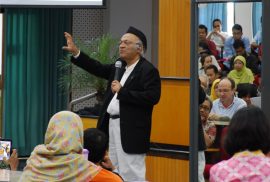
Agar tak terjebak dalam kekerasan, keterlibatan setiap muslim dalam dunia politik dan segala sendi kehidupan di dunia meniscayakan satu hal, yakni, sebagaimana ditawarkan Chaiwat Satha-Anand, “hadirnya kesadaran untuk menggeluti Realitas Ilahiah tanpa harus kehilangan kemampuan mempertanyakan diri, orang lain, dan dunia.” Hal ini dapat dicapai dengan, antara lain, meletakkan Yang Sakral di dalam cermin. Dengan begitu, seorang muslim dapat membangun jarak ideal antara dirinya dengan Yang Sakral, sehingga ia tidak menjadi—meminjam istilah Hent de Vries—“ngengat yang terpesona oleh api hingga terlalap olehnya.” Chaiwat Sata-Anand mengungkapkan hal ini dalam acara “Nurcholis Madjis Memorial Lecture” (NMML) yang digelar pada hari Kamis, 8 Oktober 2015 lalu di gedung sekolah Pascasarjana Universitas Gadjah Mada (UGM). Kuliah umum yang mengambil tema The Sacred in The Mirror; Islam and Politics in The 21st Century ini merupakan bagian dari rangkaian acara peringatan ulang tahun Program Studi Agama dan Lintas Budaya (CRCS) UGM yang kelima belas.


Abstract
The return of capital invites the return of marxism. As a set of epistemological and theoretical tools for understanding capitalism and changing it, Marxism suffers from lack of adequate presentation amid the Indonesian academia and is often discredited as obstinately “ideological”, “dogmatic” or simply “utopian”. On the other hand, suspicion over Marxism and its emancipatory practice is widespread among religious discourses. Indeed, Marxism is often understood as the antithesis of religion. Should Islam renounce Marxism and embrace the “truth” of Capital while letting itself be corrupted by Capital? Could Marxism be a viable way of restoring the liberating messages of Islam?