• Tentang UGM
  • Portal Akademik
  • Pusat TI
  • Perpustakaan
  • Penelitian
Universitas Gadjah Mada
  • About Us
    • About CRCS
    • Vision & Mission
    • People
      • Faculty Members and Lecturers
      • Staff Members
      • Students
      • Alumni
    • Facilities
    • Library
  • Master’s Program
    • Overview
    • Curriculum
    • Courses
    • Schedule
    • Admission
    • Scholarship
    • Accreditation and Certification
    • Academic Collaborations
      • Crossculture Religious Studies Summer School
      • Florida International University
    • Academic Documents
    • Student Satisfaction Survey
  • Article
    • Perspective
    • Book Review
    • Event Report
    • Class Journal
    • Interview
    • Wed Forum Report
    • Thesis Review
    • News
  • Publication
    • Reports
    • Books
    • Newsletter
    • Monthly Update
    • Infographic
  • Research
    • CRCS Researchs
    • Resource Center
  • Community Engagement
    • Film
      • Indonesian Pluralities
      • Our Land is the Sea
    • Wednesday Forum
    • ICIR
    • Amerta Movement
  • Beranda
  • nacim pak-shiraz
  • nacim pak-shiraz
Arsip:

nacim pak-shiraz

Discovering the Quranic Epic in Iranian Cinema

HeadlineNewsWednesday Forum Report Thursday, 23 February 2017

Meta Ose Ginting | CRCS | WedForum Report

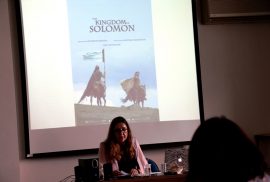
Going to the cinema is a new social practice in modern society. To some extent it can also be perceived as a spiritual practice. Dr Nacim Pak-Shiraz, the Head of Persian Studies and a Senior Lecturer in Persian and Film Studies at the University of Edinburgh and guest speaker at the Wednesday Forum on February 9th, studies this paradox in the dynamics of Iranian cinema. She began by noting that there has been only a little academic attention to the movies based on Quranic epics, in contrast to what has happened with Biblical epics from Hollywood.
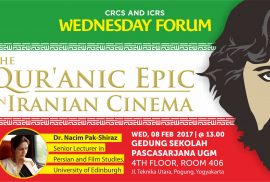
The Qur'anic Epic in Iranian Cinema

BeritaHeadlineNewsWednesday Forum News Friday, 3 February 2017

WED FORUM-02-08-BANNER
Abstract
Iranian cinema is one of the very few in the Muslim world to have employed this new medium in imagining and narrating stories of religious figures. The representation of religious figures in Islam has become particularly controversial in recent years. Therefore, it turned into a highly sensitive undertaking. In this talk I examine the complex socio-political context of Iran to study late emergence of the epic genre in Iranian cinema. In doing so I study the recent creation and development of ‘Qur’anic Films’ within Iranian cinema with specific reference to Kingdom of Solomon (Mulk-i Sulayman-i Nabi, Shahriar Bahrani, 2010), which I argue is the first Qur’anic epic in Iranian cinema if not in the Muslim world.
Speaker
Dr Nacim Pak-Shiraz is the Head of Persian Studies and Senior Lecturer in Persian and Film Studies at the University of Edinburgh. She is the author of Shi’i Islam in Iranian Cinema: Religion and Spirituality in Film (London, 2011) and a number of articles and chapters in the field of Iranian Film Studies. Dr. Pak-Shiraz also regularly collaborates with a number of film festivals, including the Edinburgh International Film Festival and The Edinburgh Iranian Festival.

Instagram

📢 Fellowship Kebebasan Beragama atau Berkeyakinan 📢 Fellowship Kebebasan Beragama atau Berkeyakinan (KBB) 2026 – Angkatan VII

CRCS UGM bersama sejumlah lembaga mitra membuka kesempatan bagi 20–25 dosen untuk mengikuti program fellowship yang berfokus pada isu kebebasan beragama atau berkeyakinan di Indonesia.
Program ini ditujukan bagi dosen dari bidang hukum, syariah, teologi, filsafat, studi agama, serta ilmu sosial dan politik yang tertarik mengembangkan pengajaran, riset, dan diskusi akademik tentang KBB di perguruan tinggi.
Melalui fellowship ini, peserta akan mendapatkan ruang belajar, jejaring akademik, serta dukungan untuk memperkuat kajian dan pengajaran tentang kebebasan beragama di kampus.
To understand Iran, geopolitics alone is not enoug To understand Iran, geopolitics alone is not enough.
Behind every headline about war or sanctions lies a deeper landscape of history, memory, and moral imagination. In this conversation, Dicky Sofjan shows that contemporary conflicts involving Iran cannot be read only through the language of strategy and power. They must also be understood through the histories and symbols that continue to mobilize political and social meaning today.

Click the link in our bio to read the full interview.
Some changes in family life arrive quietly. In Yog Some changes in family life arrive quietly. In Yogyakarta and Ponorogo, more husbands cook, clean, and care for children, while still remaining the imam in the household. What shifts is not only labor but the meaning of leadership, belief, and marriage itself. A small domestic change opens a larger question about gender, religion, and the stories families tell about themselves.

Join the conversation at the #wednesdayforum with Alimatul Qibtiyah, March 11 at UGM or via livestream. We're offering a free iftar, so get there early! This event is free and open to the public.
What is well-being? Indonesia today: land taken, f What is well-being?
Indonesia today: land taken, forests cleared, plantations marching under the banner of food security. Officials call it progress, yet Indigenous ground tells another story. Baduy farmers keep ngahuma alive: rice, ritual, survival, all tied together. Wellbeing here isn’t profit. It’s balance when human and earth still holding on.

Join us for the next  #wednesdayforum discussion at the 3rd floor of the UGM Graduate School building. We're offering a free iftar, so please register. This event is free and open to the public.
Follow on Instagram

Twitter

Tweets by crcsugm

Universitas Gadjah Mada

Gedung Sekolah Pascasarjana UGM, 3rd Floor
Jl. Teknika Utara, Pogung, Yogyakarta, 55284
Email address: crcs@ugm.ac.id


© CRCS - Universitas Gadjah Mada

KEBIJAKAN PRIVASI/PRIVACY POLICY