Abstract
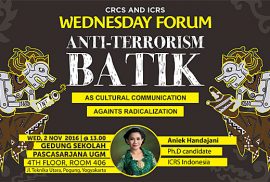
Acknowledged by UNESCO in 2009 as a Masterpiece of Oral and Intangible Cultural Heritage of Humanity, batik is produced through an introspective creative process in which the artist uncovers a truth and presents local wisdom and beauty. In this way, it can be an effective means to communicate symbols, ideas and messages about peace, respect and interreligious tolerance in order to counter the growing radicalism in Indonesian society. Aniek Handajani will present her new book Batik Antiterorisme Sebagai Media Komunikasi Upaya Kontra – Radikalisasi Melalui Pendidikan dan Budaya (co-written with Eri Ratmanto and published by UGM Press, 2016) as well as several works of batik she has commissioned in order to encourage public discussion about terrorism and peace.
Speaker
Aniek Handajani is a staff at the East Java provincial office of the Ministry of Education and an English lecturer at the Faculty of Education, Islamic University, Lamongan. She earned her Masters in Education at Flinders University in Australia and is an educator and activist for inter-religious peace. Currently, she is a Ph.D. candidate at Inter-Religious Studies (ICRS), UGM, researching terrorism and deradicalization.
Wed forum

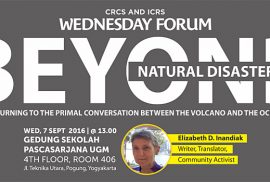
Abstract
Scientists say that we have entered the Anthropocene, the era in which the influence of humankind on the many disasters on our earth is decisive. But ancient societies already understood disasters as a very complex and subtle interaction between the mood of man and the movement of nature. This is what we are reminded of by the Javanese tale Babad Ngalor-Ngidul, the title of which comes from a word we no longer understand: ngalor-ngidul. Composed of two Javanese words– lor for north and kidul for south plus the prefix ng that marks a back and forth movement–, ngalor-ngidul must have originally meant “from north to south and from south to north, in an endless burst of reciprocity and interdependence,” but now only means to talk nonsense. In the tale, the fates of the two villages, one in the south near the sea and one in the north near the volcano, are bound together as the former, destroyed by an earthquake, rebuilds itself, body and soul, while the latter becomes mentally corrupted before being devastated by a volcanic eruption. The tale is told in restore among the survivors the clarity of the “eye of the heart” that allowed the guardian of the volcano to “read” the mother-mountain and it reminds us that we must learn again to listen to the water of the ocean and to the sand of the volcano, the last speakers of a “primal” language that has existed since long before humankind.
Speaker
Elizabeth D. Inandiak is a writer, translator and community activist. Since the age of nineteen, she has traveled the world as a reporter for various French magazines and radio broadcasters. In 1989, she settled in Yogyakarta, Indonesia. She has translated and recreated into French, Indonesian and English the great epic of Java: The Book of Centhini, published in Indonesian by Gramedia (Centhini – Kekasih yang Tersembunyi). Her new book Babad Ngalor Ngidul, (Gramedia) is a tale about the earthquake and the volcanic eruption in Yogyakarta. She is currently working on a book about Muara Jambi together with the young villagers of the site.

Abstract
Corruption is a problem of civilization which, by extension, is a problem of culture. This must be confronted by reviving the cultural values of anti-corruption. Learning from local traditions which combat corruption can be a powerful instrument to fix corrupt tendencies in a state. Strong beliefs in local cultural values can become the base of these efforts. In other words, the culture will create the people, and the people will create the civilization. Presenter try to offer an overview of Mambagi Jambar (Sharing Pieces of Meat) activity as representative of the cultural activities which combat corruption. By basing on ethnographic interviews and analysis of related texts, the presenter will describe this discussion in a systematic matter. The first part introduces global corruption and, furthermore, the issue of corruption in Indonesia. The second part describes the activities of padalan jambar juhut in Toba Batak culture. The last part then discusses these activities and their contributions in an effort to revive anti-corrupt cultural practices.
Speaker
Subandri Simbolon is Public education Staf at CRCS-UGM. His research, focused on culture and populer issue, has been published in globethic.net journal. He finished his BA at Sekolah Tinggi Filsafat dan Teologi (STFT) Widya Sasana Malang where he majored in Christian Philosophy. In 2014, he graduated from CRCS-UGM where focuse on Culture and Ecology. In 2014 and 2015, he awarded the first winner for globetthic.net essay competition about “Anti Corruption Ethics and Religiosity (2014) and “Responsible Leadership (2015)“.

Abstract
In this presentation I will explore Robert Bellah’s idea that there were four great axial civilizations which formed the modern world: China, India, Middle Eastern/Abrahamic and Greco-Roman/European. I will suggest that Indonesia occupies a unique role in the modern world because it is not dominated by any one of the 4 axial civilizations but is rather a unique synthesis of all four. Most great nations in the world are dominated by one or two, of these four axial civilizations. My research suggests that most Indonesians hold values and an imagination of social reality which is shaped by all four axial civilizations. In our pluralistic world, Indonesia may hold the key for shaping an Islamic civilization which will bring blessing to the entire world.
Speaker
Bernard Adeney-Risakotta is Professor of Religion and Social Science and International Representative at the Indonesian Consortium for Religious Studies (ICRS-Yogya), in the Graduate School of Universitas Gadjah Mada. He is currently also teaching at Duta Wacana Christian University and Universitas Muhamadiyah Yogyakarta. Bernie completed his B.A. from University of Wisconsin in Asian Studies and Literature. His second degree, a B.D. (Hons.) is from University of London, specializing in Asian Religions and Ethics. Bernie’s Ph.D. is from the Graduate Theological Union (GTU) in cooperation with University of California, Berkeley, in Religion, Society and International Relations. From 1982 until 1991 he taught at the GTU Berkeley. Bernie has been a Fellow at St. Edmunds College, Cambridge and at the International Institute for Asian Studies (IIAS), Amsterdam. From September 2013 to July 2014 he was on sabbatical leave as a Visiting Fellow at the Institute on Religion and World Affairs at Boston University. He has many publications, including: Just War, Political Realism and Faith (1988), Strange Virtues: Ethics in a Multicultural World (1995), Dealing with Diversity: Religion, Globalization, Violence, Gender and Disasters in Indonesia (2013) and Visions of a Good Society in Southeat Asia (in press, 2016). Email: baryogya@gmail.com

Abstract
The spread of religious millenarianism in the member states of the Association of Southeast Asian Nations (ASEAN) has raised significant questions about religious movement in those countries. The Baha’i religion provides an important case and relevant context as the Baha’i movement has been paralyzed in its country of origin, Iran, since the beginning of the movement in 1844. To avoid persecution and violence, many Baha’i adherents moved to other regions in Southeast Asia. The Baha’i religion is committed to developing educational skills, economic sustainability, gender empowerment, and social movements. Thus, ASEAN encompasses a dynamic and diverse region that aims to provide social, religious, economic, and cultural security for ASEAN citizens. Minority religions such as the Baha’i community, which at the times are victims of conflict and violence, play an important role in achieving those aims. Conversely, religious violence and conflict may be seen as part of the regional deficit in terms of religious freedom and tolerance. In this context, my study tries to examine religious millenarianism and the future evolution of the ASEAN community. The study investigates the co-existence of the Baha’i community with other religious groups such as Muslim, Christian, and Buddhist in their social, political, and cultural negotiations. As the Baha’i engage on some social and political issues in globalization and embrace liberalism and pluralism in the public space, I argue that this study contributes to scholarship in terms of understanding the fate of religious millenarianism in the future of the ASEAN community.
Speaker
Amanah Nurish Ph.D Cand Researcher of Baha’i studies. She is pursuing doctorate at ICRS UGM-Yogyakarta and working as consultant of USAID team-Washington for assessment program, “Fragility and Conflict”. She wrote book chapters, articles, and journals. Her latest publications: Sufism and Baha’ism: The Crossroads of Religious Movement in Southeast Asia (2016, Equinox publisher, London) Perjumpaan Baha’i Dan Syiah Di Asia Tenggara (2016, Maarif Jurnal, Jakarta) Welcoming Baha’i: New Official Religion In Indonesia (2014, The Jakarta Post) Social Injustice and Problem Of Human Rights In Indonesian Baha’is Community (2012, En Arche Journal, Yogyakarta) etc. She received prestigious awards for her academic works such as King Abdullah Bin Abdulazis’s interfaith center-Vienna, SEASREP-Philippine, ENITS-Thailand, Luce & Ford Foundation-USA, ARI-NUS, etc. With her teamwork, she is currently undertaking a broader anthropological research on “ Religious Millenarianism in ASEAN countries” for publication supported by Arizona State University of America.
Ali Jafar | CRCS | Wednesday Forum Report

The first CRCS/ICRS Wednesday Forum of 2016 welcomed Risnawati Utami, an activist for the human rights of persons with disabilities who recently played an important role in resolving a case concerning the rights of persons with disabilities in Bali to participate in their religion. . Together with her organization named OHANA (Organisasi Harapan Nusantara), she advocates for the human rights of persons with disabilities for shifting understanding about disabilities to ensure that persons with disabilities are treated as full and equal members of Indonesian society.
In her presentations, Risnawati said that “persons with disabilities constitute about 15% of the world’s population, meaning they are the largest minority in the world and mostly in the developing countries. Why persons with special needs required attention, it is because they are still discriminated against.” In religious model, Utami gave an example about persons with disabilities in Bali. Culturally in Bali, disabilities are understood as resulting from karma or actions done by the parents in their life or as punishment from bad behavior they did. When they have a disabled child, they will put their child in a different place, not in the main house. This happens not only in Bali, but also in many places.
Furthermore, Utami said that in Indonesia generally, the government looks on the person with disabilities as the object of charity, as a person who needs help and as object of development, it is kind of charity model happened. She told about disabled organizations which get a lot of rehabilitation programs, economic assistance, money, etc. ‘Can we see normality with disabilities?” said she. In medical model, Utami explained that she got polio when she was four, which has made her unable to walk. Her parents tried to make her normal. She completely disagrees with this model. It sees disability as not normal.
The term of disable is itself a problem. Utami explained that in Indonesia it is still common to use “penyandang cacat” which refers to a person with “special needs.” Meaning, we are still labelizing them. In the concept of humanity, we should not define people as “disabled,” but as “persons” because we are using concept of humanity in advocacy. According to the Convention on the Rights of Person with Disabilities, which Indonesia and most other countries have ratified, all people with disabilities can enjoy all the same human rights as everybody else, including religious freedom.
The third article of CRPD calls for the recognition of human rights and human diversity. Indonesia has not fulfilled this point, as can be seen from how LGBT (Lesbian Gay Bisexual and Transgender) Indonesians cannot be religious leaders. A man who is gay and has a ‘disability’ , for example, cannot be a leader for other men in praying. He can be the leader only for woman.. Another related example is that according to marriage law in Indonesia, a man can be divorced or marry a second wife is his wife becomes disabled. Utami argued that this is discrimination against persons with disabilities.
Utami told a her story about when she was young. Her caretaker carried her to Mushola, and all the people there were asking why she was being carried. In Indonesia, public buildings are not designed to adequately accommodate persons with disabilities. In contrast, Risnawati told another story about a Muslim friend in England who is blind and can go everywhere with his seeing-eye dog, including the mosque. This situation would not be possible in Indonesia. Utami said that this is homework for Islamic leaders: can they learn to allow a blind Muslim into the mosque with a dog in order to pray?. Utami also told about her experience in America when a pastor invited her to go to his church, which was in a building is accessible for wheelchairs. She felt she could fully participate in life in America.
Utami continued that there is a custum, when a disable enters the temple and they fall down, the temple should be purified. It is quite debatable with religious organization in Bali. What Utami and her organization have done is creating mediation. In Indonesia generally, there are many deaf organizations in helping Muslim with disabilities. When they could not hear Khutbah (Jum’at prayer), they provide sign language for Muslim with disabilities. Utami mentioned UIN Yogyakarta’s mosque as an example about friendly institution over the person with disabilities. There is sign language during khutbah and the building was designed for disable also. Utami told how the building should be designed universally, it will reduce physical barrier over person with disabilities. Regarding to the freedom of religion, Utami said that it is about attitude and perspective, and how to eliminate ignorance and prejudice. It is also about how people like her can also have access to themosque.
In Discussion session, Samsul Ma’arif asked about the relation between religious freedom and universal design for persons with disabilities. It is because the way he understood religious freedom is about how we are not necessary to have similar though in religion. Utami responded the question saying that universal design is to accommodate people to come to that building. For Utami, the building is part of socialization, how people can get access to the accessible worship place like masques or church. Religious freedom is not about only about the same rights, but also about equal access.
Following Ma’arif, Mark Woodward asked about the most reason they rely on international organizations and Utami answered the Indonesian government responds to international pressure more than to lobbying from its own citizens. Thus the CRPD is an important tool for social change in Indonesia. Meta, a CRCS student, also asked about Utami’s opinion that religion also makes them as charity object? Utami answered that she has a quite liberal perspective, and sometimes still accepts the charity concept or uses several model on the time. “I advocated for persons with disabilities so they will not be underestimated.”
Editor: Greg Vanderbilt

ABSTRACT
Hate speech is one of the factors contributing to sectarian and ethnic conflict. It typically includes social/psychological processes of dehumanization and demonization that define others as less than human and archetypes of evil. Often others are described as existential threats to the very existence of the speaker’s community. It is used to incite or justify violence, sometimes rising to the level of genocide. It is nearly often entirely inaccurate.
Hate speech is an under theorized mode of contentious discourse. It is easy to recognize and difficult to define precisely. In this paper I located hate speech within a four-point typology of contentious discourse: 1. Dialog concerning religious differences; 2. Unilateral condemnation of the beliefs and practices others; 3. Dehumanization and demonization of others and implicit justification of violence; 4. Explicit provocation of violence. For examples I rely primarily on the violent rhetoric of the Indonesian Islamic Defenders Front.
Dehumanization and demonization are the psychological processes that distinguish between civil discourse and hate speech. Levels 1 and 2 are critiques located within the limits of civil discourse because they do not implicitly or explicitly threaten others. Levels 3 and 4 are hate speech. They make symbolic associations that are inherently threatening.
Some forms of hate speech are universal or nearly so. Among these are the description of others as animals, evil, heretics and/or of engaging in “inappropriate” sexual conduct. Others are culturally or religiously specific. More research is required to understand the semantics of hate speech and how it transcends religious and ethnic boundaries.
There is an inevitable contradiction between defending freedom of speech, as guaranteed by Article 19 of the Universal Declaration of Human Rights,and protecting people, usually minorities, from the psychological harm hate speech causes and the risk of physical violence it exposes them to.Legal restrictions do not eliminate hate speech; they only drive in from the public sphere. Most laws restricting hate speech were drafted long before the Internet and social media existed. Now, they are largely ineffective. Countering hate speech requires concerted effort by religious and political leaders and netizens across a range of media, including those used most frequently, including social media, by extremists who promote it. In this presentation I rely on examples from Front Pembela Islam (Islamic Defenders Front/FPI).
SPEAKER
Mark Woodward is Associate Professor of Religious Studies and is also affiliated with the Center for the Study of Religion and Conflict at Arizona State University. His research focuses on religion-state-society relations and religion and conflict in Southeast Asia. He is author of Islam in Java. Normative Piety and Mysticism in the Sultanate of Yogyakarta, Defenders of Reason in Islam (1989)and Java, Indonesia and Islam (2010) .He has published more than fifty scholarly articles in the US, Europe, Indonesia and Singapore, many co-authored with Southeast Asian scholars. He his currently directing a trans-disciplinary, multi-country project on counter-radical Muslim discourse.
Wednesday Forum is a weekly discussion on religion-related ideas and practices organized by both the Center for Religious and Cross-cultural Studies (CRCS), Graduate School of Universitas Gadjah Mada and Indonesian Consortium for Religious Studies (ICRS), Yogyakarta. This forum is an academic space open for public, encouraged especially for our graduate students, faculties, professors, researches, Indonesian and overseas scholars. It is aimed for scholars to share their research on the field related to religion. Therefore, we invite those who have research, papers, ongoing papers, or short documentary film on the field to do presentation in the forum.
Themes
The themes discussed are including, but not limited to, interfaith dialogue; conflict resolution and peace building; religious education; art and spirituality or mysticism; religion and pop culture; religious violence and radicalism; indigenous religions; religion and ecology; religion and politics; and philosophical ideas on religion, etc.
Attendees
The forum is attended by CRCS and ICRS graduate students and faculty members, lecturers, visiting professors, activists, and students from other universities. Basically the forum is open for public.
Date and Venue
The forum is held every Wednesday, from 1 to 2.30 pm, in the Room 406 of the Graduate School Building, Sekolah Pascasarjana Universitas Gadjah Mada, Jl. Teknika Utara, Pogung, Yogyakarta. For the coming semester, the forum will start from 10th February to 11th May 2016 and from September to December 2016.
Application
Application to be a presenter can be made by sending an email to the organizer: najiyah.martiam@ugm.ac.id. Send the abstact of your research and your brief CV, primarily your study background, activities, and research. The Wedforum committees will evaluate the applications and choose the presenters.
Ali Jafar | CRCS | Wednesday Forum Report
In the beginning of her presentation, she drew a picture portraying goddesses of Nusantara (Indonesia Archipelago) on white board and told about narrative and myth over the mothers. She said that in humility paradigm of ecofeminism, all trees, animals, land and water have its own systems of thinking and communicating. How the stone whispers, why the water is raging, and how the land thinks. There is equality between human being and other non-human being. It was Dr. Phil. Dewi Candra Ningrum, the editor- in chief of Jurnal Perempuan (JP- Indonesian Feminist Journal) presenting in the CRCS’ Wednesday Forum on November 25th 2015.
Ali Jafar | CRCS | Wednesday Forum Report
Maurisa, a CRCS alumna from the batch of 2011, presented her award-winning paper in Wednesday forum of CRCS-ICRS in 11th November 2015. Her paper entitled “The Rupture of Brotherhood, Understanding JI-Affiliated Group Over ISIS”, was awarded as best paper in IACIS (International Conference on Islamic Studies) in Manado, September. Maurisa was glad to share her paper with her younger batch. To all the audiences, Maurisa told that winning as best paper was not her high expectation, and it makes her proud.
The presentation began with Maurisa’s statement that the issue of ISIS (Islamic State of Iraq and Syria) are quite to understand in relation to modern terrorism, because we always misread them and sometime we cannot differentiate between ISIS and Al-Qaeda. Maurisa continues her explanation that there are many groups in Iraq and Syria struggling for their power, terrorism is not single but many. ISIS also has supporters in Indonesia such as Jemaah Islamiyyah (JI-Islamic Group) which is considered as a big terrorist organization in Southeast Asia. This group (JI) has disappears from public consciousness, but actually its members have been spreading out. The most fascinating thing that she found is that JI in Indonesia. JI was separated into two, Majelis Mujahidin Indonesia (MMI) and Jama’ah Anshar at-Tauhid (JAT), and surprisingly JAT itself has internal conflict and divided into two; JAT and JAS (Jama’ah Anshar as Syari’ah).
Maurisa’s paper focused on questions about how does the conflict in Syria resonates with Jihadists in Indonesia, and how does political struggle within MMI show belief in a master narrative. Maurisa used Juergensmeyer’s perspective about cosmic war and the logic of religious violence. In the Juergensmeyer perspective, an ordinary conflict could become religious conflict when it is raised into cosmic level. One of the ways is demonization or Satan-ization of the enemy. In the context of Syria, the demon is Shia group which is blamed for chaotic situation within Sunni community. The master narrative was also about the same language. It is about sadness, it is about the sad feeling of being discriminated and persecuted by Shia.
According to Maurisa, not all jihadist groups support ISIS, indeed MMI was supporting Jabhat an-Nusra. The rupture of this affiliation was based on their differences in the perspective of takfirism (Apostasy). JAT and MMI have different perspectives in defining what Takfir Am (general apostasy) and takfir Muayyan (specific apostasy) is.
In seeing terrorist movements, although Maurisa saw that Jihad-ism is not monolithic, she revelas that there are five elements which are related each other. There are ideological resonance, strategic calculus, terrorist patron, escalation of conflict and the last is charismatic leadership. Terrorists also use social media, such as Facebook, Youtube and so on, to promote their propaganda, and as soft approach to other Muslims. Based on Maurisa’s research there are 50000 social media accounts to spread ISIS propaganda, but only 2000 are used to spread out propaganda. The most popular social media is Twitter, because a message can be retwited..
In the discussion session, Nida, a CRCS student asked about the current issues in which governments have banning Shi’a celebration in Indonesia, and whether there is any relation with ISIS, and how an Indonesian can be involved in the terrorism. Maurisa answered the question by explaining that Indonesia is about to change. It can be seen in Islamization created room for Islam in the public sphere. Indonesia is vulnerable since Wahabis and Iran have their political goals here and both want to establish their domination to spread out their agenda. Cases in Sampang, Madura, Pakistan and so on cannot be separated from international case. There are long story for transformation of Saudi and Iran. Our country is like something too. In talking about the entrance gate, Turkey is good entrance from Indonesia to go to Syria. If we see Turkey’s position is also questionable. They deny Isis, but they also support Isis.
Subandri also asked about the ways we interpret jihad are accessible. Therefore there are many interpretations of Jihad. That is what looks like for young Muslim now. Along with Subandri, Ruby also asked about the genealogy of Indonesian Jihadist movement. Like the connection between Indonesia and middle east that coming and potential realignment and the effect of JAT over ISIS.
In seeing connection and global phenomena, a relation between Islam and Middle East, Maurisa explained that in the United State for instance, there is relation if you wear jilbab, you are Muslim, and when you are Muslim, you are ISIS. “Here we can see the idea about securitization is like Islamophobia”, said Maurisa with showing slide about relation between Indonesia and Middle East. As she explained again “If we look at voice of Islam, we can see that there are solidarities for Syria. It is reported that medical mission in Indonesia, they have collected 1.6 million. For Syria suggesting support for the movement of mujahidin”. Maurisa also explained that globalization is the most responsible for this case. For example many Indonesia Muslims have easy access to Saudi, Iranian, Jihadist web, because of technology and so on. Young Indonesian have a lot of curiosity and they don’t ask to other.
In responding the interpretation of jihad, Maurisa gives a feedback, how do we interpret this? What makes cosmic war happen? And how to deal with them?. Maurisa began her explanation that in Islam, although there are many verses for killing, but it not necessary to do in violence. We have many steps in interpretation. There are many reasons for what make Muhammad approve of killing and in what context he did so. There are many possibilities to interpret jihad and there are many verses of good thing about Jihad. In talking about cosmic war, she said that “as long as we consider our enemy as Satan, or evil, meaning it is cosmic war”. At the end of discussion session, Maurisa concluded that the factor of jihad is not monolithic; there are many factors, even in ISIS and Al-Qaeda have different perspectives about jihad.
(Editor: Gregory Vanderbilt)
Ali Jafar | CRCS | Wednesday Forum Report
The discourse about “religion” “and” “science” has been long contested among scholars. Since the nineteenth century, religion and science have often been understood as in conflict with each other, science is human method for understanding nature using reason and religion relies on divine revelation. From different starting point, both religion and science have difficulties in finding common ground. But, starting from Ian Barbour, in the 1950s, a new discourse about the contemporary field of religion and science has proposed that integration is possible. Starting from this question at the Wednesday forum of CRCS/ICRS on 9th September 2015 , Zainal Abidin Bagir called for both side to re thinking the relation between science and religion.
Bagir described the Barbourian discourse as sympathetic to religion, accepting of the basic theories and findings of modern science, and looking at scientists’ theories and theological beliefs to understand the relationship and its impact of the former on the latter. Barbour proposed a typology: conflict, independence, dialog- integration. In the conflict relation, we have to choose one. In the independent relation religion and science belong to separate world without contact. While in the dialog, we have to find similarities of them. The last is integration meaning that religion validate science each other.
Bagir explained that the territory struggle between religion and science outside the West is not about the content itself, but it is as part of resistance to colonialism. Among this contestation, bagir told about Islamic modernist movements. In Indian subcontinent there is Sayyed Ahmed Khan who integrated religious belief with modern science. Other example include Muhammad Abduh from Egypt, Muhammad Iqbal from Pakistan, and Hossein Nasr from Iran and so on, who were communicating religious belief with scientific ideas.
Indeed, Bagir argued that discussion of the discourse on the relation between religion and science should involve historical awareness. Moreover, it should not be just discussion of the content of the two fields but rather and examination of instrumental and social ethics, as well as epistemological and metaphysical view points. Bagir also noted that there are differences in the discourse between cultures and religious tradition. One example is that evolution is not a topic of debate in the Islamic world as in the United States.
Bagir discussed several instances of the “religion and science” discourse in Indonesia. For example, this question has arisen in relation to the educational models of Islamic Universities. When some of the IAINs (State Islamic Religious Institute) were transformed into UINs (State Islamic Universities), these new universities included faculties of natural and social science and medicine. Each university took its own approach to the question, but all tried to integrate the spirit of religion and the spirit of science.
Bagir also explained that the relation between religion and science at times of disaster can be one of competing authorities. He took an example from Merapi volcano eruption in 2010, when there was debate between scientific explanation and defiance by Mbah Maridjan, the traditional spiritual guidance of the volcano, though Bagir argued that the central was issue trust, not science versus superstition. Anticipating next week’s presentation by Samsul Maarif on the forestry practice of the indigenous people of Sulawesi, Bagir argued that the “religion” part of “religion and science” must be radically questioned and opened up to include indigenous religion which are often the same as indigenous ways of knowing nature, i.e. indigenous science. Moreover we must ask what this discourse is for: it is to dominate the other or it is for the well-being of all, including non-human communities.
Responding a question about scriptural authority in relation to scientific knowledge, Bagir answered both are known through interpretation. Another question is from Fahrur, a CRCS student, who asked about Bagir opinion on the integration of religious studies and science and other field of study, including English, at UIN Yogyakarta. Bagir described the integration is still among debate. If the purpose of integration is to create Islamic identity, what makes a field of study become Islamic? He took examples from UIN Jakarta and UIN Malang. At UIN Jakarta, there is no integrated study. Science and Islamic studies each follow its own logic and methods. While in UIN Malang, student in all field are prepared for their studies by learning about Islam for one year in a boarding school that is part of the university. Still, the science learned in university is not integrated with religious science.
Concluding the discussion, Bagir explained that the discourse of religion and science is still debatable among scholar. There are many discourses and opinions of integration of religious and science. Thus, he insisted Dr. Samsul Maarif to be speaker in the next Wednesday Forum to explain indigenous science and religion. Dr Samsul Maarif has taken his research in Amatoan in which the indigenous sciences of Amaatoan about forest conservation are coherent with their religious belief. (Editor: Greg Vanderbilt)
Abstract
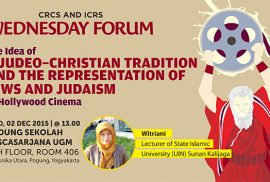
American Jews have long been prominently involved in the American media and film industries, so much so that some commentators have even said they are ‘the backbone of film production in America’. This position has indeed given opportunities for Jewish Americans in the industry to play a prominent role in shaping the business including issues of how Jews and Judaism are represented in film and other media. However, depictions of Jews and Judaism in American movies have changed according to political and cultural conditions. After World War II, a new formula emerged on the silver screen. The reframing of American religious identity as “Judeo-Christian” encouraged directors and producers who were Jewish to promote the concept of America as a Judeo-Christian nation as a response to ongoing anti-Semitism in America. Examining Biblically-themed movies such as The Ten Commandments and Ben Hur-A Tale of the Christ, this presentation intends to explore the connection between the idea of a “Judeo-Christian” tradition and the acceptance of Jewish Americans and recent immigrants by American society. The portrayal of Jews in these movies is interesting to discuss here, not only because Jews and Christians are depicted in the same framework of the Hollywood movie, but also because of the underlying politics of representations.

Abstract
Ammatoans of Sulawesi in the eastern part of Indonesia hold religious ideas of social actors that extend beyond human beings. Perceiving both human and non-human beings as equal and constitues inter subjective relationships, Ammatoans’ everyday behaviors and practices is set in this religious perception, including forest conservation. The forest, as vital part of Ammatoans’ life, is conserved by sets of regulations and punishment that restrictly enforced. This presentation will explores how the ideas and practices of Ammatoans’ forest conservation illustrate what scholars have called “religious ecology”.
Speaker
Dr. Samsul Maarif is the Secretary and Academic Coordinator of the Center for Religious and Cross-cultural Studies (CRCS), Graduate School of Universitas Gadjah Mada, Yogyakarta, Indonesia. Achieving Ph.D from Arizona State University, Temple, in Religious Studies and holding two master degree from Florida International University and Universitas Gadjah Mada; both on religious studies, Maarif has long experiences and intensive studies of indigineous religion, especially Ammatoan community.