by Dody Eskha Aquinas
I have long been familiar with the name of the late Suprapto Suryodarmo, thanks to the close relationships among interdisciplinary artists, especially within the environment of Wisma Seni at the Cultural Center of Solo, Central Java. This space was filled with warmth and a familial atmosphere. I met and got to know Mbah Prapto through various art events held at the Central Java Cultural Center, at Padepokan Lemah Putih, and through other programs organized by fellow artists across multiple art communities in Solo.
The closeness shared among artists gave me, a theater and film actor, the opportunity to know Mbah Prapto more intimately. Yet, when I first saw him practicing with his students, I wasn’t interested in getting involved. I simply thought to myself, “What are these people doing?” As time passed, I became more curious and started observing and learning.
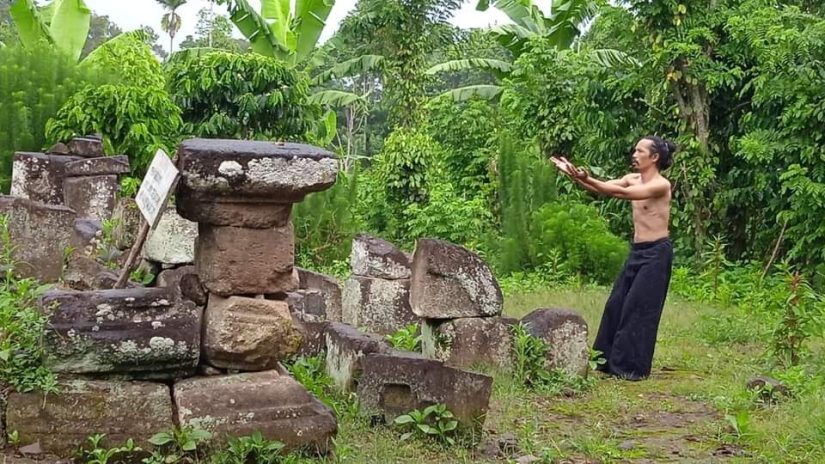
My initial interest in practicing with Mbah Prapto emerged because I was also learning about meditation at the time. I noticed similarities between his practice and meditation practice. That’s when I started seeking opportunities to join his training sessions. Around 2016, Mbah Prapto invited me to join him. Together with his foreign students from various countries, we practiced in several places such as the Pendopo at Wisma Seni, Borobudur Temple, Ratu Boko Temple, Sukuh Temple, and Parangtritis Beach. So, it could be said that I was among the latest to join the Amerta Movement practice with Mbah Prapto, therefore, I had not known this practice for very long.
Nevertheless, I gained a wealth of insight from the experience, especially regarding self-awareness in relation to other living beings and the universe. Amerta Movement helps me to become aware of the present moment: to realize that I exist, I breathe, and I am alive. This fundamental awareness introduced me to an essential value in Amerta Movement —how to find meaning in life. This value encourages me to reflect more deeply on how life should be lived meaningfully, not just for oneself and fellow humans, but also for other living beings.
The late Mbah Prapto did not impose any strict methods on how disciples should learn or practice Amerta Movement. He simply guided them to become aware of the sounds in daily life, to connect with their bodies, and to be in tune with their surroundings. The movements performed were based on each participant’s experiences and level of awareness. This approach allows Amerta Movement to be practiced by people from various backgrounds, not just those who are involved in the performing arts.
In its practice, Amerta Movement also fosters self-awareness of natural elements such as earth, fire, wind, water, and metal. Additionally, when combined with prayer or mantra, a spiritual atmosphere emerges that makes humans aware of their connection with the Creator. Nowadays, I incorporate the Amerta practice I learned from Mbah Prapto with Javanese Walikan Mantras or Kalacakra Mantras as a form of prayer or spiritual cleansing for the safety and well-being of all living beings.
Furthermore, Amerta Movement is also beneficial for emotional healing. Many people hold their problems and frustrations silently, which eventually accumulate as negative energy in the body. Through Amerta Movement, they can release these burdens. I have witnessed this during practice sessions, especially when Mbah Prapto provided a space for students to share their experiences and feelings. In these sessions, participants often open up and release long-held emotions.
On several occasions, after a session or performance, Mbah Prapto would often ask me in Javanese, “Iki mau enek nilaine ora, Gus? (Did that have any value, Gus?).” Value! Yes, that was what Mbah Prapto always emphasized—a value that could be drawn from Amerta Movement practice. This value is not numerical, but a deeper meaning that can become a provision for navigating life and a guide for the spiritual journey ahead, through deep contemplation and reflection.
In one moment, while watching his students practice—with a gaze that was both sharp and distant—Mbah Prapto, who was seated beside me, said, “Gus, golekno sejatine awakmu (Gus, seek the truth of yourself).” Those words deeply resonated with me and made me contemplate the essence of life. I was invited to think more deeply: where is this life truly heading? What is the meaning of life itself? I was reminded that human beings do not live alone, but alongside countless other creations. I was also invited to reflect deeper into the true purpose of human existence. Be grateful for your life, and live as though death may come to greet you tomorrow. That is one of the profound messages I found in the values of the Amerta Movement.
Matur sembah nuwun, Mbah. I have found many meaningful values from my encounter with Amerta Movement.
Click this link for article in bahasa Indonesia
______________________
Dody Eskha Aquinas is an actor who studied the Amerta Movement directly with the maestro of Joged Amerta, the late Suprapto Suryodarmo. He participated in practices with Mbah Prapto in various places—temples, beaches, and art houses.
Download this article in pdf format