• Tentang UGM
  • Portal Akademik
  • Pusat TI
  • Perpustakaan
  • Penelitian
Universitas Gadjah Mada
  • About Us
    • About CRCS
    • Vision & Mission
    • People
      • Faculty Members and Lecturers
      • Staff Members
      • Students
      • Alumni
    • Facilities
    • Library
  • Master’s Program
    • Overview
    • Curriculum
    • Courses
    • Schedule
    • Admission
    • Scholarship
    • Accreditation and Certification
    • Academic Collaborations
      • Crossculture Religious Studies Summer School
      • Florida International University
    • Academic Documents
    • Student Satisfaction Survey
  • Article
    • Perspective
    • Book Review
    • Event Report
    • Class Journal
    • Interview
    • Wed Forum Report
    • Thesis Review
    • News
  • Publication
    • Reports
    • Books
    • Newsletter
    • Monthly Update
    • Infographic
  • Research
    • CRCS Researchs
    • Resource Center
  • Community Engagement
    • Film
      • Indonesian Pluralities
      • Our Land is the Sea
    • Wednesday Forum
    • ICIR
    • Amerta Movement
  • Beranda
  • News
  • page. 24
Arsip:

News

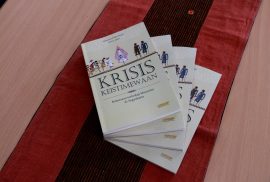
BUKU TERBARU CRCS – Krisis Keistimewaan: Kekerasan terhadap Minoritas di Yogyakarta

BeritaHeadlineNews Thursday, 20 April 2017


Yogyakarta telah lama menjadi rumah yang aman bagi berbagai tradisi, keyakinan, dan paham pemikiran yang beragam. Tetapi Daerah Istimewa ini belakangan disorot karena banyaknya aksi vigilantisme yang dilakukan sejumlah kelompok massa baik yang berlatar belakang agama atau politik. Aksi-aksi vigilantisme yang menyasar kelompok-kelompok sosial dan keagamaan minoritas menimbulkan pertanyaan apakah Yogyakarta, yang dikenal sebagai kota pendidikan dan pusat kebudayaan Jawa yang menekankan pada harmoni sosial, sudah berubah menjadi daerah yang intoleran? Laporan ini menunjukkan bahwa vigilantisme terhadap minoritas tidak cukup secara sederhana dipahami sebagai ekspresi konservatisme keagamaan dan intoleransi para pelaku terhadap minoritas, tetapi juga merupakan bagian dari proses perubahan sosial dan struktural yang diantaranya dipengaruhi oleh dinamika seputar status keistimewaan Yogyakarta. Tidak bisa dipungkiri, sektarianisme yang menguat belakangan ikut berpengaruh, tetapi seringkali kekerasan terhadap minoritas lebih tampak sebagai alat mobilisasi kelompok-kelompok kepentingan tertentu untuk mempertahankan basis sosial-politik yang menentukan kendali mereka atas ruang dan sumber daya.
_________________________

Judul: Krisis Keistimewaan: Kekerasan terhadap Minoritas di Yogyakarta
Penulis: Mohammad Iqbal Ahnaf & Hairus Salim
Penerbit: CRCS UGM
ISBN: 978-602-72686-7-8
Tebal: 134 halaman; 15×23 cm
Cetakan Pertama: April 2017
Harga: Rp60.000,00
__________________________

Narahubung untuk mendapatkan buku ini:
Divisi Marketing CRCS UGM
Gedung Lengkung Lantai 3
Sekolah Pascasarjana Lintas Disiplin Universitas Gadjah Mada
Jl. Teknika Utara, Pogung, Yogyakarta, Indonesia 55281
Telephone/Fax: 0274-544976
Atau melalui WA: 082141724150 (Bandri)
Lihat juga buku-buku publikasi CRCS yang lain di sini.

Perceiving Islam and Muslims in Poland in the context of the European refugee crisis

HeadlineNewsWednesday Forum News Wednesday, 12 April 2017


Abstract
The EU countries have been inefficiently managing the latest European migrant crisis, among them Poland was particularly unsuccessful. Contemporary discourse on refugees from the Middle East in Poland revolves around the following issues: the danger of altering Polish culture, the increase of the likelihood of terrorism, and the postulate of empathy towards people threatened by war. The religious factor plays a significant role in this discourse, since refugees who come from predominantly Muslim countries from a group of special interest in this Catholic-majority state. Halina Grzymała-Moszczyńska, Adam Anczyk, and Anna M. Maćkowiak have examined, qualitatively, how Poles perceive Islam, and how this image may be associated with attitudes towards refugees. The aim of this study was to analyze narratives about Islam and the religious Other, emerging from partially structured interviews. The questionnaire, containing citations from the Bible, the Quran, and the Bhagavad Gita served as the trigger for interviews conducted after filling it out.
Speaker
Anna M. Maćkowiak is a doctoral student at the Department of Phenomenology and Anthropology of Religion, Institute for the Study of Religions, Jagiellonian University, Krakow. Currently she is beginning to realization of her individual research grant (Preludium) concerning constructing meanings of selected Indonesian religious rituals by hosts, tourists, and travellers. Her academic interests and activities pertain also to inter-religious relations, religious syncretism, and the influence of religions on daily life of Indonesian and Poles.
Look at the full poster of the event here.

Emplacement and displacement in the Banda Islands

HeadlineNewsWednesday Forum Report Wednesday, 12 April 2017

Anthon Jason | CRCS | Wednesday Forum Report

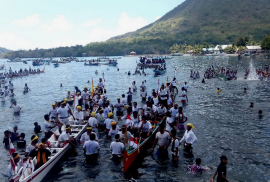
The Kora-Kora race in Banda Neira. Photo by Kelli Swazey

In Indonesia, people can be called by their homeland’s name, such as orang Batak, orang Sunda, orang Manado and so on. The Indonesian concepts that are tied tightly to ideas of land, community, and cosmology referred to as adat have a dynamic and complex relationship to people’s religious identification and how they understand their identities. People can be emplaced or displaced in regard to how their religious identity relates to their cultural identification with particular places. While emplacement is the process by which people identify themselves with a place, displacement is a dislocation, removal, expropriation, takeover, or ideological process to refute claims of rights over land, the use of cultural symbols, or the ability of people and groups to self-identify.

Does religion help the environmental cause in Indonesia and around the world?

HeadlineNewsPerspective Tuesday, 11 April 2017

Jonathan D Smith | CRCS | Essay

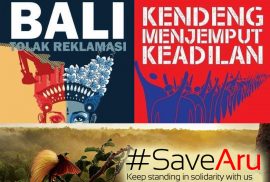
Indonesia is home to many environmental movements, either led by established environmental activists or by groups of indigenous people. The reclamation project in Benoa Bay, cement mining in Kendeng area, Central Java, and the Save Aru movement are just a few recent examples. Does religion play a role in these movements? Are these local movements related to the growing global environmental movement?
The local and global is a crucial element of environmental movements, because environmental problems defy boundaries. Our rapidly-changing climate poses an urgent challenge that is both global and local. As national governments slowly acknowledge their role in reducing carbon emissions (with some exceptions), local communities in Indonesia are living with the problems of rising temperatures and sea levels, increases in natural disasters, and increasing pollution of our air and water.
Local-global connections in religious environmental movements
In 2016 at the climate summit in Morocco, governments met to affirm their adoption of the 2015 Paris Climate Agreement. Signed by 111 countries (as of November 2016), the agreement commits to reducing carbon emissions and recognizes the human impact on climate change. At the same climate summit in Marrakech, hundreds of religious leaders and environmental activists launched the Interfaith Climate Statement.
The Interfaith Climate Statement included these words:

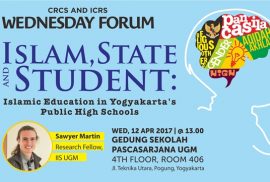
Islam, State and Student: Islamic Education in Yogyakarta’s Public High Schools

HeadlineNewsWednesday Forum News Friday, 7 April 2017


Abstract
One of the most significant ways the Indonesian state plays an active role in the country’s religious life is through education: Muslim students at all levels are required to take Islamic education classes, for which the government writes curricula and employs teachers. Therefore, the state—from the center at the Ministry of Religious Affairs to the periphery at individual teacher at public schools—has considerable power to shape religious perspectives of each new generation. His ongoing research is an ethnographic study of Islamic education in public high schools (Sekolah Menengah Atas Negeri) in the province of Yogyakarta, carried out through classroom observation, teacher interviews, and student focus groups. He will present the characteristics and effects of Islamic education in three fields: (a) perspective of religious diversity within Islam; (b) the valorization of the democratic nation-state as Islamic; and (c) the gender ideologies promoted as normatively Islamic. It is also noted how these phenomena vary in and among schools, noting the influence of socio-economic class, education, gender and religious background.
Speaker
Sawyer Martin French is research fellow at the Institute for International Studies at the Faculty of Social and Political Sciences at Universitas Gadjah Mada. He is currently conducting a yearlong research project on Islamic education in public high schools in Yogyakarta with the support of a grant in socio-cultural anthropology from the National Science Foundation.
Look at the full poster of the event here.

Showing off piety: between wefies and riya’

HeadlineNewsWednesday Forum Report Thursday, 6 April 2017

Anang G Alfian | CRCS | Wednesday Forum Report

As a product of the globalized world, social media have created a virtual space of communication and interaction. Many people use it with enthusiasm as it helps humans build communication and connectivity much faster than ever before. On the other hand, many consider this phenomenon a challenge for living ethically and productively.

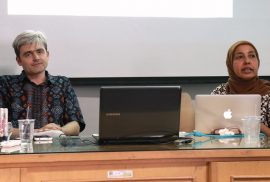
Dealing with this topic, Wednesday Forum on February 9th 2017 held a discussion on “wefies” (group self-portraits posted on social media) in relation to the Islamic concept of riya’ (showing off piety). The two speakers, Fatimah Husein, currently teaching at CRCS/ICRS as well as UIN Sunan Kalijaga, and Martin Slama of the Institute for Social Anthropology at the Austrian Academy of Sciences, presented the emerging phenomenon of online piety in Indonesia, especially on how Muslims rethink riya’ in today’s popular “wefie” culture. The presentation was based on Husein’s article titled “The Revival of Riya’: Displaying Muslim Piety Online in Indonesia” which has been submitted for a virtual issue of American Ethnologist and Slama’s research project on “Islamic (Inter)Faces of the Internet: Emerging Socialities and Forms of Piety in Indonesia” funded by the Austrian Science Fund.

1…2223242526…53

Instagram

crcs_ugm

Sedang tidak baik-baik saja, kamu biasanya mencari Sedang tidak baik-baik saja, kamu biasanya mencari apa di internet?

Banyak anak muda hari ini menemukan ketenangan, nasihat, bahkan jawaban atas kegelisahan melalui media sosial, konten keagamaan, akun kesehatan mental, hingga AI chatbot. Namun, bagaimana sebenarnya pengalaman itu terjadi?
Kami sedang melakukan penelitian untuk memahami bagaimana generasi muda usia 10–24 tahun mencari informasi keagamaan maupun kesehatan mental saat menghadapi masa-masa sulit.
Jika kamu merasa topik ini dekat dengan pengalamanmu, kami mengundangmu menjadi responden.
Partisipasi bersifat sukarela dan seluruh jawaban dijaga kerahasiaannya.
Kamu bisa langsung kirim DM jawabanmu atau mau tanya-tanya dulu juga boleh.

Kami tunggu ya.
Katanja koeliah S2 itoe mahal? Eitss , djangan s Katanja  koeliah S2 itoe mahal? 
Eitss , djangan salah
Bersama keempat mahasiswa angkatan 2025, kita akan ngobrolin djoeroes-djoeroes djitoe mendapatkan beasiswa di CRCS UGM

Begitoe?
Before petroleum fueled the world, it fractured th Before petroleum fueled the world, it fractured the archipelago

The raise of the colonial petroleum industry in the Dutch East Indies was also the emergence of new spatial inequalities. Outer Java was not merely discovered as a resource zone. It was politically produced as an extractive territory through imperial concessions, colonial state-building, and global struggles over resource control.

Join us in this presentation on capitalism, oil, and the colonial fractures that continue to haunt the geography of modern Indonesia. We provide snacks and drinks, don't forget to bring your tumbler. This event is free and open to public.
M B G Satu kotak makan berisi nasi putih pulen seb M B G
Satu kotak makan berisi nasi putih pulen sebagai sumber karbohidrat utama, dimasak dari beras medium pilihan, air, sedikit garam, dan beberapa tetes minyak agar tidak cepat basi. Di sampingnya terdapat ayam semur kecap, dibuat dari potongan daging ayam, bawang merah, bawang putih, kecap manis, daun salam, lengkuas, garam, dan sedikit gula sehingga memberi asupan protein hewani yang cukup untuk pertumbuhan. Sebagai pendamping lauk utama, disediakan tempe orek manis gurih dari tempe iris tipis, bawang merah, bawang putih, cabai, kecap, dan gula merah. Tempe ini berfungsi menambah protein nabati sekaligus membuat kotak makan tampak lebih penuh, sebab protein memang sering lebih meyakinkan bila hadir rangkap dua. Untuk unsur sayuran, ada tumis wortel dan buncis yang dimasak dari wortel segar, buncis, sedikit kol, bawang putih, garam, merica, dan minyak sayur. Warna oranye-hijau pada sayur ini penting: bukan hanya untuk vitamin A dan serat, tetapi juga agar foto dokumentasi tidak terlihat terlalu pucat.Sebagai pelengkap vitamin alami, satu buah pisang atau sepotong pepaya matang diletakkan di sudut kotak. Buah dipilih yang murah, tahan banting, tidak gampang memar, dan cukup fotogenik ketika dibagikan massal. Terakhir, ditambahkan susu UHT kotak kecil berbahan susu sapi, gula, dan fortifikasi vitamin, atau kadang telur rebus utuh sebagai penutup protein tambahan.

Berbuih-buih seperti pelaksanaannya ...
Follow on Instagram

Twitter

Tweets by crcsugm

Universitas Gadjah Mada

Gedung Sekolah Pascasarjana UGM, 3rd Floor
Jl. Teknika Utara, Pogung, Yogyakarta, 55284
Email address: crcs@ugm.ac.id


© CRCS - Universitas Gadjah Mada

KEBIJAKAN PRIVASI/PRIVACY POLICY