Azis Anwar Fachrudin | CRCS | Opinion

[pullquote align=”right” cite=”” link=”” color=”” class=”” size=”15″]Fatwa MUI telah digunakan orang-orang intoleran untuk mempersekusi yang difatwa sesat[/pullquote] Sebagaimana mutakhir diberitakan, Majelis Ulama Indonesia (MUI) Pusat hendak menyusun beberapa kriteria tentang ajaran sesat, khususnya ajaran yang “mencaci-maki Sahabat Nabi Muhammad SAW, menolak kepemimpinan al-Khulafa’ ar-Rasyidun, dan memperbolehkan nikah mut’ah.” Kriteria ini jelas diarahkan kepada Syiah, yang sebagian telah menjadi korban tindakan kekerasan.
Maka kini adalah waktu yang tepat, bahkan mendesak, bagi MUI—yang susunan pengurus barunya diduduki oleh orang-orang berpendidikan tinggi—untuk mengkaji lagi perannya dalam konteks kenegaraan. Sebagai organisasi yang tak sepenuhnya dapat dipisahkan dari negara, MUI memiliki tanggung jawab kewargaan (civic) untuk memperhitungkan dampak fatwa-fatwanya bagi setiap warga negara Indonesia, termasuk yang dianggap sesat. Di tahun-tahun belakangan, beberapa fatwa MUI tentang kesesatan suatu kelompok tak selalu membantu tumbuhnya hubungan antarkelompok yang lebih baik. Fatwa MUI malah kerap digunakan sebagai justifikasi kekerasan. Tantangan utama MUI adalah mengedepankan paradigma moderat sebagaimana disampaikan sendiri oleh Ketua Umumnya.
Fatwa untuk Mazhab yang Sah
Yang pertama kali perlu dipertimbangkan adalah, kalaupun fatwa itu akan dikeluarkan, jangan sampai di-gebyah-uyah atau dipukul rata untuk semua orang Syiah. Bagi para penebar propaganda “Syiah bukan Islam” atau “Syiah kafir”, semua Syiah dianggap sama; semua Syiah dianggap Rafidhah; semua Syiah di mana dan kapan saja dikira berkeyakinan dan berperilaku sama. Ironisnya, orang-orang penyebar propaganda takfiri itu tak mau bila organisasi seperti Taliban, al-Qaeda, dan ISIS dijadikan representasi Ahlus-Sunnah (Sunni) dan semua Sunni dianggap sama belaka dengan mereka—kecuali bagi orang-orang yang memang menjadi pendukung gerakan-gerakan barbar itu.
Sudah sering diulang-ulang, bahkan bagi beberapa orang mulai agak klise, argumen-argumen bahwa Syiah merupakan mazhab dan bagian yang sah dalam Islam. Upaya institusionalisasi “pendekatan antarmazhab” (at-taqrib bayn al-madzahib) sudah diinisiasi lebih dari setengah abad lalu oleh ulama al-Azhar. Sejak saat itu, fikih Syiah-Ja’fariyah diakui sebagai bagian dari delapan mazhab fikih Islam yang legitimate dan masuk dalam kitab-kitab fikih perbandingan mazhab yang dikaji di universitas-universitas Islam bercorak Sunni. “Risalah Amman” yang menyerukan keabsahan dan persaudaraan mazhab-mazhab Islam (Sunni, Syiah, Salafi) sudah mengudara sejak 2005 dan dideklarasikan oleh ratusan ulama dan intelektual Muslim terkemuka sedunia, tak terkecuali dari Indonesia.
 Jika menginginkan argumen yang lebih gampang: Orang-orang Syiah bersyahadat, salat, membayar zakat, puasa saat Ramadan, dan bisa berhaji ke Mekkah—kurang lebih 15 persen dari sekitar 16 juta penduduk Arab Saudi adalah orang Syiah. Argumen yang lebih gampang lagi: Iran, yang mayoritas Syiah itu, adalah anggota Organisasi Kerjasama Islam (OKI) yang sekretariatnya kini ada di Arab Saudi; dan konferensi ke-8 OKI pada 1997 diselenggerakan di Teheran, Iran. Ini mestinya sudah cukup untuk mengatakan bahwa Syiah memang bagian dari Islam.
Atau, supaya lebih dekat dengan Indonesia, sudah banyak tokoh-tokoh Muslim Indonesia baik dari Nahdlatul Ulama (NU) maupun Muhammadiyah yang menyatakan Syiah adalah mazhab yang sah dalam Islam, seperti Kiai Hasyim Muzadi, Kiai Said Aqil Siradj, Buya Syafii Maarif, Prof. Amien Rais, dan Prof. Din Syamsudin (yang kini menjadi ketua dewan pertimbangan MUI). Yang termutakhir, Syaikh al-Azhar Ahmad at-Thayyib datang ke MUI belum lama ini dan melarang mengkafirkan semua orang Syiah secara umum berdasar pada prinsip “la nukaffiru ahadan min ahl al-qiblah” (“kita tak mengkafirkan seorangpun dari ahli kiblat”). Tak bisa pula dilewatkan, kedatangan Syaikh al-Azhar ke MUI itu bersama ulama Syiah Lebanon, Sayyid Ali al-Amin.
Stigma-Stigma Klasik
Berangkat dari argumen-argumen di atas, jika MUI mau mengeluarkan fatwanya, seharusnya itu mengerucut pada tindakan saja, misalnya soal “mencaci-maki Sahabat”, dan tidak digeneralisasikan kepada ke-syiah-an secara umum. Menjadi Syiah tak serta merta berarti pencaci Sahabat, sebagaimana menjadi Sunni tak serta merta berarti memiliki keyakinan yang sama dengan Taliban, al-Qaeda, dan ISIS; atau, lebih sempit lagi, menjadi Salafi tak serta merta berarti “Salafi-Jihadi”.
Hal yang sama juga berlaku untuk stigma-stigma lainnya yang kerap ditempelkan pada Syiah. Di antara stigma klise itu, misalnya, bahwa Syiah memiliki al-Quran yang beda dari Sunni. Ini satu stigma yang tidak ada bukti fisiknya (al-Quran yang terbit di Iran sama dengan al-Quran yang dibaca kaum Sunni) dan hanya didasarkan pada riwayat di kitab klasik Syiah tertentu. Tapi naas, beberapa kaum takfiri memilih bebal dalam soal ini. Padahal bila mau balik bercermin, standar penilaian yang sama sebenarnya juga bisa diberlakukan terhadap Sunni: Dalam kitab-kitab hadis Sunni—yang pasti sudah diketahui para kiai dan cendekiawan MUI—terdapat hadis yang menginformasikan bahwa dulu ada ayat tentang rajam dalam al-Quran tapi hilang dimakan kambing (ini terkenal dengan sebutan “hadits ad-dajin”) dan bahwa dulu surah al-Ahzab (kini 73 ayat) panjangnya sama dengan surah al-Baqarah (286 ayat). Pun demikian, dengan berbekal hadis-hadis ini seseorang tak serta merta bisa menyimpulkan bahwa al-Quran yang dibaca Sunni sudah mengalami tahrif (distorsi) dan/atau semua Sunni berkeyakinan bahwa al-Quran saat ini sudah tidak asli.
[pullquote align=”left” cite=”” link=”” color=”” class=”” size=”15″]Orang-orang Islam yang tidak menyukai standar ganda politik Barat dalam mendiskreditkan umat Islam seperti ini sudah seharusnya tidak melakukan standar ganda yang sama[/pullquote]
Hal yang sama juga bisa diberlakukan untuk kasus nikah mut’ah. Benar bahwa pandangan ortodoksi Sunni mengharamkan nikah mut’ah sejak masa Khalifah Umar ibn al-Khatthab. Namun hadis di Sahih Muslim merekam bahwa nikah mut’ah pernah boleh di zaman Nabi, lalu dilarang, lalu boleh lagi, dan kemudian baru dilarang untuk selamanya oleh Khalifah Umar. Ada pernyataan menarik dari Imam as-Syafi’i tentang hal ini: “La a’lamu fil-Islam sya’ian uhilla tsumma hurrima tsumma uhilla tsumma hurrima ghayra ‘l-mut’ah, Aku tak tahu sesuatu dalam Islam yang dihalalkan lalu diharamkan lalu dihalalkan lalu diharamkan selain nikah mut’ah.” (Dengan ini maka beberapa kaum takfiri yang menyatakan bahwa nikah mut’ah sama dengan zina berarti telah menyatakan suatu klaim yang berbahaya: itu klaim yang berimplikasi bahwa Nabi pernah membolehkan zina!)
Di sini, sekali lagi, yang penting ialah untuk tidak melakukan generalisasi dan standar ganda. Akan lebih baik bila bisa mengakomodasi keragaman pandangan dalam Syiah, juga memperhatian isu-isu paralelnya dalam Sunni untuk berkaca: jangan-jangan yang dituduhkan kepada Syiah itu memiliki basis atau preseden yang mirip dalam literatur klasik Sunni sendiri. Yang lebih penting lagi ialah memiliki sejumput empati: sebelum suatu standar dipakai untuk menilai kelompok lain, pakailah standar itu terlebih dulu kepada kelompok sendiri.
Hal itu karena tendensi tekstualisme tampak kuat dalam cara MUI mengolah fatwa. Maksudnya ialah kecenderungan berpikir “bila statemen X disebut secara literal di kitab kelompok Y maka berarti kelompok Y otomatis meyakini X.” Ketahuilah bahwa ini juga cara berpikir kaum Islamofobia di Barat. Islam di Barat, oleh kaum Islamofobis, dianggap agama yang mengajarkan kekerasan semata-mata karena terdapat ayat-ayat dalam al-Quran yang, setidaknya bila dibaca secara sekilas, memerintahkan tindak kekerasan (misalnya, QS 2:191; 4:89; 9:5 & 29). Dalam aspek ini, cara sebagian kaum anti-Syiah di sini memperlakukan Syiah memiliki paradigma yang mirip dengan kaum Islamofobis memperlakukan umat Islam di Barat. Oleh karena itu, MUI seharusnya tidak mengadopsi paradigma semacam itu.
Fatwa Bukan Sekadar “al-Bayan”
Hal lain yang seharusnya menjadi catatan bagi MUI ialah bahwa fatwa-fatwanya dapat menjadi alat pembenar untuk mempersekusi mereka yang difatwa sesat. Dalam situasi ketika sekelompok warga negara menjadi korban kekerasan, fatwa tentang kesesatan mereka justru memperburuk situasi. Sebagaimana ditunjukkan beberapa riset, fatwa MUI juga dapat melemahkan kerja penegak hukum ketika menghadapi kelompok-kelompok pelaku kekerasan terhadap kelompok yang difatwa sesat. Inilah yang terjadi dalam kasus persekusi terhadap Ahmadiyah (di Bogor pada 2005, di Kuningan hingga 2010, dan Lombok Barat pada 2006). Dalam kasus di Sampang, fatwa tentang kesesatan Syiah dikeluarkan MUI Jawa Timur justru setelah komunitas Syi’ah di Sampang menjadi korban penyerangan. Ini seperti memberi alat pembenar kepada massa untuk membakar properti, melukai dan mengusir ratusan orang Sampang dari desanya (yang kini sudah lebih dari 3 tahun ditempatkan di Sidoarjo).
Ironisnya, ketika terjadi tindak persekusi dan kekerasan yang menjadikan fatwa MUI sebagai alat legitimasi, MUI cenderung lepas tangan, seakan-akan fatwa sesatnya tidak berkontribusi dan tidak mengandung ‘saham dosa’ sama sekali. Dalam kasus penyerangan sadis terhadap warga Ahmadiyah di Cikeusik yang mengakibatkan kerusakan properti berharga dan tiga orang Ahmadi meninggal, MUI tampak cenderung menyalahkan Ahmadiyah dan menolerir tindakan intoleran massa. Dan ketika para pembunuh dalam kasus Cikeusik itu dihukum hanya antara tiga sampai enam bulan, tak ditemukan komentar kecaman dari MUI atas ketidakadilan itu. Lebih dari orang awam, para kiai di MUI mestilah tahu bahwa membunuh tanpa hak merupakan dosa besar.
Dalam kasus Sampang, ketua komisi fatwa—dan kini sudah ketua umum—MUI, Kiai Ma’ruf Amin, sebagaimana ditulisnya dalam artikel di Republika (8/11/2012), mengafirmasi fatwa MUI Jatim tentang Syiah. Kiai Ma’ruf mengatakan bahwa fatwa MUI dalam soal akidah dimaksudkan “sebagai panduan dan bimbingan kepada umat tentang status paham keagamaan yang berkembang di masyarakat”. Fungsi fatwa, katanya, ialah sebagai “al-bayan atau penjelasan”. Namun yang terjadi, fatwa MUI Jatim dipakai oleh pengadilan setempat untuk mempidanakan dan memvonis Tajul Muluk dengan hukuman 4 tahun penjara.
Dengan kata lain, Fatwa MUI ternyata bukan sekedar “al-bayan” sebagaimana disampaikan Kiai Ma’ruf, tapi telah digunakan orang-orang intoleran untuk mempersekusi yang difatwa sesat dan, lebih fatal dari itu, diadopsi oleh pemerintah hingga seolah-olah memiliki kekuatan hukum mengikat. Yang terakhir ini telah dilakukan belum lama ini ketika walikota Bogor, Bima Arya, melarang peringatan Asyura.
Mencegah Normalisasi Intoleransi
Persepsi publik yang cenderung tak membedakan antara fatwa sebagai pendapat yang tak mengikat dan vonis pengadilan, lebih-lebih undang-undang, adalah aspek yang harus dipertimbangkan dalam pengolahan fatwa MUI. Tanpa mempertimbangkan ini, alih-alih bisa meminimalisasi penyebaran ‘aliran sesat’, MUI justru berkontribusi terhadap digunakannya fatwanya untuk menzalimi orang lain. Dengan kata lain, bermaksud memberantas kemungkaran tapi melahirkan kemungkaran baru berupa persekusi dan kekerasan. Dalam aspek yang terakhir ini MUI telah digeret—baik oleh orang MUI sendiri maupun pemerintah terkait—melampaui proporsi yang semestinya sebagai lembaga non-pemerintah (yang juga bukan ormas, dan karena itu tak setara dengan NU dan Muhammadiyah). Fatwa MUI, semua tahu, tidak memiliki status hukum dalam tata aturan perundang-undangan negeri ini.
[pullquote align=”right” cite=”” link=”” color=”black” class=”” size=”15″]Wasathiyyah (moderatisme) berarti kesediaan untuk berdialog dan bernegosiasi, serta berkompetisi secara fair dan memperlakukan kelompok lain, termasuk yang dianggap sesat, dengan adil. [/pullquote]
Dengan rentannnya fatwa MUI digunakan sebagai justifikasi tindak kekerasan, semestinya MUI punya fatwa khusus tentang fatwa sesatnya. Pertanyaannya bisa dirumuskan, misalnya, begini: Bolehkah fatwa sesat jadi legitimasi untuk melakukan tindakan vigilantisme atau main hakim sendiri dan melangkahi kewenangan negara? Bila jawabannya tidak, maka sudah seharusnya MUI berfatwa tentang itu. Bunyi fatwa itu bisa dibuat misalnya begini: “Barangsiapa menggunakan fatwa MUI untuk membenarkan tindakan vigilantisme maka tindakan itu juga sesat.” Dengan fatwa seperti ini, MUI menegaskan bahwa ia tidak berlepastangan dari tindak intoleran yang menggunakan fatwanya.
Hal yang terakhir ini sangat penting, mengingat yang terjadi di Indonesia akhir-akhir ini ialah adanya gejala normalisasi tindakan intoleran terhadap mereka yang difatwa sesat. Yakni, ketika orang-orang yang difatwa sesat dilukai, dibunuh, dihancurkan propertinya, dan diusir hingga harus mengungsi di negeri sendiri, dan pada saat yang sama para pelaku kezaliman malah bebas atau dihukum ringan dan tak setimpal. Normalisasi membuat kezaliman seperti ini jadi fenomena yang tampak ‘wajar’.
Normalisasi semacam ini jelas tak bisa dibenarkan, baik ditinjau dari perspektif negara yang berasaskan “keadilan sosial bagi seluruh rakyat Indonesia” maupun dari perspektif Islam yang di antara tujuan syariatnya ialah menjaga properti (hifzhul-mal) dan menjaga hidup (hifzhun-nafs). Normalisasi semacam ini pulalah yang terjadi dalam diskursus di Barat: ketika suatu kejahatan dilakukan Muslim, istilah ‘terorisme’ cepat mengemuka dan tampil dalam headline media, sementara ketika ia dilakukan non-Muslim maka dianggap kejahatan ‘biasa’. Orang-orang Islam yang tidak menyukai standar ganda politik Barat dalam mendiskreditkan umat Islam seperti ini sudah seharusnya tidak melakukan standar ganda yang sama: bila suatu kesalahan dilakukan orang yang dianggap sesat maka dibesar-besarkan (dan kadang dicari-cari untuk membunuh karakternya), sedangkan persekusi dan kezaliman yang dilakukan orang-orang intoleran dipandang ‘lumrah’.
Masa Depan MUI: Wasathiyyah?
Mengeluarkan fatwa bisa dipandang sebagai hak, namun pada akhirnya, lebih merupakan tanggungjawab kewarganegaraan MUI. Sebelum fatwa sesat dikeluarkan, belum terlambat untuk berbenah. Juga merevisi fatwa-fatwa yang lampau atau fatwa-fatwa diskriminatif di tingkat daerah. Kalau perlu bahkan MUI bisa melakukan “reformasi dan pembaruan”, sebagaimana istilah yang tercantum dalam website MUI tentang misinya: “sebagai gerakan al-ishlah wat-tajdid”. Kiai Ma’ruf Amin bahkan pernah menyatakan bahwa MUI harus berparadigma wasathiyyah, yaitu keislaman yang mengambil “jalan tengah (tawassuth), berkesimbangan (tawazun), lurus (i’tidal), toleran (tasamuh), egaliter (musawah), mengedepankan musyawarah (syura), berjiwa reformasi (ishlah), mendahulukan yang prioritas (awlawiyyah), dinamis dan inovatif (tathawwur wa ibtikar), dan berkeadaban (tahaddhur).” Klaim semacam ini terasa indah didengar, tapi akan kehilangan makna bila tanpa bukti—dan terbukti/tidaknya akan segera terlihat agaknya tak lama lagi.
Wasathiyyah (moderatisme) berarti kesediaan untuk berdialog dan bernegosiasi, serta berkompetisi secara fair dan memperlakukan kelompok lain, termasuk yang dianggap sesat, dengan adil. Moderatisme berarti mengupayakan titik temu, alih-alih titik tengkar dengan mengobarkan api sektarianisme yang belakangan sedang memanas. Moderatisme juga meniscayakan adanya pendekatan dan ishlah yang, selain bermakna reformasi, juga berarti rekonsiliasi secara damai. Jika tidak, alih-alih ishlah, yang mungkin terjadi adalah ifsad (menebar kerusakan).

Penulis adalah mahasiswa Program Studi Agama dan Lintas Budaya (CRCS), UGM, angkatan 2014.
Arsip:
News

Abstract
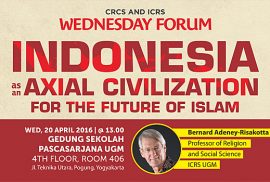
In this presentation I will explore Robert Bellah’s idea that there were four great axial civilizations which formed the modern world: China, India, Middle Eastern/Abrahamic and Greco-Roman/European. I will suggest that Indonesia occupies a unique role in the modern world because it is not dominated by any one of the 4 axial civilizations but is rather a unique synthesis of all four. Most great nations in the world are dominated by one or two, of these four axial civilizations. My research suggests that most Indonesians hold values and an imagination of social reality which is shaped by all four axial civilizations. In our pluralistic world, Indonesia may hold the key for shaping an Islamic civilization which will bring blessing to the entire world.
Speaker
Bernard Adeney-Risakotta is Professor of Religion and Social Science and International Representative at the Indonesian Consortium for Religious Studies (ICRS-Yogya), in the Graduate School of Universitas Gadjah Mada. He is currently also teaching at Duta Wacana Christian University and Universitas Muhamadiyah Yogyakarta. Bernie completed his B.A. from University of Wisconsin in Asian Studies and Literature. His second degree, a B.D. (Hons.) is from University of London, specializing in Asian Religions and Ethics. Bernie’s Ph.D. is from the Graduate Theological Union (GTU) in cooperation with University of California, Berkeley, in Religion, Society and International Relations. From 1982 until 1991 he taught at the GTU Berkeley. Bernie has been a Fellow at St. Edmunds College, Cambridge and at the International Institute for Asian Studies (IIAS), Amsterdam. From September 2013 to July 2014 he was on sabbatical leave as a Visiting Fellow at the Institute on Religion and World Affairs at Boston University. He has many publications, including: Just War, Political Realism and Faith (1988), Strange Virtues: Ethics in a Multicultural World (1995), Dealing with Diversity: Religion, Globalization, Violence, Gender and Disasters in Indonesia (2013) and Visions of a Good Society in Southeat Asia (in press, 2016). Email: baryogya@gmail.com
Endy Saputro* | Alumni News| CRCS

Sebagai salah satu alumni, saya merasa bangga pernah menganyam pendidikan di Program Studi Agama dan Lintas Budaya (CRCS), Sekolah Pascasarjana UGM. Anyaman tersebut paling tidak telah ikut merajut dua pola kerangka berpikir ilmiah saya.
Pertama, karakter interdisiplin pembelajaran CRCS telah membentuk pola pikir sintesis-kritis-verifikatif saya. Hal ini saya rasakan ketika pindah-kerja di Fakultas Ekonomi dan Bisnis Islam (FEBI) IAIN Surakarta. Semula saya bingung dituntut mengajar matakuliah Metodologi Studi Islam (MSI) di sebuah lingkungan dengan ekonomi kuantitatif sebagai domain studi. Untunglah, CRCS telah mengajari saya bagaimana meramu satu disiplin dengan disiplin lain. Saya pun mulai meracik silabus dengan memposisikan Islam sebagai lokus dan ekonomi sebagai fokus. Silabus saya rancang dengan mengurai tiga kluster paradigma studi Islam: klasik, orientalis dan post-orientalis. Bagian kedua, dengan desain by-research, saya ajak mahasiswa melihat hubungan Islam dan ekonomi. Isu-isu terkini, kali ini terkait ekspresi kelas menengah muslim Indonesia, saya diskusikan dengan mahasiswa. Kemudian, saya minta mahasiswa untuk “turun” ke lapangan melihat apa yang sebenarnya terjadi dalam realitas. Mereka pun segera memadati BMT (Baitul Maal wal Tamwil), bank Islam, rumah zakat, bazar buku Islam, toko busana muslim, halal food expo, dan hotel syariah di kota Solo.
Masih dalam tarikan nafas yang sama, kesadaran mental interrelijius (inter-religious) telah memberi corak semangat-menghadirkan-yang-lain-sebagai-kawan dalam setiap perkuliahan saya. Menurut pengakuan beberapa mahasiswa, di kampus saya yang baru ini, sebagian minor dosen masih suka mengumbar kata “sesat” dan “menyimpang” di hadapan mahasiswanya. Sialnya, sebagian besar mahasiswa sekarang cerdas, dan mempertanyakan sikap dosen yang seperti itu. Kehadiran dosen yang inklusif, alhamdulillah, telah memberikan harapan bagi mahasiswa: masih ada dosen yang berpikiran berbhineka tunggal ika. Hal ini penting saya sampaikan di tengah gempuran reproduksi eksklusivisme di kalangan mahasiswa yang dilaksanakan dengan berbagai varian kontestasinya.
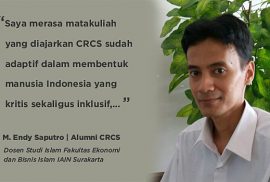
Dari pengalaman tersebut, saya merasa matakuliah-matakuliah yang diajarkan oleh CRCS sudah adaptif dalam membentuk manusia Indonesia yang kritis (nonesensialis) sekaligus inklusif (nondiskriminatif), tentunya dengan tidak tanpa catatan kritis.
Pertama, jika dua anyaman akademis saya di atas hanya dianggap sebagai soft-skills, CRCS perlu mentransformasikannya menjadi sebuah matakuliah. Matakuliah Teaching Religions in Diverse World perlu didesain sebagai matakuliah wajib; bahkan bisa dijadikan alternatif Sekolah Pengelolaan Keragaman, dengan subjek partisipan menyasar dosen-dosen Perguruan Tinggi Keagamaan Islam.
Kedua, saya kira semua alumni sepakat, CRCS telah sanggup menghadirkan atmosfer intelektualitas kelas dunia. Bagaimana kemudian menghadirkan atmosfer ini pada jejaring alumni di seluruh Indonesia. Bagaimana selanjutnya kapital sosial dan kapital budaya akademik CRCS didistribusikan di seluruh pelosok Nusantara. Bagaimana selanjutnya produk mesin-mesin intelektualitas CRCS bisa disebarkan di seluruh Indonesia.
Satu hal hampir terselip dalam ingatan, bagaimana CRCS mampu memberikan sentuhan everyday life dalam setiap matakuliahnya. Everyday religions sebagai subperkuliahan di matakuliah Academic Study of Religions telah menjadi pembuka bagi mahasiswa untuk sadar mencermati kehidupan sehari-hari. Kiranya akan lebih kuat apabila pendekatan-pendekatan budaya populer turut diperkenalkan kepada mahasiswa. Selain itu, riset kuantitatif perlu segera dianyamkan di CRCS agar dapat memperkuat basis kualitatif yang menjadi karakter ilmiah produksi pengetahuan CRCS.
Demikian, semoga dapat menjadi momen untuk mengenang alumni-alumni CRCS yang tersebar di seluruh dunia. Bravo CRCS !!
* Penulis adalah Alumni CRCS angkatan 2006, pernah menjadi koordinator divisi Riset di CRCS. Saat ini menjadi anggota Staf Pengajar Studi Islam Fakultas Ekonomi dan Bisnis Islam IAIN Surakarta.
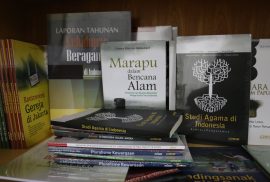

Center for Religious and Cross-cultural Studies (CRCS), Graduate School, Gadjah Mada University proudly announces the call for Thesis Award. The Award is aimed to encourage CRCS students of batch 2015 to write a high quality of master thesis and a publishable article out the thesis on “Religious Education in Higher Education.”
The requirements of the Thesis Award are:

Abstract
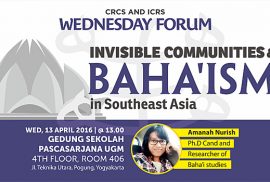
The spread of religious millenarianism in the member states of the Association of Southeast Asian Nations (ASEAN) has raised significant questions about religious movement in those countries. The Baha’i religion provides an important case and relevant context as the Baha’i movement has been paralyzed in its country of origin, Iran, since the beginning of the movement in 1844. To avoid persecution and violence, many Baha’i adherents moved to other regions in Southeast Asia. The Baha’i religion is committed to developing educational skills, economic sustainability, gender empowerment, and social movements. Thus, ASEAN encompasses a dynamic and diverse region that aims to provide social, religious, economic, and cultural security for ASEAN citizens. Minority religions such as the Baha’i community, which at the times are victims of conflict and violence, play an important role in achieving those aims. Conversely, religious violence and conflict may be seen as part of the regional deficit in terms of religious freedom and tolerance. In this context, my study tries to examine religious millenarianism and the future evolution of the ASEAN community. The study investigates the co-existence of the Baha’i community with other religious groups such as Muslim, Christian, and Buddhist in their social, political, and cultural negotiations. As the Baha’i engage on some social and political issues in globalization and embrace liberalism and pluralism in the public space, I argue that this study contributes to scholarship in terms of understanding the fate of religious millenarianism in the future of the ASEAN community.
Speaker
Amanah Nurish Ph.D Cand Researcher of Baha’i studies. She is pursuing doctorate at ICRS UGM-Yogyakarta and working as consultant of USAID team-Washington for assessment program, “Fragility and Conflict”. She wrote book chapters, articles, and journals. Her latest publications: Sufism and Baha’ism: The Crossroads of Religious Movement in Southeast Asia (2016, Equinox publisher, London) Perjumpaan Baha’i Dan Syiah Di Asia Tenggara (2016, Maarif Jurnal, Jakarta) Welcoming Baha’i: New Official Religion In Indonesia (2014, The Jakarta Post) Social Injustice and Problem Of Human Rights In Indonesian Baha’is Community (2012, En Arche Journal, Yogyakarta) etc. She received prestigious awards for her academic works such as King Abdullah Bin Abdulazis’s interfaith center-Vienna, SEASREP-Philippine, ENITS-Thailand, Luce & Ford Foundation-USA, ARI-NUS, etc. With her teamwork, she is currently undertaking a broader anthropological research on “ Religious Millenarianism in ASEAN countries” for publication supported by Arizona State University of America.


When it comes to sacred scriptures, among the things that challenge the believers is how to interpret them in ways that are faithful, on one hand, and are aware of today’s context and problems on the other hand. Addressing this issue, on March 29, 2016, CRCS student Azis Anwar Fachrudin interviewed Emanuel Gerrit Singgih, professor of theology at Duta Wacana University. Prof. Singgih taught at CRCS and advised a number of CRCS students’ thesis and is now teaching philosophical hermeneutics and interpretation of sacred scripture at the Indonesian Consortium for Religious Studies (ICRS). Since finishing his Ph.D. at the University of Glasgow, United Kingdom, in 1985, Prof. Singgih has written numerous articles and books which mostly concern Christian theology and interpretation of the Bible, particularly the Old Testament. Among his important books are Berteologi dalam Konteks (2000), Hidup di Bawah Bayang-bayang Maut: Sebuah Tafsir Kitab Pengkhotbah (2001), Doing Theology in Indonesia (2003), Dua Konteks (2009), and Menguak Isolasi Menjalin Relasi (2009).
***
There are several approaches to interpreting the Bible as you elaborate in your book Dua Konteks: dogmatic, historical criticism, literary criticism, and reader’s response. Do you think there is a problem with the dogmatic (or traditional, if you will) approach so that other methods are needed?
Not exactly a problem that will remain unsolved. It depends on how we see the four models in the framework of philosophical thinking. Even the first model (the dogmatic or the traditional model) can be used fruitfully if it is not used in isolation from other factors; for instance, the context of the text and the reader(s). If these factors are seen together, I think the traditional interpretation will not be something considered as bad in the ethical sense, or old-fashioned, or outdated.
Any example? I mean, of the traditional approach isolated from those factor?
If we read Paul’s admonitions in the New Testament, for instance, in the letter to Corinthians, there he said that women should not talk in the congregation. Of course it means that only men can talk. Before I became aware of other models or other hermeneutical understandings, I always said to my students that, well, you can put this text inside a cupboard or inside a fridge, because nowadays there are women who talk in congegrations or are ordained as pastors. So in the Protestant church, how can you reconcile this fact with that text? After I became aware of, for instance, Paul Ricoeur’s explanation of the hermeneutical arcs, I then began to think that maybe it was something done in the time of Paul and maybe he thought that it was necessary at that time to admonish the ladies in the congregation not to talk,because maybe something negative has happened because of that kind of situation.
What was that kind of situation?
There are commentators who think that maybe at that time there were movements which tried to counter the authority of the leaders (who are usually men) inside the congregation, and usually the proponents of these movements were women. Now we have feminist movements; we now do not think of them as negative; instead we understand that women have been oppressed and they should have the right to revolt, and that these movements see the text of Paul as being oppressive to women. On one hand, I agree, but still, on the other hand, I think we have to get a fair picture, following Ricoeur, to try to look at Paul’s reasoning and not immediately regard him negatively. The situation may be negative to Paul, and his reactions could be seen as negative, but still, we have to understand why Paul comes to that kind of admonition.
Doesn’t that imply that modern facts, so to speak, can change the interpretation or the religion itself?
What modernity has achieved cannot be seen as something independent in itself. What people now have achieved has its roots in the past. So, why are we against, for instance, slavery? Because there are people in the past who were already against that. Why are we criticizing Paul? Because at that time there were women who were against marginalization of women. Modernity is a continuation of the past.
I reflect that to what happens in Islam, and I see some ‘reformers’ who do that kind of thinking to the scripture are sometimes regarded as betraying the scripture.
I am not qualified to evaluate my Muslim friends, but, within Christian interpretation of scripture, that has to change, especially when we are now aware of at least four models or alternatives of interperation. We cannot say that any longer. We can say “that is not according to my view of scripture,” but we cannot say “that is not according to scripture.” Because we interpret scripture.
So, interpretation is always relative….
Not necessarily so. What I understand about the scripture is my own view, but it doesn’t mean we cannot find consensus of what is the right interpretation. For me, it is one of the traits of modernity that it is always afraid of losing absoluteness and saying, “If we lose this, we will become relative.” In postmodern thought, people are not going to the relative side, but they are saying that we cannot be absolute; what we can reach is probability, and by looking at probability we can discuss together and hopefully at one time we will find some consensus.
Sometimes I come across some ex-Christian atheists, particularly in the Western discourse, who say that Paul was a misogynist. How would you respond to that sort of accusation?
It depends on what we see as the meaning of the text. If we understand it literally and we cannot do other ways, then of course Paul is misogynist. But who can tell that that is the understanding of the text? I know that sometimes when you wrote your article, you said that this is the understanding and you either agreed or not with that, am I right?
Sometimes, because my audience is mostly conservatives who don’t like obscurity…
I should question the equation between the meaning and the text. By doing that, I try to become postmodernist in the sense that I am not against conservatives as such. In postmodernity we try to go together, and if we can come to some common understanding on the sacred text, I think that is good. And that is what we are trying to look for in lectures such as understanding of scripture. We are not trying to say that you are wrong and I am right. Let us look for truth.
It is like we should emphasize on the process rather than the result…
Yes, that is right.
You mostly do interpretation of the Old Testament. I come across some who say that figures like Moses, David, Solomon, the prophets are not historical; they did not actually exist. Your response?
First I would like to say that in the beginning historical criticism was very harsh; it started from skepticism. But then after around fifty years, people became aware that the Bible was not written directly by this and that figure. Mostly, those who are responsible for the edition of the Bible as we have it now were editors who lived long after the patriarchs and the kings. They were talking about people in their own past. How shall we then respond to this new finding that it is the editors not the authors who are responsible? We can now say that what is important historically for us is the way the editors edited the Bible and the stories in it. It was historical according to them, but of course it is different from what we now understand as history.
Meaning?
Meaning, we are now looking at history in a very academic way, but they had their own understanding of history, which was maybe not academic at all. But can we say that what they are saying is nonsense?
Well, why isn’t it nonsense? I mean, those who don’t believe in those stories would ask why we should look at ancient stories that are sometimes terrible to address today’s problems? Take the example when God punished people of a tribe, He committed something like genocide; or there is the example of Abraham sacrificing his own son.
But God intervened, so the killing did not happen after all.
In Christianity Abraham is not understood as a prophet, right?
No. We call him father of all believers. First, Abraham is very obedient, but his obedience has a limit. In the end, he does not follow the command to kill his only son, because he believes that there is another commandment of God which is in contrary to the first commandment. The first said kill him, the next said do not kill him. That is a kind of what people now call as faith struggle; in the life of the faithful there is a struggle to know what is the will of God. And it is not easy, sometimes we have to choose from contradictory statements . The lesson we can get from this story of Abraham and Isaac is that we can choose not to kill; we can choose to prevent our beloved ones from being killed.
I don’t know the details of the story in Christianity. But in Islam, God commands Abraham through a dream to kill his son.
That is the same. Then the point is that when Abraham is gong to execute the command, there is an angel that comes down…
So, God was testing Abraham?
What we mostly understand from the story is that it is a test. Actually in the text, in the Indonesian Bible, it is said “Allah mencoba …” [God tested…]. But a test can become problematic if the price is very high. In the book of Job, Job is also tested by God, but that too can be regarded as a problem; that is why in the middle of the book, Job revolts against God. But in the text itself there is a dynamic, which in the end gives something to us why Abraham then decides “no”; what God demands from me should not be something evil. The very high price in itself signifies that, in the end, it does not need to be executed.
Last topic: Jesus said that he came to earth not to bring peace but rather the sword. And in another occassion, Jesus said to turn the other cheek. How to deal with this sort of contradiction?
First, the Bible has many contradictions, and many of these contradictions are constructed by the people themselves. Some say the Old Testament is violent while the New Testament is not, and they make an opposition between these two books. But I think the real case is not like that. In the Old Testament, you will find images of followers of God who are compassionate, and in the New Testament you will find texts which are violent. If we now go to the New Testament, to the sayings of Jesus, you will see two contradictory sayings. Now what shall we do? Shall we harmonize them? I think we should not. Following Foucault, let them be like that. In our search for truth, sometimes we come to positions which seem to contradict each other, but both have their own positive and negative sides. You don’t have to harmonize them.
How would you personally interpret the violent one, that Jesus came by sword?
He is somebody who is very concerned with the injustice of this world, and he intends to overcome this injustice. That is why he is in opposition to the religious leaders.
That would imply that violence can sometimes be justifiable to fight against oppression…
When there is no other way out. Well, I belong to a group of people in Christianity called Calvinists. There are other people called Mennonites; they are against violence; in every situation they do not advocate violence. Calvin said in some extreme cases, for instance, in his context where the king was stifling religious freedom, you can raise arms to defend your freedom. I belong to this tradition. But I of course never recommend violence.
There is an idea that says that the scripture is malleable, meaning it is the readers who bring their values or ideology into the scripture, not the other way around. If you’re a violent person or living in oppressed areas, like in Latin America in the 1980s, for example, your interpretation would tend to justify violence against the oppressors. If you’re the oppressor, you’d tend to pick the peaceful side of scripture to calm down the subsersives. Any response?
That is too extreme. The Latin American people fought against oppression, and the result is democratic societies; the dictatorships came crumbling down, and what appeared are democratic societies. The only successful revolution is of course Cuba. But the others come to normal situation by the process of non-violent opposition to dictatorships. I do not agree one hundred percent with the above theory. Liberation theology’s emphasis is not on violence, but on the preferential option for the poor and the weak. That is the main tenet of liberation theology. It places priority for the poor and the weak.
What about the Catholics at the time of Nazi Germany? I heard that they were supporting or at least silent in front of the Nazi persecution of the Jews.
They did not speak strongly enough against the Nazis, nor did the Protestants. But there were some Catholic priests who courageously defied the Nazi regime, and so did some pastors from Protestant churches. Martin Niemöller, for instance, was put in prison. Also, Dietrich Bonhoeffer who joined the plot to kill Hitler was imprisoned and later hanged by the Nazis.
Okay, that’s all. Thank you, Pak Gerrit.