Applications for admission to the Center for Religious and Cross-cultural Studies (CRCS) for the 2016/2017 academic year are now being accepted. For more information click Admission 2016 and information on scholarship click Scholarship


Applications for admission to the Center for Religious and Cross-cultural Studies (CRCS) for the 2016/2017 academic year are now being accepted. For more information click Admission 2016 and information on scholarship click Scholarship
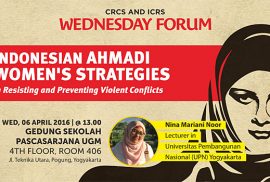

Abstract
The Indonesian Ahmadiyya community has been facing violent conflicts after the Reformasi era. This dissertation focuses on the narrative of Ahmadi women about their experiences in dealing with daily conflicts they face in relation to their faith. This paper focuses on the acts of the Ahmadi women organization called Lajnah Imaillah from 2000 to early 2015 by examining their defense mechanism and exercising agency in resisting and preventing conflicts. The study was conducted in four areas in Indonesia, Kuningan in West Java, Yogyakarta, Lombok in West Nusa Tenggara and Head Office of Lajnah Imaillah in Bogor. The informants were Ahmadi women from different socio economics status and positions in the organization. Using narrative inquiry, this research found out that in responding and resisting to violent conflicts, Lajnah Imaillah has been changing its way of resistance and its forms of defense mechanism. The conflicts that Ahmadi women face have encouraged them organizationally and individually to be more actively participate in wider society and build good relationships with the religious others outside of the community. Therefore this paper argues that non-violent defense mechanism promotes better relations and mutual understanding among conflicting parties in society.
Speaker
 Nina Mariani Noor just earned her Ph.D from Inter Religious Studies, ICRS (Indonesian Consortium For Religious Studies) Universitas Gadjah Mada last January. Her concern is on conflict resolution, gender, and minority studies. Nina is Programme Executive Globethics.net Indonesia (www.globethics.net) . Globethics.net is the biggest, global online platform dedicated to promote inclusive, values-driven transformation for sustainable living, through access to knowledge, networking, collaborative research, training and events. She also teaches in Universitas Pembangunan Nasional (UPN) Yogyakarta this semester.


Film title : Growing Cities (2013, USA)
Director : Daniel Susman
Producer : Dana Altman
Editor : Alexandru Moscu
Writers : Andrew Monbouquette, Daniel Susman
Storyline
In their search for answers, filmmakers Dan Susman and Andrew Monbouquette take a road trip and meet the men and women who are challenging the way this country grows and distributes its food, one vacant city lot, rooftop garden, and backyard chicken coop at a time. Join them as they discover that good food isn’t the only crop these urban visionaries are harvesting. They’re producing stronger and more vibrant communities, too.Written by IMDb: Titles With Plot Summary Written By “Growing Cities Official” Sorted by Title Ascending
We invite friends from Sekolah Petani Muda (School of Young Farmer) Sleman, Yogyakarta to share with us in the discussion. Join us!
CRCS’s location: click here
![IMG-20160323-WA0004[1]](http://web07.opencloud.dssdi.ugm.ac.id/wp-content/uploads/sites/73/2016/03/IMG-20160323-WA00041.jpg)
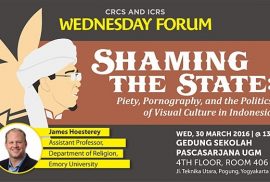
Abstract
This presentation examines the role of visual culture in the constitution – and contestation – of public piety during Indonesia’s controversial anti-pornography campaign. Building on Hirschkind’s concept of the “pious sensorium,” the paper describes how seeing itself can be an ethical act. Inspired by al-Ghazzali’s notion of the “fornication of the eye,” celebrity televangelist Abdullah Gymnastiar preached that those who cannot control their sexual gaze eventually tarnish their hearts and lose their sense of shame. Gymnastiar leveraged his public pulpit to discipline state officials, summoning them to publicly support legislation to ban Playboy magazine. On the other hand, opponents of the anti-pornography bill deployed visual media to satirize what they viewed as inauthentic displays of piety by Islamist politicians and public icons. By attending to the diverse ways in which Indonesians mobilize media, this paper argues that an analysis of visual culture in post-authoritarian Indonesia provides unique insights into political Islam that enrich, nuance, and at times contradict the current scholarly focus on electoral politics and Islamist institutions.
Speaker
James Hoesterey is Assistant Professor on Department of Religion, Emory University, and cultural anthropologist whose research focuses on popular culture, religious authority, and political Islam. His first book explores post-Islamist politics in Indonesia through the story of the rise and fall of Indonesia’s celebrity televangelist Aa Gym, Rebranding Islam: Piety, Prosperity, and a Self-help Guru (2016). Hoesterey has also published on Islamic cinema and has served as anthropological consultant for documentary films broadcast worldwide on the Discovery Channel, National Geographic, and the BBC.
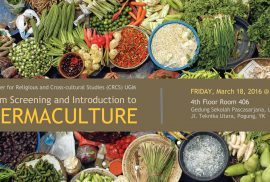

Film title: INHABIT: A Permaculture Perspective (2015, USA)
Director: Costa Boutsikaris
Producer: Emmett Brennan
Cast: Geoff Lawton, Charles Eisenstein, Ben Falk, Mark Krawczyk
SOME DEFINITIONS OF PERMACULTURE
Bill Mollison, Founder of Permaculture
Permaculture is a philosophy of working with, rather than against nature; of protracted & thoughtful observation rather than protracted & thoughtless labour; of looking at plants & animals in all their functions, rather than treating any area as a single-product system.”
David Holmgren, Co-founder of permaculture
Permaculture is ‘Consciously designed landscapes which mimic the patterns and relationships found in nature, while yielding an abundance of food, fibre and energy for provision of local needs. People, their buildings and the ways in which they organise themselves are central to permaculture. Thus the permaculture vision of permanent or sustainable agriculture has evolved to one of permanent or sustainable culture.
Graham Bell, The Permaculture Way
Permaculture is the conscious design and maintenance of agriculturally productive systems which have the diversity, stability, and resilience of natural ecosystems. It is the harmonious integration of the landscape with people providing their food, energy, shelter and other material and non-material needs in a sustainable way.
Ilma Sovri Yanti Ilyas | CRCS | Artikel
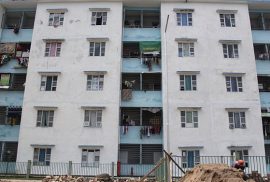
Bangunan kembar yang terdiri dari lima lantai dengan cat berwarna biru dan putih nampak kokoh dilihat dari seberang jalan (pasar induk Puspa Agra). Di dalamnya masing-masing gedung itu memiliki sekitar 76 kamar di blok A dan 76 kamar lagi di blok B dengan total 152 kamar, dan hanya 76 kamar yang dihuni oleh warga pengungsi Syiah yang berjumlah 82 KK. Selebihnya kamar diisi oleh masyarakat yang mengontrak di sana. Sementara masih ada sekitar 7 KK hingga penulis membuat tulisan ini mereka belum mendapatkan kamar, dan terpaksa tinggal menumpang di kamar lain dengan bersempit-sempitan.

Berdasarkan data yang penulis himpun, saat ini sejumlah 332 jiwa menjadi pengungsi akibat konflik yang terjadi (th 2015), terdiri dari 154 anak-anak usia sekolah dan 9 usia batita (0-3 th). Dan saat penulis berada di lokasi, terhitung hanya sekitar 234 jiwa yang menetap di rusun lima lantai tersebut. Lalu di mana yang lainnya.
“Yang lain tinggal bersama keluarganya karena menikah dengan orang luar (non pengungsi),” ujar Nur Cholish, pendamping pengungsi yang menemani penulis. “Ada juga yang bekerja di Malaysia, ada juga yang tinggal bersama orang tuanya karena mengurus orang tua yang sudah tua.”
Kondisi Pengungsi Syiah Sampang
Area rusun, mulai dari gapura Puspa Argo, dijaga 24 jam oleh petugas parkir atau satpam pada malam harinya. Dan khusus untuk warga pengungsi yang berlalu lalang dengan motor mau pun sepeda dibebaskan biaya tiket masuk area. Sementara sekitar 200 meter dari gapura, ada juga pos keamanan yang dijaga oleh petugas keamanan, tetapi nampaknya tidak begitu ketat karena pos sering terlihat kosong penjaganya. Namun pada sore hari menjelang malam pos dijaga oleh petugas keamanan.
Area rusun nampak berhalaman luas dan berjalan beton. Pepohonan tampak beberapa batang saja, selebihnya pemandangan luas bebas pohon. Kondisi penerangan lampu sekitar rusun sangat minim. Jika memasuki gedung, pada bagian bawah bangunan kembar ini terdapat lokasi parkiran untuk motor dan sepeda milik warga pengungsi Sampang dan juga ada warga lain (non pengungsi) yang mengontrak di rusun tersebut. Umumnya warga non-pengungsi tinggal di kamar lantai II Gedung B, selebihnya berada di Gedung A. Interaksi antara warga non pengungsi dengan warga pengungsi nampak biasa-biasa saja, namun terlihat warga pengungsi Sampang yang selalu menjaga sikap agar tidak menganggu aktivitas warga lain yang tinggal di rusun tersebut. Hal ini penulis simpulkan saat melihat kondisi beraktivitas di dalam dan di luar bangunan. Untuk aktivitas pengajian dan belajar anak-anak selalu menggunakan lantai 5 atau di lokasi parkiran motor (bawah).
Suasana gedung tempat para pengungsi. Dokumentasi Pribadi.Untuk kondisi kamar yang dihuni seluruh warga berukuran 6 x 6. Ada satu kamar dengan pembatas dari triplek, sedikit ruang untuk kumpul keluarga, ruang tamu, dapur dan kamar mandi. Ada sedikit ruang kosong yang disediakan tiap kamar untuk menjemur pakaian. Kondisi air di sana menggunakan mesin pompa air. Artinya air yang dikonsumsi adalah air tanah yang, walau jernih, namun agak sedikit bergetah bila dirasakan di badan. Pompa air sejak dua tahun terakhir ini sering mengalami kerusakan. “Sudah 8 kali rusak dan itu pun lama baru diperbaiki,” kata Fitri. “Terbayang kan bagaimana para orang tua yang tinggal di lantai atas harus mengambil air ke bawah dan membawanya lagi ke atas.”
Kondisi pembuangan atau saluran air di kamar mandi cukup rendah sehingga mudah sekali air menjadi penuh dan dapat membenamkan kaki saat menggunakan kamar mandi. Karena itu, setiap rumah terpaksa lubang saluran air dipecah agar penyaluran air lancar, walau hasilnya tidak merubah situasi yang penulis alami. Untuk sarana dan fasilitas tengah gedung yang seharusnya dapat digunakan untuk penghijauan menanam tanaman, dibiarkan kosong melompong sehingga banyak terdapat kotoran kucing mau pun ayam dan membuat aroma kurang sedap. Belum lagi teras rumah di atas milik beberapa warga terdapat kandang burung dan kotoran burung peliharaan.
Tangki air pun tidak berfungsi otomatisnya, sehingga jika air penuh akan tumpah ke bawah bak air hujan lebat jika terlambat mematikan saklar air. Risikonya pun jika saklar lampu terkena percikan air akan terjadi konslet menyebabkan listrik padam seluruh gedung dan menunggu untuk diperbaiki bukanlah hal yang cepat dapat dilakukan.
Terasing di Kampung Sendiri
Selengkapnya di satuharapan.com
Penulis adalah alumnus Sekolah Pengelolaan Keragaman (SPK) CRCS UGM Angkatan ke VI, 2015