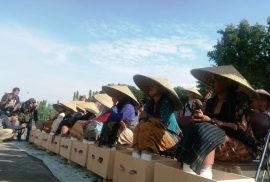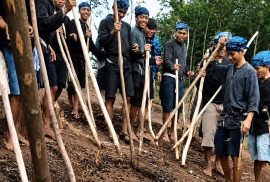
Gerakan perempuan Samin melawan tambang semen di Pegunungan Kendeng tidak hanya menjadi bentuk perlawanan terhadap eksploitasi, tetapi juga penolakan terhadap logika dualisme manusia-alam. Perjuangan tersebut merepresentasikan upaya mewujudkan kewargaan ekologis yang berangkat dari pengalaman tubuh perempuan.
Agama dan Ekologi
Beradaptasi lewat Agama di Tengah Abrasi Pantai Utara Jawa
Rezza Prasetyo Setiawan – 20 Juli 2024
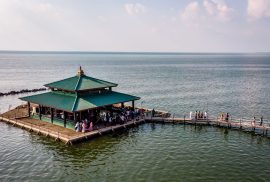
Salah satu dampak nyata krisis iklim ialah kenaikan air laut dan abrasi yang menenggelamkan daerah-daerah di kawasan garis pantai. Sebagai negara dengan garis pantai terpanjang di dunia, Indonesia menjadi salah satu wilayah yang paling terdampak. Lantas, bagaimana masyarakat Indonesia yang tinggal di kawasan terdampak beradaptasi dengan hal ini? Sejauh mana pemahaman dan praktik keagamaan mereka berperan dalam proses adaptasi tersebut?
Pertanyaan itu menjadi salah satu titik tolak disertasi Aliyuna Prastiti yang ia presentasikan dalam Wednesday Forum bertajuk “Making Sense of Religion in Adaptation Processes”, 8 Mei 2024. Dosen program studi Hubungan Internasional, Universitas Padjadjaran, ini meneliti dua komunitas masyarakat yang tinggal pesisir utara Pulau Jawa, yaitu Bedono, Kabupaten Demak, Jawa Tengah dan Pantai Bahagia, Bekasi, Jawa Barat.
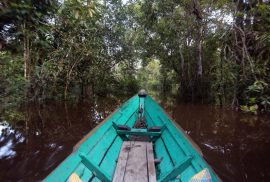
Pendekatan etika keagamaan adalah ruh yang menjiwai program revitalisasi gambut dan mangrove sekaligus memastikan keberlanjutan upaya pelestarian ini. Utamanya, ketika program ini usai.

Abstract
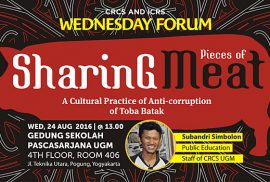
Corruption is a problem of civilization which, by extension, is a problem of culture. This must be confronted by reviving the cultural values of anti-corruption. Learning from local traditions which combat corruption can be a powerful instrument to fix corrupt tendencies in a state. Strong beliefs in local cultural values can become the base of these efforts. In other words, the culture will create the people, and the people will create the civilization. Presenter try to offer an overview of Mambagi Jambar (Sharing Pieces of Meat) activity as representative of the cultural activities which combat corruption. By basing on ethnographic interviews and analysis of related texts, the presenter will describe this discussion in a systematic matter. The first part introduces global corruption and, furthermore, the issue of corruption in Indonesia. The second part describes the activities of padalan jambar juhut in Toba Batak culture. The last part then discusses these activities and their contributions in an effort to revive anti-corrupt cultural practices.
Speaker
Subandri Simbolon is Public education Staf at CRCS-UGM. His research, focused on culture and populer issue, has been published in globethic.net journal. He finished his BA at Sekolah Tinggi Filsafat dan Teologi (STFT) Widya Sasana Malang where he majored in Christian Philosophy. In 2014, he graduated from CRCS-UGM where focuse on Culture and Ecology. In 2014 and 2015, he awarded the first winner for globetthic.net essay competition about “Anti Corruption Ethics and Religiosity (2014) and “Responsible Leadership (2015)“.