• Tentang UGM
  • Portal Akademik
  • Pusat TI
  • Perpustakaan
  • Penelitian
Universitas Gadjah Mada
  • About Us
    • About CRCS
    • Vision & Mission
    • People
      • Faculty Members and Lecturers
      • Staff Members
      • Students
      • Alumni
    • Facilities
    • Library
  • Master’s Program
    • Overview
    • Curriculum
    • Courses
    • Schedule
    • Admission
    • Scholarship
    • Accreditation and Certification
    • Academic Collaborations
      • Crossculture Religious Studies Summer School
      • Florida International University
    • Academic Documents
    • Student Satisfaction Survey
  • Article
    • Perspective
    • Book Review
    • Event Report
    • Class Journal
    • Interview
    • Wed Forum Report
    • Thesis Review
    • News
  • Publication
    • Reports
    • Books
    • Newsletter
    • Monthly Update
    • Infographic
  • Research
    • CRCS Researchs
    • Resource Center
  • Community Engagement
    • Film
      • Indonesian Pluralities
      • Our Land is the Sea
    • Wednesday Forum
    • ICIR
    • Amerta Movement
  • Beranda
  • 2016
  • page. 8
Arsip:

2016

Cultural Practice of Anti-corruption of Toba Batak

BeritaHeadlineNewsWednesday Forum Report Friday, 30 September 2016

Meta Ose Ginting | CRCS | Wednesday Forum Report
subandri-simbolonCorruption is one of many problems that Indonesia as a nation faces. It is not only a law-related problem but also a cultural problem. As such, culture and the values it promotes could also in one way or another be a powerful weapon to fight corruption. These are the points that Subandri Simbolon emphasized in his presentation about a ritual of sharing meat as a value to prevent corruption in Toba Batak society.
To begin his presentation, Subandri showed a video about the process of sharing meat (membagi jambar) ritual at a wedding in Batak land. The video tells about how the meat is shared to certain groups of families as a symbol of acknowledgment and appreciation of their existence. In the video, family members circle around the meat as it is being cut into specific portions and one person lifts up a portion of the meat and calls out family names and gives the meat to them as other people can watch them clearly. The portion of the meat is given out based on the Batak system of family kinship called Dalinan No Tolu..
The process of sharing jambar is arranged in some parts. First, mengalap ari. Mengalap ari is the process of choosing a good day to begin the ritual. Secondly, the ritual begins by cutting the meat into certain portions while the audience can see it clearly. The leader will then share the meat to the people by calling their names. Here is the strong educational point by the sharing meat ritual happened. By sharing the meat and let everyone watch it, it teaches people about honesty, appreciation and acknowledgment of the relationships among families. The meat being shared in jambar juhut is a representative of “source of life”. By receiving the source of life, people are receiving blessings. Other than being a symbol of blessing, meat also a symbol of people’s rights. When they receive their portion, it means their existence and their rights to be involved and participate are being acknowledged.. Therefore, discussing blessing and rights in the Toba Batak context invites people to not be greedy and to say enough when it is enough.
Subandri highlighted the point that in the process of sharing meat there are strong and meaningful interpretations where the generations can learn about anti-corruption attitudes. Moreover he added, in the ritual of jambar juhut there is a strong relational concept shows that humans are connected to each other. Because this cultural conception is to some extent closer to Batak Toba people’s daily lives than the abstract legal definitions of fairness and government laws, Subandri argued  that it can be more effective and powerful to turn people from corruption. In a relational framework, corruption is an activity that is detrimental because it violates and even negatesrelationshipsReflecting on this relational framework, Subandri  revisited the meaning of sharing meat in Toba Batak tradition, arguing that it can be interpreted as an effort to strengthen relationships and promote honesty.
During the discussion session there were many fascinating questions that led people to deeper reflection on how humans sometimes are separated from their tradition to such an extent that they no longer think of it as a part of their existence or as a medium to learn from but merely as ceremony. One challenging question was about how, in many other traditions, instead of fulfilling the intention of renewing people’s understanding about relationships, this kind of ritual fails because it becomes a problem because of economic reasons. In order to answer that, Subandri encouraged the audience to think about the meat as a symbol of source of life: if it feels burdensome, people can replace the meat with something else like vegetables so that no one will be excluded.   Subandri was also asked about the role of Christianity as the major religion in Toba land in this kind of ritual. He answered that while sometimes a priest or pastor is invited to begin the ceremony with prayer, there is not really any significant influence.
The discussion came to an end with a challenging invitation for all of us to find in our own culture the values that we can use to develop  a cultural defense against corruption.  Even though there is always to the possibility we might misinterpret the meaning of rituals such as this one,  in the end, it is worth trying.
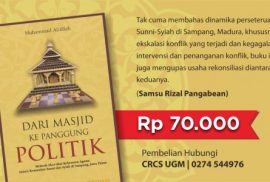
Dari Masjid ke Panggung Politik, Melacak Akar-akar Kekerasan Agama Antara Komunitas Sunni dan Syiah di Sampang, Jawa Timur

BeritaBerita Utama Thursday, 29 September 2016

dari-masjid-ke-panggung-politik1revisi_7_septemberJudul
Dari Masjid ke Panggung Politik, Melacak Akar-akar Kekerasan Agama Antara Komunitas Sunni dan Syiah di Sampang, Jawa Timur
Penulis
Muhammad Afdillah
Penerbit
CRCS 2016
ISBN
978-602-72686-6-1
Harga
Rp 70.000,-
Beberapa aspek politik dan kekerasan Sunni-Syiah di Sampang dibahas di dalam buku ini. Salah satu di antaranya penyebab konflik antara komunitas Sunni dan Syiah di Sampang. Selain itu, buku ini membahas dinamika konflik Sunni-Syiah, khususnya eskalasi konflik yang terjadi seiring dengan berjalannya waktu dan kegagalan intervensi dan penanganan terhadap konflik tersebut. Buku ini juga membahas usaha – usaha rekonsiliasi kedua komunitas, khususnya setelah kekerasan terbuka yang terjadi di Bulan Desember 2011 dan Agustus 2012.
(Samsu Rizal Panggabean, Pengajar di Magister Perdamaian dan Resolusi Konflik di Fakultas Ilmu Sosial dan Ilmu Politik, Universitas Gadjah Mada).
__________________________
Bagi yang tertarik, bisa menghubungi:
Divisi Marketing CRCS UGM
Gedung Lengkung Lantai 3
Sekolah Pascasarjana Universitas Gadjah Mada
Jl. Teknika Utara, Pogung, Yogyakarta, Indonesia 55281
Telephone/Fax : + 62-274-544976


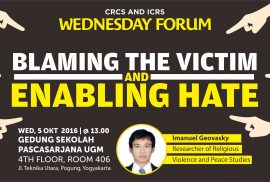
Wednesday Forum: Blaming The Victim and Enabling Hate

NewsWednesday Forum News Thursday, 29 September 2016

wed-forum-10-05banner
Abstract
Who has the authority to end the discrimination and violence religious minority groups continue to face despite protections promised in Indonesia’s constitution? This talk examines three recent cases—the Ahmadiyya in West Java, Shi’a in East Java, and two HKBP churches also in West Java—to show how the three kinds of authority (legal-rational, traditional, and charismatic) identified by Max Weber are all used to legitimate extremism and violence in the face of contradictory actions by the government, including religious leaders with institutional authority inside it. Unless the actors in the government recognize that they must use their authority responsibly, extremist religious leaders who seek to mobilize hate against others, especially minorities, will continue to be able to do so and Indonesian society will remain immature.
Speaker
Imanuel Geovasky is graduated from School of Public Policy and Social Research International Christian University, Tokyo, Japan. He got Japan ICU Foundation Scholarship (JICUF) (New York based) and United Board for Higher Education in Asia (UBCHEA) (New York and Hongkong based) Faculty Development Scholarship for Master Degree in Peace Studies at International Christian University, Tokyo, Japan, from September 2013 – July 2015. His focus research on Religious-based violence and discrimation against minorities in Indonesia society, Human security and Peace building.

Negotiating Women’s Modesty in the Gendered Dynamics of Minang Society

Wednesday Forum Report Tuesday, 27 September 2016

Negotiating Women’s Modesty in the Gendered Dynamics of Minang Society

M Rizal Abdi | CRCS | Wednesday Forum Report


The woman knelt down, supporting her body wrapped in traditional Minang cloth. She held a microphone that echoed her reedy singing and reverberated with the sound of flute from the man next to her. Suddenly, the sound of electronic music rushed in, disrupting the serene and heartbreaking melody with the upbeat dangdut rhythm. Still kneeling down and the female singer continued her sad singing with contradictory backsound as if it is synchronized to each other.
“Two decades ago, this wouldn’t be happening,” said Jennifer A. Fraser, Associate Professor of Ethnomusicology and Anthropology from Oberlin College, US. The contradictory yet fascinating scene above was shown during Fraser’s presentation in CRCS-ICRS Wednesday Forum on Wednesday, 8th August 2016. Entitling her presentation “Playing with Men: Female Singers, Porno Lyrics, and the Male Gaze in a Sumatran Vocal Genre”, Fraser shared her latest findings on Saluang Jo Dendang (literally flute with song), one of the Minangkabau music arts which is celebrated for its refined poetry based on allusions and its sad songs that induce tears in a listener. Using ethnographic research in West Sumatra dating from 1998, she tracked the gendered dynamics and increasingly sexualized interactions between female singers and their male audiences. In the 1960s, Saluang Jo Dendang was predominantly a male performance. Based on Minangkabau Islamic modesty, it was not considered appropriate for women to attend such an exclusively male event, let alone become the center of attention. The only possibility for a woman to participate as a performer was when her husband was the flute player. However, by the 1990’s, women started to displace men as the singer or pededang so that nowadays male pedendang are extremely rare. In fact, as one of male singers admitted, no one wants to listen to a male pedendang anymore.
Moreover, Fraser showed that there are shifting relations between the padendang and pagurau or attendees. In the past, with male singers, the pagurau usually listened to the song and fell into deep reflection on the lyrics. Sometimes the pagurau could also make song requests to the padendang directly. Nowadays, the pagurau usually tease or seduce the padendang by throwing some off-color jokes or requesting particular themes like divorce, asking for marriage, or other private matters. However, according to Fraser, the porno lyrics in the saluang performance refer to something different from the common understanding of pornography. Rather than explicitly using sexual vocabulary, most of lyrics categorized as porno by the audiences refer to anatomical description through allusion that tends to be not harmful but playful. For example,

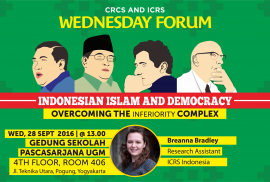
Wednesday Forum: Indonesian Islam and Democracy, Overcoming The Inferiority Complex

Wednesday Forum News Monday, 26 September 2016

wedforum-28-thumb
Abstract
Indonesian Islam connotes a pluralistic form of faith that is open and deeply engages local-specific cultures that concurrently emphasize a rigorous pursuit of social justice and equality for all. Despite the voluminous scholarship on Indonesian Islam, its correlation with Muhammadiyah’s “Islam Berkemajuan” and Nahdhatul Ulama’s “Islam Nusantara”—each having its own vision for a good society—remains woefully unexplained. This paper explores the interplay between Indonesian Islam and the praxis of democracy within the historical context of overcoming an apparent inferiority complex suffered by some segments of the Muslim community. The authors argue that as much as Indonesian Islam may have proven itself to be distinct from ‘the other Islams’, commonly found in its birthplace in the Middle East, there is still much to be desired for in terms of how to confidently overcome the historical baggage as a once colonized people. Using Said and Foucault’s analytical frameworks, the paper argues for a less humble attitude toward the propagation of Indonesian Islam to the outside world, given the protracted period of instability in the Middle East, ongoing terror attacks in different parts of the world and the politics surrounding Islamophobia.
Speaker
Breanna Bradley is an undergraduate student at Georgetown University’s Edmund A. Walsh School of Foreign Service located in Washington, District of Columbia, USA. Bradley’s studies focus on the relationship between culture and politics in Southeast Asia. She is currently a research assistant at the Indonesian Consortium for Religious Studies (ICRS), a Ph.D. program in Inter-Religious Studies located at Universitas Gadjah Mada, Yogyakarta, Indonesia. She has previously held positions as an undergraduate research fellow at Georgetown University’s Berkley Center for Religion, Peace and World Affairs and as a program coordinator for Georgetown University’s D.C. School’s Project, a program aimed to provide English language access for the immigrant community of the Washington DC area. She is interested in the role that Indonesian Islam plays in Indonesian culture and politics and is currently assisting with research surrounding the Tabot festival, a festival with its roots in Shia Islam celebrated by a majority Sunni community every year in Bengkulu, Sumatra.

Dari Masjid ke Panggung Politik, Melacak Akar-akar Kekerasan Agama Antara Komunitas Sunni dan Syiah di Sampang, Jawa Timur

BeritaHeadlineNews Thursday, 22 September 2016

dari-masjid-ke-panggung-politik1revisi_7_septemberJudul
Dari Masjid ke Panggung Politik, Melacak Akar-akar Kekerasan Agama Antara Komunitas Sunni dan Syiah di Sampang, Jawa Timur
Penulis
Muhammad Afdillah
Penerbit
CRCS 2016
ISBN
978-602-72686-6-1
Harga
Rp 70.000,-
Beberapa aspek politik dan kekerasan Sunni-Syiah di Sampang dibahas di dalam buku ini. Salah satu di antaranya penyebab konflik antara komunitas Sunni dan Syiah di Sampang. Selain itu, buku ini membahas dinamika konflik Sunni-Syiah, khususnya eskalasi konflik yang terjadi seiring dengan berjalannya waktu dan kegagalan intervensi dan penanganan terhadap konflik tersebut. Buku ini juga membahas usaha – usaha rekonsiliasi kedua komunitas, khususnya setelah kekerasan terbuka yang terjadi di Bulan Desember 2011 dan Agustus 2012.
(Samsu Rizal Panggabean, Pengajar di Magister Perdamaian dan Resolusi Konflik di Fakultas Ilmu Sosial dan Ilmu Politik, Universitas Gadjah Mada).
__________________________
Bagi yang tertarik, bisa menghubungi:
Divisi Marketing CRCS UGM
Gedung Lengkung Lantai 3
Sekolah Pascasarjana Universitas Gadjah Mada
Jl. Teknika Utara, Pogung, Yogyakarta, Indonesia 55281
Telephone/Fax : + 62-274-544976
 

1…678910…24

Instagram

Before petroleum fueled the world, it fractured th Before petroleum fueled the world, it fractured the archipelago

The raise of the colonial petroleum industry in the Dutch East Indies was also the emergence of new spatial inequalities. Outer Java was not merely discovered as a resource zone. It was politically produced as an extractive territory through imperial concessions, colonial state-building, and global struggles over resource control.

Join us in this presentation on capitalism, oil, and the colonial fractures that continue to haunt the geography of modern Indonesia. We provide snacks and drinks, don't forget to bring your tumbler. This event is free and open to public.
M B G Satu kotak makan berisi nasi putih pulen seb M B G
Satu kotak makan berisi nasi putih pulen sebagai sumber karbohidrat utama, dimasak dari beras medium pilihan, air, sedikit garam, dan beberapa tetes minyak agar tidak cepat basi. Di sampingnya terdapat ayam semur kecap, dibuat dari potongan daging ayam, bawang merah, bawang putih, kecap manis, daun salam, lengkuas, garam, dan sedikit gula sehingga memberi asupan protein hewani yang cukup untuk pertumbuhan. Sebagai pendamping lauk utama, disediakan tempe orek manis gurih dari tempe iris tipis, bawang merah, bawang putih, cabai, kecap, dan gula merah. Tempe ini berfungsi menambah protein nabati sekaligus membuat kotak makan tampak lebih penuh, sebab protein memang sering lebih meyakinkan bila hadir rangkap dua. Untuk unsur sayuran, ada tumis wortel dan buncis yang dimasak dari wortel segar, buncis, sedikit kol, bawang putih, garam, merica, dan minyak sayur. Warna oranye-hijau pada sayur ini penting: bukan hanya untuk vitamin A dan serat, tetapi juga agar foto dokumentasi tidak terlihat terlalu pucat.Sebagai pelengkap vitamin alami, satu buah pisang atau sepotong pepaya matang diletakkan di sudut kotak. Buah dipilih yang murah, tahan banting, tidak gampang memar, dan cukup fotogenik ketika dibagikan massal. Terakhir, ditambahkan susu UHT kotak kecil berbahan susu sapi, gula, dan fortifikasi vitamin, atau kadang telur rebus utuh sebagai penutup protein tambahan.

Berbuih-buih seperti pelaksanaannya ...
G U S Mulanya "gus" adalah panggilan untuk anak ki G U S
Mulanya "gus" adalah panggilan untuk anak kiai yang belum cukup pantas secara umur dan ilmu dipanggil sebagai kiai. Masih magang. Namun, tradisi itu sedikit goyang karena dua sosok: Gus Dur dan Gus Miek. Keduanya tentu sudah pantas menyandang gelar kiai, tetapi rupanya nama magang itu sudah kadung merasuk dan menubuh. Jadilah istilah gus naik pangkat di kalangan awam sebagai sebutan untuk pemuka agama kharismatik yang ndak kalah aji dengan kiai. Kini, gelar gus lagi-lagi goncang. Pasalnya, banyak sosok yang mengaku dan didaku sebagai gus. Parahnya, banyak orang tak lagi bertanya: siapa gurunya, siapa nasabnya, atau apa yang dibaca? Gus seolah menjadi lisensi untuk mengais gold dan glory dalam bisnis berjenama "agama". 

Simak sindiran @safinatul_aula atas fenomena gus-gusan yang kerap membuat kita mengelus empedu. Hanya di situs web crcs.
S U R G A Surga dan neraka memang dibuat sebagai a S U R G A
Surga dan neraka memang dibuat sebagai alat ukur dan wadah pemisah. Keberadaanya merupakan konsekuensi logis dari sebuah tarik ulur tentang baik dan buruk. Mereka yang dijanjikan surga patut bersenang hati. Namun, ada saat ketika keyakinan tentang keselamatan tidak lagi menenangkan. Mungkin persoalannya bukan siapa yang akan masuk surga, melainkan mengapa kita begitu sibuk memastikan orang lain tidak.
Berawal dari percakapan antah berantah, @safinatul_aula tengah berefleksi tentang nasib diri dan teman-temannya nanti. Simak refleksinya di situs web crcs.
Follow on Instagram

Twitter

Tweets by crcsugm

Universitas Gadjah Mada

Gedung Sekolah Pascasarjana UGM, 3rd Floor
Jl. Teknika Utara, Pogung, Yogyakarta, 55284
Email address: crcs@ugm.ac.id


© CRCS - Universitas Gadjah Mada

KEBIJAKAN PRIVASI/PRIVACY POLICY